METRO BEIJING / METRO BEIJING
Interracial relationships
Over 60,000 South Koreans are married to Chinese spouses
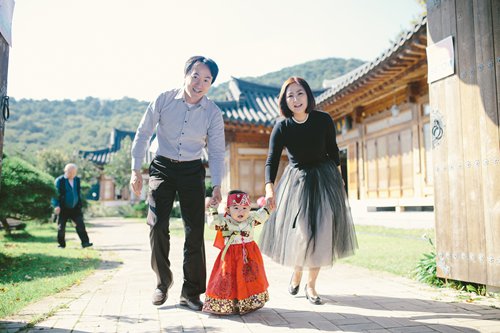
Chinese-South Korean couples believe that there are no barriers in their cross-culture marriages. And that love can help them overcome all the difficulties of marriage. Photo: VCG
Love, the universal language, can help make interracial marriages possible. According to Xinhua News Agency's official WeChat account, the South Korea Ministry of Justice announced in June that about 60,000 South Koreans are married to Chinese spouses. So how did these cross-cultural couples break through the barriers to wedlock? What would being in a multicultural relationship bring them? Two pairs of South Korea-Chinese couples recently shared their stories of interracial love with the Metropolitan.
Hwang Yumi, 38, from the South Korean city of Chungju, met her Chinese husband Hu Guohua, a yoga coach, in Beijing back in 2005. First making his acquaintance at Hu's yoga class, Hwang describes him as a tough yet thoughtful and gentle husband.
"He is very hardworking and this characteristic attracted me so much," said Hwang, who was born to a wealthy South Korean family whose father built his own business from scratch.
Hu shared a similar work ethic with Hwang's father, which attracted her to him. "At the time we met, he was teaching yoga for very little pay," Hwang said, explaining that he eventually saved enough money to open his own cafe in Beijing's Chaoyang district.
He named it The Enjoy Your Life Cafe and the mixed-race couple are now running it together and considered "a match made in heaven" by their customers.
Meanwhile, South Korean national Jung Jihoon, 35, left Beijing in 2016 with his Chinese wife Shan Zimo, 31, after exchanging vows. They are now living in Buchon, west of Seoul.
Jung told Metropolitan that, compared with South Korean women, his Chinese wife is more independent in nature, which makes her "charming" in his eyes.
Before moving back to South Korea, Shan worked in the 798 Art Zone of Chaoyang district. Though she cannot speak fluent Korean yet, Shan works as a daigou, purchasing imported Korean commodities for her friends in the Chinese mainland.
As the couple now have two children in tow, Shan struggles to balance her small business with family responsibilities. The Jungs, as they are now known, are planning on eventually opening and running a Sichuan restaurant in Buchon.
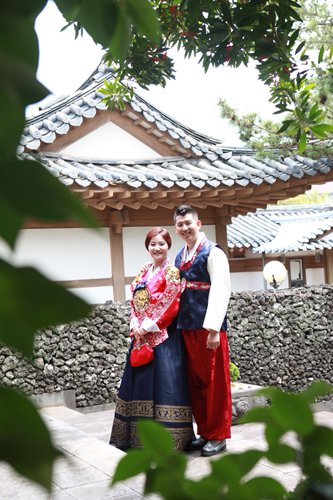
Inset: Hwang Yumi (left), from Chungju, South Korea, says her Chinese husband Hu Guohua is very thoughtful and responsible about supporting their family. Photo: Courtesy of Hwang Yumi
We are all Asian
"As Asians, we look the same and there are some close traditions shared between the two countries," Jung told Metropolitan, adding that such similarities help make them feel more comfortable in their relationship.
Hwang agrees. "The difficulties we have to overcome are caused by our different culture backgrounds, for example, cuisine and dining traditions," she said.
Hu tries to act as "the balancer" in their relationship, suggesting that they choose fusion cuisine in their daily life as a sort of compromise. "To me, a Chinese man from Northeast China, Korean food is light and vice versa," said Hu.
Hu recollected that, during the 2018 Russia World Cup, Hwang asked him why he supported Poland rather than Japan in the competition between the two teams, as China, South Korea and Japan are all Asian countries.
"Such cultural differences should not be seen as barriers existing in our marriage, because we are all Asian," said Hwang.

Photo: VCG
No winning side
"Love helps you become a more tolerant person. It helps avoid conflicts or topics which may cause quarrels," Hu said when explaining his philosophy about keeping love fresh.
Hwang said that, when differences arise, she always tries to remember that there is "no winning side" in a quarrel between two spouses who are from different countries. In addition to tolerance, cross-cultural marriages are about mutual teaching and learning.
"If I hadn't tied the knot with my wife, I would not have understood the culture differences between our two counties," Hu says.
In order to get on well with Hwang's family members, he learned to communicate with them in Korean. Trips to China also help make it possible for Hwang's parents to learn some Chinese.
For Shan and Jung, their daughter and son benefit from learning both Chinese and Korean language and culture from their parents. Seeing their children thrive in this mixed-race family makes them feels more satisfied about their marriage.
For some interracial couples, culture barriers are so difficult to overcome that many marriages end in divorce. But for these two Chinese-South Korean couples, at least, dealing with such difficulties help make their relationships even stronger.
