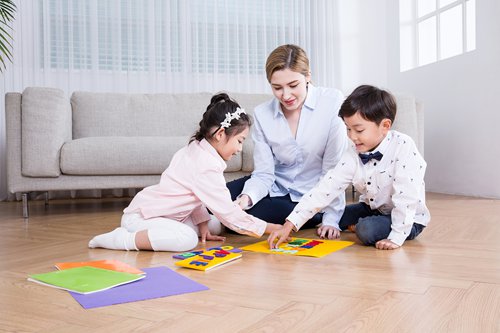
Connecting Western travelers with Chinese families is a booming business for au pair agencies. Photo: VCG
At first sight, Giacomo D'Alessandris and Salima Chérifi look like any other expat in Beijing. They take Mandarin classes, enjoy site-seeing and grab drinks with friends at night. But the two do not have their own apartments; instead, they live with a Chinese family. Neither do they earn any salary. Their working days exceed the regular five days per week and their working hours extend beyond 9 to 5. These young Europeans are here on an F (noncommercial visit) visa. They are au pairs.
D'Alessandris and Chérifi represent a larger intercultural phenomenon taking place in China, as more young Westerners are working here as au pairs in order to immerse themselves in Chinese culture.
Demand among wealthy Chinese families for au pairs from the West (as opposed to traditionally Chinese or Filipino nannies) is also on the rise, and au pair agencies catering to that demand are doing booming business.
Li Zengchun, aka Nancy Li, a program service manager at Beijing-based au pair service Lopair, confirms this trend. "More and more Western au pairs come to China to learn Chinese and understand Chinese culture," Li told Metropolitan.
Among wealthy Chinese families, the au pair concept has become quite popular, while expectations on an au pair's skills and duties vary considerably from other countries. In China, local families see an au pair somewhere between a nanny and a live-in English tutor.
"Lots of Chinese families already have an ayi (housekeeper), so they expect the au pair to teach [them or their children] English," Li said, explaining that applicants must complete an English test; the higher the score, the higher the fee the family is willing to pay to the agency.
According to Li, the fee ranges between 8,000 and 9,000 yuan ($1,161 to 1,306) per month.
"Often, these families work for a foreign company or have lived abroad, so they can accept a foreigner in their household," Li told Metropolitan. "They already have an understanding of Western culture and hope that their child can also grow up learning about Western culture and languages."
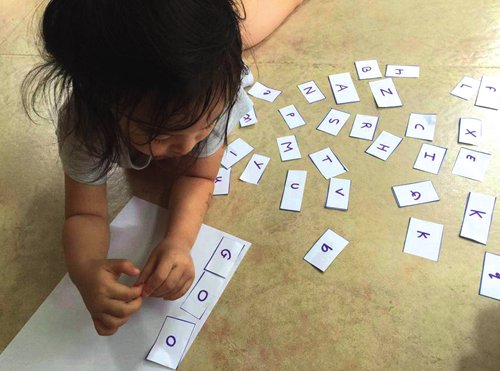
A three-year-old Chinese girl forms English words during a game created by her au pair Salima Chérifi. Photos Courtesy of Salima Chérifi
Like a family member
Au pair agencies in Beijing have little difficulty recruiting new au pairs, as those who eventually return back to their home countries share their experiences with their friends or on social media, and thus the positive word-of-mouth spreads, according to Li.
Chérifi recently returned to her home country, France, where she now works for her father's company after graduating from law school. She spent 18 months in China as an au pair, which she refers to as the "best experience" of her life. She still speaks with her host family every week and has already booked tickets to China to visit them again.
"They treated me like a real family member," she said, adding that she called her host parents "mama" and "baba," Mandarin for Mom and Dad.
Because she enjoyed caring for her host family's daughter and made improving her English a personal mission, Chérifi didn't mind working seven days a week. Her sense of responsibility went so far that she often did not leave the house to meet up with friends until the girl was in bed. She had some time for herself while the little girl was at school.
In China, au pairs are not paid for their work. Agencies pay for their flight tickets, Chinese classes and cultural activities, while their host family provides them with food, housing and some pocket money.
The amount depends on the agency and the family. The Lopair standard is 1,500 yuan per month, but Chérifi received 4,000 yuan and was also able to accompany her family on paid trips to Hong Kong and Japan.
Different expectations
Money is not what the au pairs sign up for. For D'Allessandris, who studies Mandarin in his home country, Italy, an au pair program was the "cheapest option" to live in China in order to improve his Chinese. Having "fallen in love with Beijing," D'Allessandris has spent two summers here as an au pair.
Thus far he has lived with five different families. The changes were due to contracts between the agency and the family concluding or when a family went on a trip, which his single-entry visa wouldn't allow him to join. In between families, his agency arranged for a stay in a hostel.
Another host family provided him with an apartment all to himself in the city center. The wealthy family owned another apartment just for their collection of pet cats. His duties were simply to play with the family's children, do some sports activities with them and teach them English.
"Most of these families also had several other private tutors for the kids, for example, a piano teacher that came every evening," D'Allessandris said.

Salima Chérifi Photo: Courtesy of Salima Chérifi

Giacomo D'Alessandris Photo: Courtesy of Giacomo D'Alessandris
Culture clashes
Lopair observed a 25 to 30-percent rate of au pairs switching families during their stay. Sometimes, differences emerge when expectations diverge or cultural misunderstandings arise, especially when the au pair's Mandarin level or the host family's English level are equally low, according to Li.
"In the West, people may ask if someone needs help. In China, they expect you to provide help without asking," she said, citing an example when a host mother was carrying heavy bags, she expected her au pair to carry them for her without asking, and yet, upon asking if she needed help, the mother was too proud to say yes.
On some occasions, the relationship between the host family and the au pair can be damaged beyond repair. On the website gooverseas.com, where au pairs are able to write reviews of their agency, user "Keira" claimed that "Many mornings I had to go without breakfast because the parents or one of the three nannies would not set the table or cook for me." User "Annie" wrote that she lost her host family's trust just because she came back late from her day off.
In these cases, Lopair said they will analyze the reasons behind the discord. However, some former au pairs who worked in China claimed that, regardless of the real reasons, the agencies always side with the host families, whom they receive their revenue from. It is an accusation that Lopair firmly rejects.
"We want that both the family and the au pair are happy with the arrangement," Li said.
Former au pair Chérifi stresses how important the choice of a reputable agency is, as "some agencies just look for profit." Open communication with the host family is also crucial, she added, especially when the au pair encounters cultural differences.
Despite these predestined cultural clashes, Beijing's booming au pair business is here to stay. With the rapid rise of a wealthy Chinese middle class and the expectations for their children to learn English at an early age, Western au pairs will become more sought after while Chinese nannies decline in demand.
For Chérifi and D'Allessandris, their simple aim of traveling to China and immersing themselves in the culture and language for a spell was easily achieved.
"Being an au pair in China made me more open-minded and patient while allowing me to find my true path in life," Chérifi concluded. D'Allessandris, however, is already making plans to come back to China, but this time as a student.
