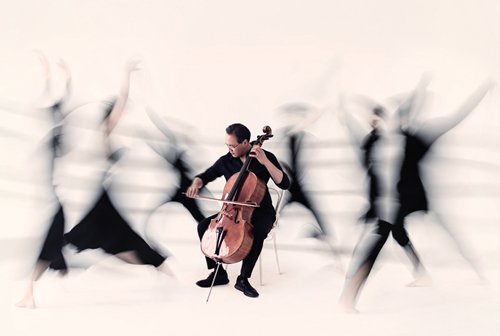
Cover for Yo-Yo Ma's new album Six Evolutions - Bach: Cello Suites Photo: Courtesy of Sony Music Masterworks
An 18-time Grammy winner and major contributor to the theme music for Oscar-winning film Crouching Tiger, Hidden Dragon, Yo-Yo Ma is definitely one of the world's most well-known ethnic Chinese virtuosos.
Though the Chinese-American cellist has performed in the Chinese mainland from time to time since 1982, the musician rarely sits down for an interview with local media.
On October 26, the cellist performed with the Silk Road Ensemble members at the closing concert of the 21st Beijing Music Festival (BMF). The day before, the musician sat down with the Global Times to talk about his music, his ongoing projects and work with his not-for-profit organization Silk Road.
Music and humanity
"Music is a part of my life," the 62-year-old musician told the Global Times.
Born in 1955 to Chinese parents living in Paris, Ma began to study the cello at age 4. After his family moved to New York when he was 7, he continued his studies, eventually attending the Julliard School at age 19.
As a Harvard graduate that majored in anthropology, it seemed natural for Ma to constantly relate human studies to music during the interview.
"Studying music is about studying human beings - what they're living for and also their life experience," Ma said.
"School teachers can help you obtain good skills, but music has to be able to address hearts."
Trust is key
Aside from his career as a performing artist, Ma is also known for his efforts to explore music's social impact, such as through his Silk Road project. He initiated the program in 1998 with the aim to bring together artists from countries and regions along the ancient Silk Road to create music.
"I started the Silk Road project around the time when all these Central Asian countries became countries after the Soviet Union collapsed," Ma said.
Before that, the musician - an experienced traveler - used to think he had a concept of what the world is like, but quickly found out he had much to learn.
"One way I can try to find out more about the world is to look at all the people and music and do their music… then I can feel that I know a little bit more about our planet," said Ma.
Serving as a bridge between Eastern and Western arts, the ensemble currently consists of more than 50 artists such as Syrian clarinet composer Kinan Azmeh and Chinese pipa (a Chinese four-stringed instrument) player Wu Man. The goal of the ensemble is to compose and create music "that you can be proud of and what I can be proud of, and could be referred to our traditions, but somehow it's new," Ma explained.
Ma's experiment has proven to be a success. In 2016, the group's Sing Me Home won the Grammy's Best World Music Album. The creative process behind the album was recorded in a documentary titled The Music of Strangers directed by Oscar-winning director Morgan Neville.
Talking about the ensemble's key to success despite members' differences in language and culture, Ma said the key for him has always been "trust."
"If you don't have trust, you can't build anything," said Ma, referring to trust as "culture's currency" and "a social capital" that he hopes can be promoted and continued via the project.
'Bach is like an uncle'
While the Silk Road project has been a 20-year effort, the musician's Bach project is one of his latest programs.
A tour that will see Ma perform 17th century German composer Johann Sebastian Bach's music at 36 concerts around the world, the project is motivated by the artist's six-decade-long relation with the Baroque master's music. The musician's Six Evolutions - Bach: Cello Suites, which was released in August by Sony Classical, also features his new interpretation of Bach's music.
Why Bach?
"In so many ways he is a great composer, great musician, but I also think he is a great scientist - but a scientist of human nature and of Nature," Ma told the Global Times.
"He is also like your uncle who you can go and tell secrets to… he is empathetic and he is objective - he doesn't judge but he gives perspectives - he is actually that uncle for so many people," said the cellist, adding that he is not the only one that feels this way about the composer.
"People use his music to get married, play the same music when they have to bury somebody or they're ill… He [Bach] not only addresses your intellect, but also addresses your heart," Ma said.
Considering this, Ma suggested that Bach's music might well be able to help connect countries and people together.
"I want to play it at the 38th parallel between North and South Korea, play it at the borders between Mexico and Texas, because I think the music is there to build bridges between people. I don't mean the music is there to solve political problems, but it recognizes the humanity behind it. And it doesn't put itself in front saying that 'we will solve your problems' but 'you can start conversation.'"
Zhang Ni contributed to this story.
