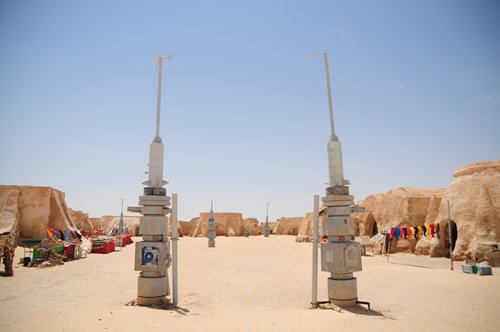
The Star Wars set at Mos Espa in Tunisia on May 29, 2017 Photo: IC
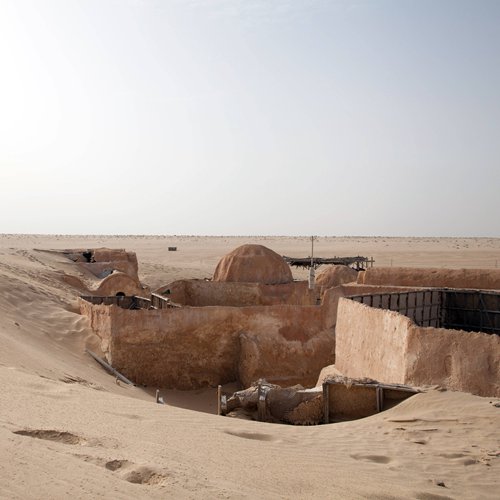
The Star Wars set at Mos Espa in Tunisia on May 29, 2017 Photo: IC
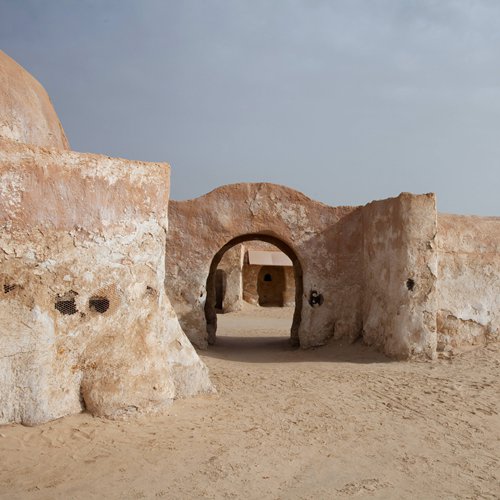
The Star Wars set at Mos Espa in Tunisia on May 29, 2017 Photo: IC
Ahmed Ben Salem, a 19-year-old Tunisian boy, runs the camel-ride business in Star Wars film location Mos Espa, located in the Sahara desert in Tozeur region in southern Tunisia.
"There were Chinese tourist groups here every day in December," said Salem, adding that "they prefer to sit on the nearby sand dunes in the morning, watching the sunrise in the desert and they told me it feels like being on another planet."
"We welcome more Chinese tourists for visits, which can help promote the local economy, and provide more business for us," Salem said.
Lying in the north point of the African continent, with a history of over 3,000 years, Tunisia borders the Sahara desert and Mediterranean sea, renowned for its rich tourism resources.
Houcine Melki, a 27-year-old local tour guide in Tamerza, a mountain oasis near Sahara desert, told the Xinhua News Agency that winter is the peak tourism season for southern Tunisia, which provides various landscapes, including desert, oases, mountains and canyons.
As an increasingly popular destination for Chinese tourists, Tunisia had attracted nearly 22,000 Chinese tourists by October, 2018, a 43 percent year-on-year growth, according to the Tunisian government.
In 2017, Tunisia began to offer visa-free entry for Chinese tourists and the number of Chinese tourists rocketed to around 20,000 last year, 12,000 more than in 2016.
China has become one of Tunisia's fastest-growing tourism markets.
In a guesthouse in Tamezret, a traditional Berber village in Gabes region in southern Tunisia, three rooms in local troglodyte style mainly focus on individual tourism. The Belgium manager Patrick Bourseaux has run this guesthouse with his wife since 2014.
"Chinese now account for over 40 percent of international tourists. Tunisia's visa-free policy encourages more individual Chinese tourists here," said Bourseaux.
"Although they are from a completely different part of the world, Chinese tourists are not afraid to tour and explore this North African country by themselves," he added.
"We have received tourists almost worldwide, but Chinese tourists showed the most interest in local culture," said Bourseaux, adding that "they prepare incredibly well before their travel, already researching a lot of information."
Bourseaux also suggested that the government improve the local infrastructure, especially public transportation, to provide better service.
According to the Tunisian Ministry of Tourism and Handicrafts, Tunisia attaches great importance to the Chinese market, and endeavors to make Chinese tourists' journeys in Tunisia more convenient and enjoyable.
Chinese Ambassador to Tunisia Wang Wenbin pointed out that bilateral tourism collaboration has been promoted in recent years, and tourism is among the prioritized cooperation sectors between China and Tunisia.
Tunisian Ambassador to China Dhia Khaled said, "Tunisia is capable of and is willing to have more Chinese tourists. Tunisia values cooperation with China in tourism and looks forward to a higher level of cooperation."
Karim Jatlaoui, a representative from the Tunisian National Tourism Office Beijing Bureau, expected Chinese tourists to increase to 50,000 by 2020.
Tunisia has witnessed a slump in its tourism since 2015 when three major terrorist attacks claimed the lives of more than 70 people, mostly foreign tourists and security forces.
Accounting for about 8 percent of the country's GDP, the tourism sector started to revive in 2017.
