Chinese actor Li Dongxue talks about his role in the newest TV adaptation of Louis Cha’s wuxia novel ‘The Heaven Sword and Dragon Saber’
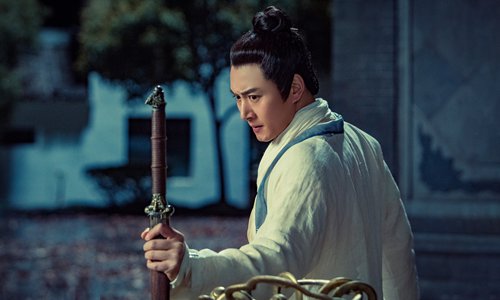
Chinese actor Li Dongxue as Zhang Cuishan in TV drama The Heaven Sword and Dragon Saber Photo: Courtesy of Li Dongxue Studios
China's wuxia, a genre of Chinese period fiction about the adventures of chivalrous martial artists, has been on the frontline of modern Chinese culture's influence overseas.
On Wednesday, wuxia lovers worldwide paid close attention to the Chinese mainland debut of new TV series The Heaven Sword and Dragon Saber, which is based on the novel of the same name. The novel is one of the most popular wuxia classics from Louis Cha (1924-2018). The author, better known by his pen name Jin Yong, wrote a total of 15 classic wuxia works between 1955 and 1972.
In the new series, Chinese actor Li Dongxue plays the role of Zhang Cuishan, a martial artist and the father of main character Zhang Wuji. Sitting down with the Global Times for an interview, Li revealed that the role puts him under great pressure since the story is such a well-known classic.
"We wanted to present a more complete personality, and intellectual and emotional growth that is reasonably connected to what happens to him. I didn't choose the safer path - to make him merely a transit to introduce his son Wuji," he said.
"I hope overseas viewers will also accept [my interpretation of] wuxia, especially since this is Cha's work and such a classic."
Over the last four decades, the story has been adapted into more than a dozen TV series and films. Stepping out from under the shadow of previous generations of actors and actresses to present characters who are already well-known by millions of viewers is already a great challenge for the cast and crew. Adding to the pressure is the fact that this is the first TV series based on Cha's works to come out since his death on October 30, 2018.
Adapting to modern audiences
Li said his version of Zhang Cuishan, the fifth apprentice of Wudang Sect founder Zhang Sanfeng, is different from previous interpretations.
"Who is Zhang Cuishan? What kind of 'hero' would take such risks and choose a so-called 'demon woman' as his wife? Is he merely a talented young man who listens to his master and might be his successor someday; or is he a young man just like any other in the world who is chivalrous and dreams of fighting evil and unfairness?" Li said.
To research the characters, Li read the novel several times and scoured social media posts and well-known writers who specialize in Cha's works.
According to Li, one of the challenges with the role was interpreting the growth and changes the character experience. The character goes from a hot-blooded young man who wants nothing else than to avenge his brother to a husband and father living on a faraway island.
Li also pointed out that actors nowadays need to learn what audiences want and take into account changes brought about by technology and the way people watch shows.
"For instance, watching a show at 1.5 or twice the normal speed is something new, and a lot of young viewers choose to watch shows this way," he said.
"Not everyone really gets involved in a drama to savor the lines anymore. Actors should just accept these new changes and adapt, and they should reflect on the criticism that viewers provide."
Gaining attention overseas
Although the new drama hasn't been released internationally, some overseas viewers are already looking forward to watching. On MyDramaList, a forum for discussing Asian dramas and films, the show has more than 100 comments, mostly concerning when English subtitles will be ready. Meanwhile, volunteer translators on viki.com, a video-sharing website specializing in Asian dramas, have already begun preparations to provide English subs.
Crouching Tiger, Hidden Dragon (2000) directed by Ang Lee was the first wuxia film to capture the attention of the mainstream international audience. Over the years since its release, wuxia has not only been appreciated visually in film but also via words as well. One of the most popular platforms for wuxia enthusiasts outside China is wuxiaworld.com, which offers English translations of Chinese novels. Founded in 2014, the site receives nearly 3 million views each day.
Some wuxia lovers attribute the popularity of the works to a common love of concepts such as romance, betrayal and duty shared by readers across the world, according to a Global Times report from May 2017.
Chinese pop culture, including literature, TV dramas and films, is earning a fairly large audience outside of China, especially in Southeast Asian countries.
The Legend of Zhenhuan (2011), or Empresses in the Palace, is often considered the most successful Chinese TV series shown overseas. Since the show first became available on Netflix in 2015, Chinese TV series and films in a wide range of genres, from wuxia to modern urban dramas, have become more and more common on international platforms.
Li should be a familiar face to many of these viewers as he played one of the lead characters in The Legend of Zhenhuan, Prince Yunli, the emperor's brother and the love of Zhenhuan's life.
"The Legend of Zhenhuan succeeded because of the time. It was not just due to the work of its excellent creators, but also luck," Li said.
"My Prince Yunli was pure. But now at my age, I hope that I can present a more complicated and 'true' character in my career," the 36-year-old added.
