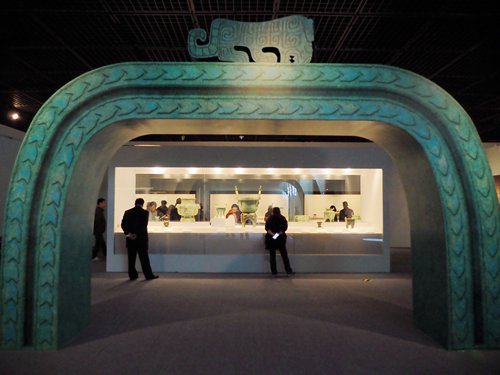
An exhibition scene of Wangjun Ji'an at Beijing's Capital Museum on Satursday. Photo: IC
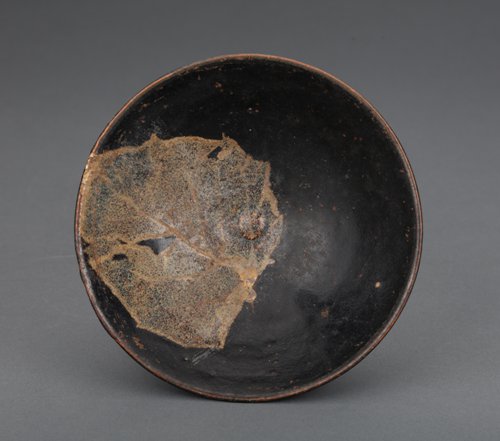
A leaf Tenmoku Photo: Courtesy of Beijing's Capital Museum
When visitors stepped inside the exhibition hall on the third floor of Beijing's Capital Museum on Saturday, the first thing they saw were four Chinese characters shimmering on a white silk-like screen in front of a forest of green bamboo that contrasted heavily with the purple lights that shined on the ground.The characters read Wangjun Ji'an, or Esteemed Prefecture Ji'an, the title of the city's first themed exhibition at the museum, which is set to end on June 23. A prefecture-level city located in East China's Jiangxi Province, Ji'an received the title of wangjun in ancient Chian for its splendid cultural achievements.
Although it is not a household name in China, Ji'an has played an extraordinary role in Chinese history. It was not only home to an impressive bronze civilization and major pottery industry but also the birthplace of many important figures in Chinese history.
Bronze culture
When more than 400 bronze wares were discovered in a small village in Ji'an in 1989, this provided evidence that the representative cultures of the Shang Dynasty (c.1600 BC-1046BC) were not limited to the Yellow River basin but also existed in the Yangtze River basin as well.
Many different kinds of bronze wares unearthed in Ji'an are on the display for the exhibition, including farming tools, weapons and musical instruments. Wang Jian, a professor at the School of International Trade and Economics, University of International Business and Economics, who was visiting the exhibition with his wife, told the Global Times that he was astonished to find that Ji'an has such a large number of well-preserved bronze wares. Before coming to the exhibition, Wang had never known that bronze culture had been so developed in Ji'an.
The collection was impressive not only for its large number of bronzes, but also due to the historical and artistic value of some of the individual wares.
For example, one bronze of a two-tailed crouching tiger was particularly exquisite. Visitors could clearly see the carved patterns around the tiger's entire body and the figure of the tiny bird sitting on its back. The clumsy air of the tiger and the bird's nimble nature was very obvious, and contrasted well with each other in the work.
Innovative porcelain
Black glaze porcelain is the signature type of ceramics produced at the Jizhou Kiln, a local kiln in Ji'an. When the porcelain was introduced to Japan, the Japanese called it Tenmoku and began imitating the design. Today, the Tokyo National Museum has a decent collection of imported Tenmoku porcelains that were produced by the Jizhou Kiln during the Southern Song Dynasty (1127-1279).
The original black glaze porcelains exported to overseas markets were normally tea bowls. The most special type produced by the Jizhou Kiln was leaf Tenmoku, which involved placing an actually real leaf on the bowl during the glazing process. When the clay body was fired at more than 1,000 C, the leaf burned away but left a brown scarring mark behind that was an almost exact copy of the leaf. When these bowls were used to drink tea, the leaf would appear to be floating on the surface of the tea.
A similar technique also made use of paper cut-outs. After firing in the kiln, the place covered with the cut-out kept the original color of the porcelain while the other parts turned dark, leaving behind various beautiful patterns.
Land of learning
In ancient China, jinshi was the highest and final degree in the imperial examination.
There is a saying that more than 3,000 of these jinshi graduates came from Ji'an, making it No.1 in the entire nation.
The Bailuzhou Academy in Ji'an witnessed the emergence of many influential cultural figures in Chinese history. For instance, the famous government official and poet Wen Tianxiang, whose entire albums are on display at the exhibition, was born and studied in Ji'an. When the Southern Song Dynasty was overthrown by the Mongols, Wen refused to serve the new government and was first tortured and then executed for his loyalty to the former dynasty.
A lot of carved seals and wooden book cabinets used by the students of the Bailuzhou Academy are present at the exhibition, providing insight into the life of scholars at the time.
Throughout Ji'an the connection to traditional education has inspired residents to take part in various cultural activities.
According to Beijing resident Peng Shaojiang, whose father was from Ji'an, fans of calligraphy can be found everywhere in his hometown. He said that when he visited the city, he was amazed by the high level of proficiency of the written couplets he saw hanging on the doorways of some people's homes.
"The calligraphy of the couplets was so well done that I thought they might have been mistaken for the works of a master if I had brought them back to Beijing,�?he said.
