ARTS / CULTURE & LEISURE
Lijiang, One of China’s top tourist cities strengthens cultural protection
Old Town, New Life
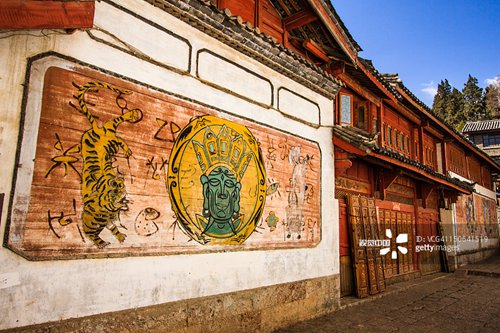
A Naxi Dongba painting in Lijiang, Yunnan Province Photo: VCG
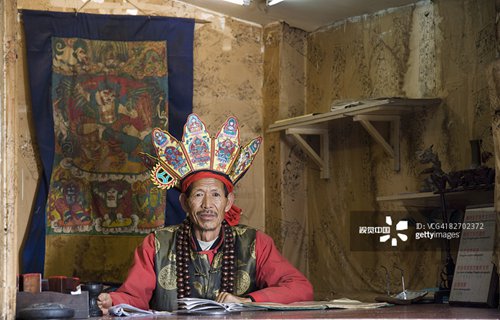
A Naxi man poses for a picture. Photo: VCG
Every day, He Runyuan explains what happiness is to hundreds of tourists."Dongba symbols are used by China's Naxi ethnic minority and one of the world's only remaining pictographs. For them, happiness is a steaming hot pot of food," He said.
"As in the past, having a hot meal means everything."
Dressed in a traditional Naxi goatskin vest and a white robe, 42-year-old He guides tourists to learn the Naxi scripts, history, culture and tradition in his Center of Naxi Dongba Pictographs and Paintings in the Old Town in the city of Lijiang, Southwest China's Yunnan Province.
"Peak seasons such as national holidays and summer and winter vacations see around 5,000 visitors a day," he said.
"After explaining the symbols, I will ask the tourists to pick one they like and try to write it down," he added.
As a Naxi ethnic minority, He grew up in Old Town, a UNESCO World Heritage Site that attracted over 14 million tourists in 2018.
He has been studying Naxi painting and pictographs for about 30 years.
"With a population of more than 300,000, less than 700 Naxi people now understand Dongba pictographs, and only a dozen can do traditional Naxi paintings," he said.
"I think it's my responsibility to pass down our culture and let more people know about it," he said, adding that most Naxi people live in Lijiang.
"That's why I came back here after graduation. The origin of Naxi culture is here."
His devotion to cultural protection is greatly supported by the local government, which entrusted He to open the experience center in 2016 in the busiest area of Old Town and gives him 400,000 yuan ($59,600) a year for daily maintenance and other expenses.
"The local government offered us this two-story cultural courtyard with traditional Naxi characteristics as our center. Covering about 300 square meters, we have separated it into several rooms for exhibitions and classrooms," he said.
He and four other Naxi guides work 14 hours a day.
"During peak seasons, we can barely take a sip of water," he said.
"It's hard, but it's worth it. We are so proud of what we are doing," he said.
By the end of 2018, there were 17 free cultural courtyards in Old Town, including He's. With the support of the local government, a further 12 are expected to open to the public this year.
"I think the courtyard is a window for promoting the culture of Lijiang, as well as an important base for visitors to learn and try by themselves to gain a more comprehensive understanding of our culture," he said.
He's experience center has also cooperated with travel agencies, summer camps and schools to offer free training classes on Naxi culture, receiving more than 7,000 students each year.
"Without the courtyard, nothing would even be close to possible," he said.
To prevent the ancient Chinese city from over commercialization after years of tourism development, the local government has set up a specialized annual fund of 10 million yuan for cultural protection in Old Town.
"Lijiang has long been China's name card to the world with Old Town as its core. For sustainable development, we must spare no effort in protecting our culture and make it one of the most attractive parts of the city," said He Tang, an official with the Protection and Administrative Bureau of Lijiang Old Town.
All the buildings in Old Town are required to maintain traditional ethnic characteristics. Dancing halls, internet bars and other buildings that are inconsistent with the ancient town have all been closed.
A total of 299 traditional houses and 236 yards have so far been restored and renovated by the local government and the Global Heritage Fund.
"We also invite folk artists and culture inheritors to show their skills in Old Town to get more tourists involved. On traditional festivals, we hold grand celebrations in Old Town," He Tang said.
More than 90 sets of books telling stories of Lijiang and the culture of Naxi have also been published.
"Our life is limited, but so long as everyone makes even an effort, the life of a culture can exist forever," He Runyuan said.
