ARTS / ART
Shan Jixiang, adored museum director who made Beijing’s Forbidden City less forbidding, retires

Two tourists paint a pair of emperor and empress dolls. Photo: VCG
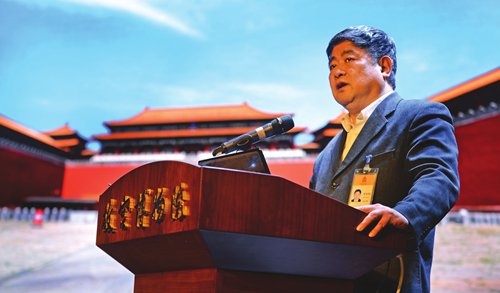
Shan Jixiang gives a speech in the Palace Museum in Beijing on February 12, 2017. Photo: VCG
Shan Jixiang can finally get some decent rest. After 2,645 days of hard work, the 65-year-old now former director of Beijing's Palace Museum has retired.
While it may be hard to say who the most successful director in the history of the Palace Museum has been, most people agree that Shan was the most innovative and reform-minded of them all.
After his retirement was announced on Monday, the news quickly became a hot topic on Sina Weibo, receiving more than 180 million views and 44,000 discussions.
"I like director Shan, he did a brilliant job," posted netizen BoywholovesConverse.
"A respectful legend. He rejuvenated the Palace Museum,"another said.
The creative reformer
Before Shan, the Palace Museum was already a globally famous institution, but for many the solemn atmosphere of the Forbidden City, where the museum is housed, made it feel very distant from the lives of most people, especially younger people.
This has all changed, however, due to the efforts of Shan and his team.
Two years after Shan took over as director in 2012, the Palace Museum introduced its first series of creative souvenirs, the designs of which were based on its collection of culturally rich relics. The interesting and unique items quickly captured people's attention and soon after the museum's online stores on e-commerce platform Taobao gained millions of followers.
After that Shan decided to expand the museum's reach to television with the documentary series Masters in the Forbidden City in 2016. The series proved to be extremely popular with young Chinese, receiving more than 4.4 million views on ACG (Anime, Comic and Games) streaming platform Bilibili and earning a score of 9.4/10 on Chinese review platform Douban.
The museum even came up with a line of cosmetics. In December 2018, the museum released a line of Palace Museum brand lipsticks that sold out in just two days.
On February 17, to celebrate Chinese Lantern Festival, the Palace Museum decided to hold a free nighttime light show. The new popularity of the museum ended up proving too much for its online ticketing system, which crashed almost immediately after news of the event hit the web.
All these innovative ideas stemmed forth from Shan's push to integrate cultural resources and people's lives.
Modern upgrade
While the former imperial palace held a position as one of the top museums in the world prior to 2012, this position also made it one of the most complained about attractions in China. A small number of bathroom facilities, exhausting long lines for tickets and areas of the Forbidden City not open to the public were just some of the issues visitors had with the institution.
Under Shan's direction, these issues were put to rest.
It's worth mentioning that while only about 52 percent of the Forbidden City was open to the public in 2014, this percentage has grown to more than 80 percent today. This increase of display space now allows the museum to display around 8 percent of its collection at a time instead of the former 1 percent, Shan noted in an interview with The Beijing News.
Shan also pushed to integrate the newest technology into the museum's relic conservation and tourism efforts.
In 2015, a digital museum was established at the Duanmen, or the Gate of Uprightness, so visitors could learn more about the Forbidden City through multimedia exhibits.
Additionally, in 2018 the Palace Museum launched a high-tech interactive art performance Along the River during the Qingming Festival 3.0. Using real life actors mixed with digital presentations, the performance blended the real and the virtual.
Prior to his retirement, Shan set the Palace Museum for future high-tech expansion through a cooperation agreement with telecommunication giant Huawei that will see 5G and smart facilities come to the museum.
In good hands
In an interview with NetEase, one of Shan's assistants revealed that the director spent his first five months in charge constantly walking around the 1,200 buildings and 9,371 rooms in the Forbidden City, wearing out 20 pairs of shoes in the process.
This dedication has made Shan something of a role model in the eyes of the public as well as lifted the position of Palace Museum director to the level of a major public figure.
With the announcement of Shan's retirement, many netizens naturally were concerned about the future of the museum.
"Where will the new director lead the Palace Museum?" is one of the most frequent questions appearing in online discussions about the institution.
Fortunately, it seems that the museum has been left in good hands.
Wang Xudong, the new head of the Palace Museum, is also an expert in relic protection. As the head of the Dunhuang Academy, Wang made the digitization of cultural relics and the development of creative cultural products major priorities.
According to Chinese news outlet The Paper, Wang has proposed that a complete "digital reconstruction" be carried out of the Mogao Grottoes, a network of cave temples in Gansu Province that are one of the biggest and oldest repositories of Buddhist art in China. Currently, the Dunhuang Academy has established a digital archive covering 150 caves.
According to industry analysts, the museum's current direction is unlikely to change very much in the near future considering Wang's achievement at Dunhuang. However, Wang will also have to face his share of doubts about his ability and challenges, just like Shan did seven years ago.
