Jimmy Lai denied bail again by HK court, ruling 'in line with expectations'
By Published: Feb 18, 2021 09:38 PM

Jimmy Lai Photo: VCG
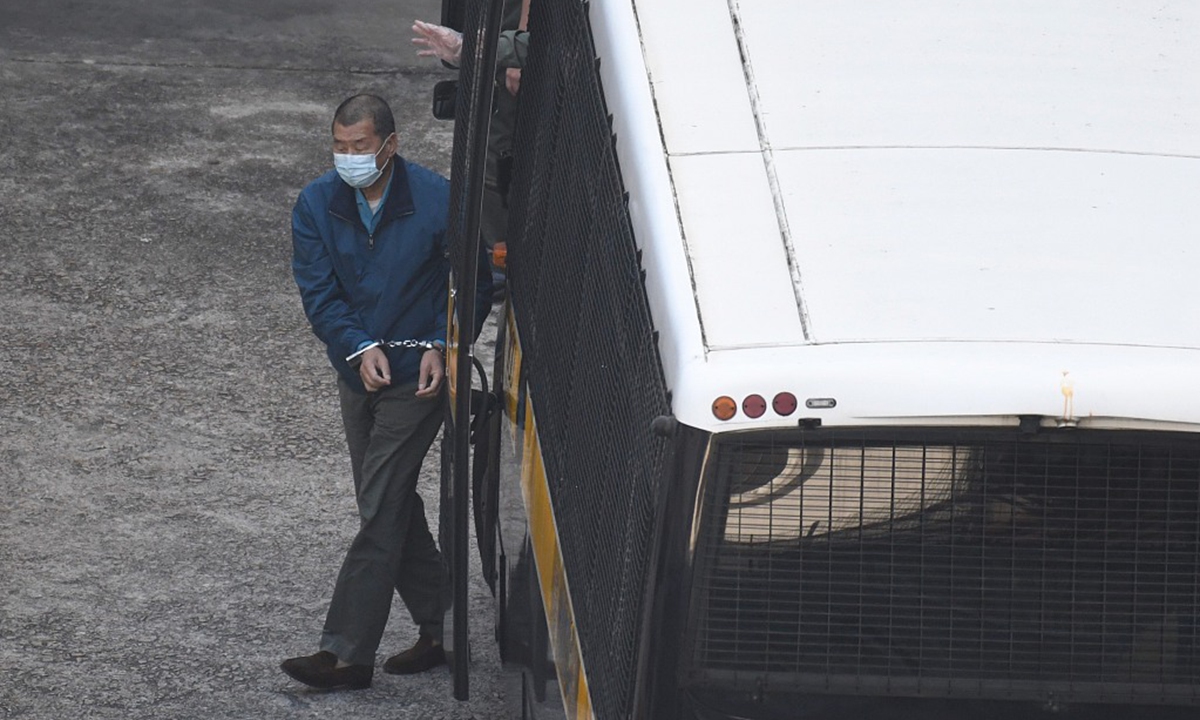
Hong Kong secessionist Jimmy Lai was denied bail again on Thursday, the second rejection within a month, after the Court of Final Appeal, the city's highest judicial institution, revoked the bail order for the Hong Kong media tycoon on February 9.The case was handled by the designated judge for the National Security Law-related case, Anthea Pang Po-kam, after Justice Lee Wan-tang of the High Court in Hong Kong had granted bail of HK$10 million ($1.29 million) on December 23, 2020, which was harshly criticized by the Hong Kong legal and political sphere as well as experts in the Chinese mainland.
The Court of Final Appeal ruled on February 9 in favor of the Department of Justice (DOJ), which had challenged Lai's bail decision. The move was widely seen as a symbolic ruling showing that the common law system of Hong Kong is adapting its bail conditions to the National Security Law.
Article 42 of the National Security Law for Hong Kong states that no bail shall be granted to a criminal suspect or defendant unless the judge has sufficient grounds for believing that the criminal suspect or defendant will not continue to commit acts endangering national security.
Some legal experts in the mainland and Hong Kong said Lai's applications for bail were a waste of time.
"The Court of Final Appeal has already set the tone for the case, so the judges at lower judicial institutions won't approve bail conditions for him," Tian Feilong, an associate professor at Beihang University in Beijing and a member of the Beijing-based Chinese Association of Hong Kong and Macao Studies, told the Global Times on Thursday.
The latest ruling was also in line with the expectations, Tian said.
"It is an unrealistic application without merit in the first place," Lawrence Ma, barrister and chairman at Hong Kong Legal Exchange Foundation, told the Global Times on Thursday.
There is no change in condition or any new facts that warrants the court's reconsideration of bail, so it is simply a waste of time, Ma noted, adding that if a suspect has more charges laid on him, the tendency of that suspect to flee is higher.
Lai was formally charged under the National Security Law for Hong Kong for colluding with foreign forces to endanger national security on December 11, in what was widely seen as a high-profile case. The 73-year-old has been considered a "modern-day traitor" for instigating one of the most violent and chaotic riots in the city in 2019.
He was again arrested by Hong Kong police on charges of "aiding criminals" and "colluding with foreign forces," according to media reports. Lai is also suspected of aiding Andy Li Yu-hin's attempt to escape from Hong Kong to the island of Taiwan.
RELATED ARTICLES