Expected higher level of pest infestation and disease severity this spring won’t affect food security in China: expert
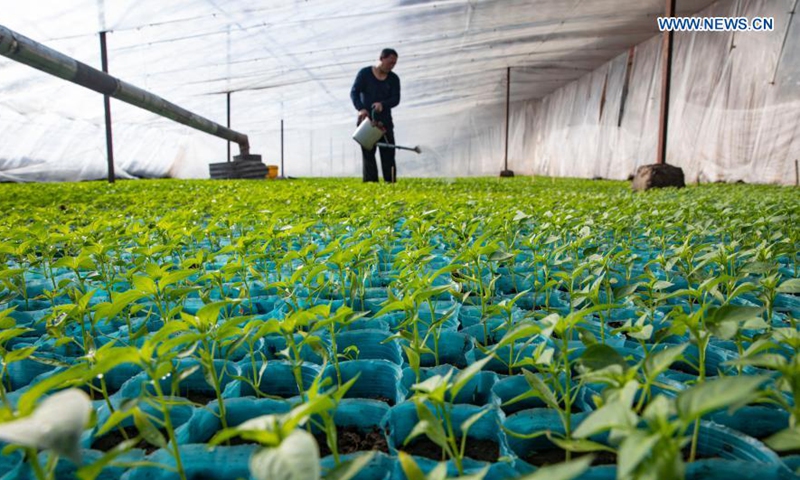
A staff member works at a greenhouse in the agricultural area of Hongqi Farm, northeast China's Heilongjiang Province, March 1, 2021. With the help of technologies, agricultural production is still carried out efficiently in the low temperature environment of Heilongjiang Province. Photo: Xinhua
China's agricultural department issued new guidance for wheat production on Thursday in preparation for an estimated higher level of pest infestation and disease severity this spring compared with the same period last year.
It is estimated that 800 million mu (53 million hectares) area of wheat production field and 28 million mu area of potato production will be infected with disease and pests this spring, according to Ministry of Agricultural and Rural Affairs.
The ministry has set the goal to keep the wheat loss rate affected by the diseases and insect pests under 5 percent, potato loss rate under 8 percent and underscored key points of prevention and control for different planting regions.
"Scientific prevention and control measures should be taken to grasp key areas and major diseases and insect pests to ensure yield and crop security," read the guidance.
Affected by El Nino , the weather factors will be more complicated this year leading to a higher level of pest infestation and disease severity. In addition, the increase of extreme cold weather in spring has also affected the growth of the crops, Jiao Shanwei, editor-in-chief of cngrain.com, a website specializing in grain news told the Global Times on Thursday.
However the severity will not have a major impact on China's food security and self-reliance, he said.
"It will not have a great impact on grain production or diminish the yield of summer harvest as the prevention and control measures of the country's agricultural sector are already in place with the allocation of prevention and control funds and guidance to farmers," he added.
China's grain output set a new record in 2020 with a yearly growth of 0.9 percent despite the coronavirus-related impacts to the general economy, according to data released by the National Bureau of Statistics in January.
Last year, China produced 669.49 million tons of grain, up 5.65 million tons, or 0.9 percent compared with 2019. Wheat output also increased by 0.5 percent, soybean production edged up 8.3 percent, and rice output grew by 1.1 percent, the NBS data showed.
RELATED ARTICLES