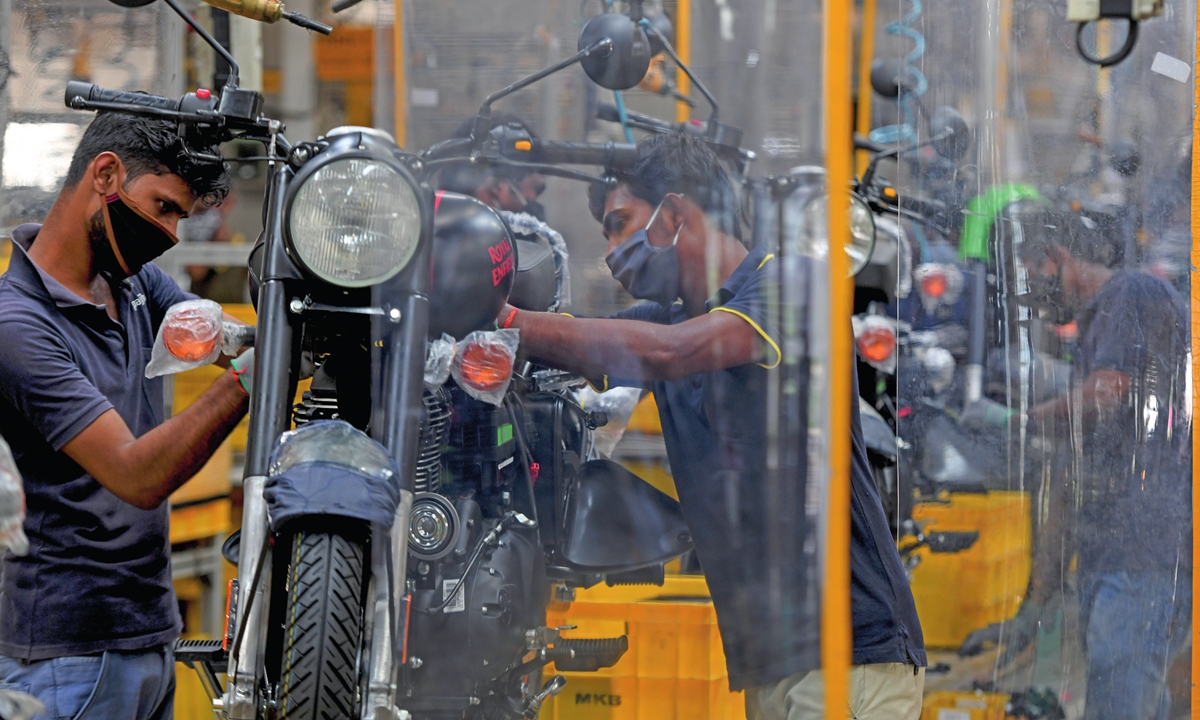
Workers assemble Royal Enfield motorcycles at a factory in Oragadam, India. Photo: AFP
China's yuan is emerging as a strong benchmark for India's rupee, as the South Asian economy is trying to maintain its export competitiveness amid accelerating changes in the global currency and macroeconomic environment.
The Reserve Bank of India (RBI) is shifting its focus to the Chinese Yuan also while deciding its intervention policy, rather than just the US dollar alone, CNBC-TV18 reported. The RBI is informally aiming at the benchmark level of 11.50 yuan-rupee, said the report.
A closer focus on yuan rather than only following the US dollar is a more balanced approach for Indian central bank in monetary policy decision. It is a necessary move in accordance with changes to the international trade and currency environment, and it is not timely compared with other countries.
Since China's yuan joined the International Monetary Fund's (IMF) basket of reserve currencies five years ago, its international status has seen significant rise. A total of 75 countries and regions have included yuan in their foreign exchange reserves. The latest data from the IMF reveals that the global central bank holdings of yuan foreign exchange reserves reached $287.464 billion at the end of the first quarter of this year.
China's rising economic competitiveness, its irreplaceable position in the global value chain, and opening-up policies have substantially raised its status within the global trading system. China has become the largest trading partner of more than 120 countries. Despite the impact of the pandemic and tensions in relations, bilateral trade volume between China and India has continued to grow. China-India trade exceeded $100 billion for the first time in October.
As India's central bank gears to tune economic support in line with recovery, a shift from only focusing on the US dollar to also closer focus on yuan is apparent a more flexible and balanced approach, which benefits its exports and narrows down trade deficit with China.
With supplies being hit by the COVID-19 pandemic, several global manufacturers are looking at other manufacturing destinations outside of China. The Indian central bank aims to maintain India's export competitiveness among Asian peers to attract more manufacturers to invest in India, according to Indian media outlets.
India's eager desire to take advantage of the industrial chain adjustments caused by the pandemic to attract the manufacturing industry is understandable, but it is difficult to achieve such a goal only by monetary policy adjustments. India needs to do a lot to revitalize its manufacturing industry.
India still faces a lot of challenges to attract manufacturers to relocate their production. In terms of human resources, compared to China, India lacks a critical mass of well-trained and educated workers. To attract foreign brands to open factories, the Indian government also needs to provide supporting infrastructure including transport system, logistic system and complete facilities for foreign trade.
The article was compiled based on an interview with Qian Feng, director of the research department of the National Strategy Institute at Tsinghua University. bizopinion@globaltimes.com.cn
