ARTS / BOOKS
What would you see through "The Door"? ---The independent perception from an ordinary Beijing high-school girl of the social phenomenon through voluntary teaching
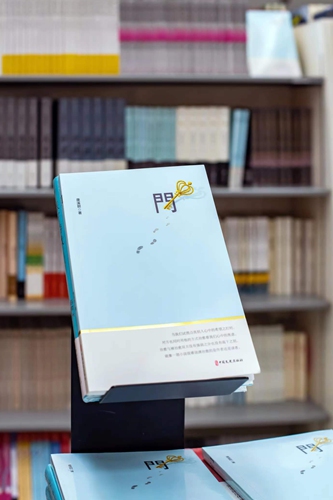
The Door
November seems to represent a month of writers. Ever since the 17th century, this month has seen the birth of great authors, including Voltaire and Schiller, Mark Twain and Ivan Turgenev, and also Ba Jin and Qian Zhongshu.With the dawn of the 2020s, a new era has come bombarded with videos. However, in such an era when - as Li Dan has suggested - "everyone is capable of the five-minutes talk show", is there anyone who still would like to write?
There must be someone! Kang Xilang, a seventeen-year-old high-school girl from Beijing, hopes to write a non-fiction of herself and all her friends, which reminds us of what is said by Romain Rolland: "No one ever reads a book, only one reads himself in it, finds himself or examines himself."
From Yu Xiu's Flower Season and Rainy Season twenty-five years ago, the publishing industry in China has never seen a shortage of young talents. However, The Door is different. This book, which has taken the spare time of the author's past two years, keeps a real record of several fragments she has experienced and the relevant thinking afterwards. The author intends to interpret the world independently and also to reconstruct life with her perception. Ever since the voluntary teaching in the poor mountain village in the Hebei province, she has begun to pay close attention to people's life choices facing different situations.
The Door, from a certain perspective, is more like a survey report through the eyes of an ordinary high-school girl during her voluntary teaching. It is about poverty alleviation, the village people's attitude towards poverty in North China, as well as their choices. At least, it is not that gloomy.
In the book, the author does not describe poverty deliberately but emphasizes all the positive attempts and efforts to curb poverty. Those villagers have not become numb or lost themselves because of sheer poverty, which has added temperature and color to the base of poverty. In the meantime, an author has also - in the contact with children in the villages - formed a deeper understanding of the importance of education.
The author narrates in the book the stories of people living within her life radius who have come to work or start their own business in Beijing, including the door-to-door waste collection man, the SF-Express guy, the delivery guy, etc. Their own stories serve to demonstrate that they have become an indispensable part of Beijing, and at the same time, their attitude towards life are also beginning to change. As especially stated in the book, when the author, an ordinary girl, tries to communicate with those nobodies, she not only starts to obtain a preliminary understanding and appreciation of the complexity of life, but gives more insights into both the shadows and brightness of human nature as well. Those people make unrelenting efforts to present the story about how small ones pursue their dreams of breaking the circles and becoming "us" while exhibiting the positiveness and perseverance in humanity. Equally important, the story of a three-generation family and what they have experienced in times of scarcity, clearly demonstrate the life changes in the new era and the importance of poverty alleviation.
Despite her child-like innocence, the author Kang Xilang provides a unique interpretation of the world that comes only from young girls, which further demonstrates the kaleidoscopic images of a high-school student.
In the end, the author walks through the "arbitrary gate" and enters the future more than a decade away. When life becomes better, villages become urbanized, and science and technology make our life more comfortable, people who have come out of poverty might experience different kinds of troubles and psychological problems. The author puts forward how to open the hearts and the ultimate thinking about the truth of happiness.
This book is, in a way, a healing story. In it, the author boldly expresses her ideas and her psychological path.
For example, "fortune" - apart from money in the real sense - has many connotations: it might refer to ceaseless self-development rather than the destination in others' eyes - the ranks, and also it might be love and spirit.
Also, when the author intends to light up the hope in their hearts through voluntary teaching, a conversation during the blackout at night unexpectedly eases the anxiety inside her heart. As to how to interpret anxiety, the author has given her understanding in the book: "There lies no difference between to cure and to be cured, just as no one can tell explicitly whether the book has cured the writer or the reader."
The Door represents through a minor perspective the fate and choices of nobodies during the poverty alleviation in China. This book, which covers the author's high-school life, presents its unique purity when three seemingly unrelated terms - adolescence, poverty alleviation, and COVID-19 - intersect with each other.
With a door open, whether it is active or passive, different readers look for different information. Everyone faces in his life various doors, the door towards the heart included, just as written in the book: "Whether you are standing inside or outside, who might take the first step to walk through the door and become the counterpart? Who might be the healer? It is hard to tell." That is the ideology of the book, which will never stop with the publication of the book.
It is Kang Xilang's first piece of work. As an ordinary girl growing up in Beijing, she tries her best to perceive the world from an extraordinary angle, simply as said by Albert Camus, an author marked by November: "Only if I can embrace the world, what does it matter if I embrace it awkwardly?"
Introduction:
Kang Xilang (Evelyn), born in Beijing in the July of 2004, has been living and growing up in Beijing. She shows great interest in literature and charity. She is currently a year-12 student in the International Sector of No. 2 Middle School, Beijing.
