COVID-19 outbreak in S.China’s Guangxi, major aluminum production hub, boosts price
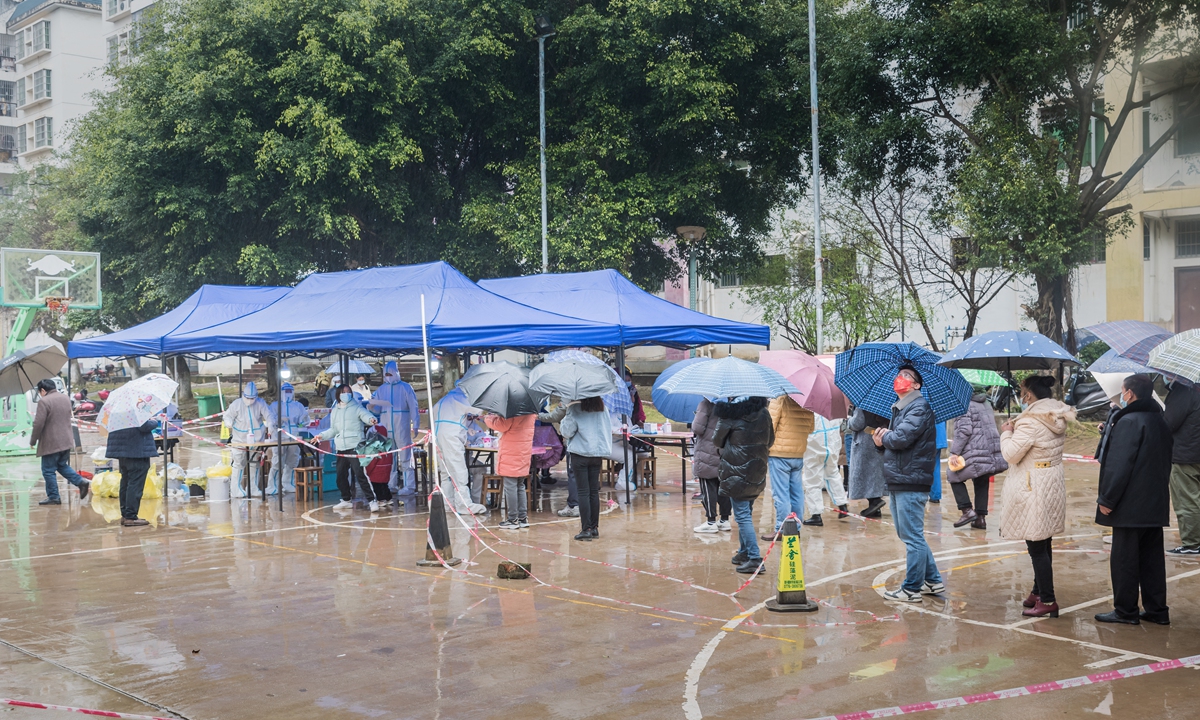
Residents line to take nucleic acid tests in Debao county, Baise, South China's Guangxi Zhuang Autonomous Region on February 6, 2022. Photo: VCG
A new COVID-19 outbreak in Baise in South China's Guangxi Zhuang Autonomous Region, a major domestic production hub of aluminum, is expected to tighten supply and lift prices amid booming demand and low inventories after the Chinese New Year holidays.
The city accounts for 5.6 percent of China's total production of electrolytic aluminum, and interruptions to production will push up prices for raw materials upstream, along with other factors, industry insiders said.
Production in Baise has been suspended amid a citywide lockdown for epidemic prevention, according to industry sources.
A manager with Guangxi Yangyang Aluminum told the Global Times on Tuesday that production was halted on the first working day after the Chinese New Year holiday due to epidemic prevention. The company is awaiting notice to resume, and it's hard to tell at the moment what the business impact will be.
Another person with a local aluminum company said the production suspension drove up prices by "hundreds of yuan per ton" in a single day on Monday and Tuesday.
"We are now in a situation where the price is rising but these orders were taken before and during the Chinese New Year, when the price was lower," the person said, so the company faces some potential losses.
Baise launched citywide traffic controls on Sunday, barring all vehicles and people from entering and leaving, as part of the latest measures for the strict but necessary epidemic prevention in responding to the latest outbreak in the region.
As of 5 pm on Monday, there were 66 new confirmed cases reported in the previous 24 hours in Baise, taking the total confirmed cases to 102.
"Epidemic prevention, which led to the production and transport restrictions in Baise, will surely boost the market price for corresponding materials such as alumina and electrolytic aluminum," Chen Huan, an industry analyst, told the Global Times on Tuesday.
But as the outbreak in Baise has just started, the actual impact on the middle and downstream industry is still too early to assess, Chen said.
Baise's annual alumina production capacity is up to 10 million tons, or 13.8 percent of total domestic capacity. Electrolytic aluminum production capacity in the city takes up to 80 percent of the whole figure for Guangxi, and 4-5 percent of China.
Booming demand coupled with the traffic controls in Baise are likely to mean lower inventories and higher prices.
While there are still around 7-10 days of inventories left in Guangxi, companies face challenges in preparing the necessary raw materials once the anti-virus measures end, according to media reports.
The domestic market has been optimistic about the recovery of aluminum consumption after the Spring Festival. The scale of accumulated storage around the Spring Festival in 2022 is expected to be the lowest in the past five years, according to the Shanghai Metals Market (SMM), an industry news portal.
Shares of aluminum companies rose on Tuesday, with Yunnan Aluminium Co surging 8.13 percent. Futures and spot prices also rose.
Industry players told the Global Times on Tuesday that prices have been rising due to low inventories. Output at factories in Northern China has been suspended during the holidays, even as demand is likely to boom. The production halt in Baise will fuel further gains.
China is the world's largest electrolytic aluminum producer with output accounting for over half of the global total, and it has shown rapid growth in recent years, industry data showed.
Despite the high output, most aluminum-related products are consumed domestically for the production of new-energy vehicles and infrastructure.
RELATED ARTICLES