ARTS / CULTURE & LEISURE
Revamped classic
Shanghai tailors keep ‘qipao’ dress tradition alive
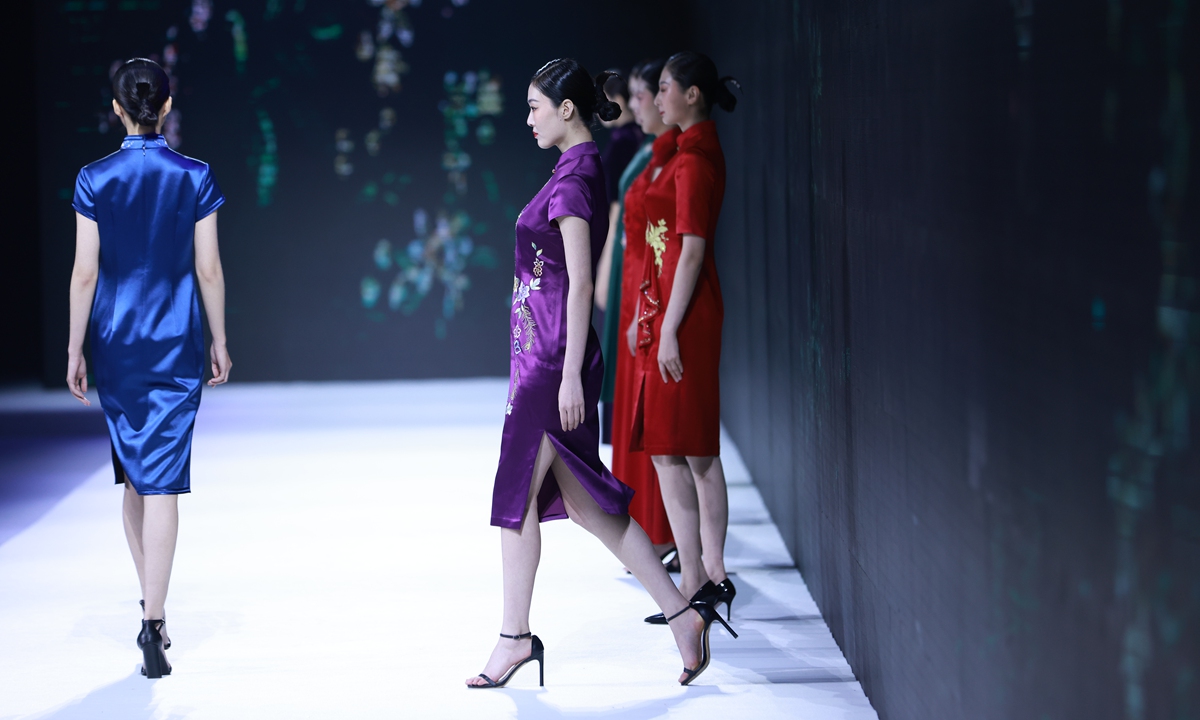
Models wearing qipao walk the catwalk at a cultural event in Northeast China's Liaoning Province on October 14, 2021.Photo: IC
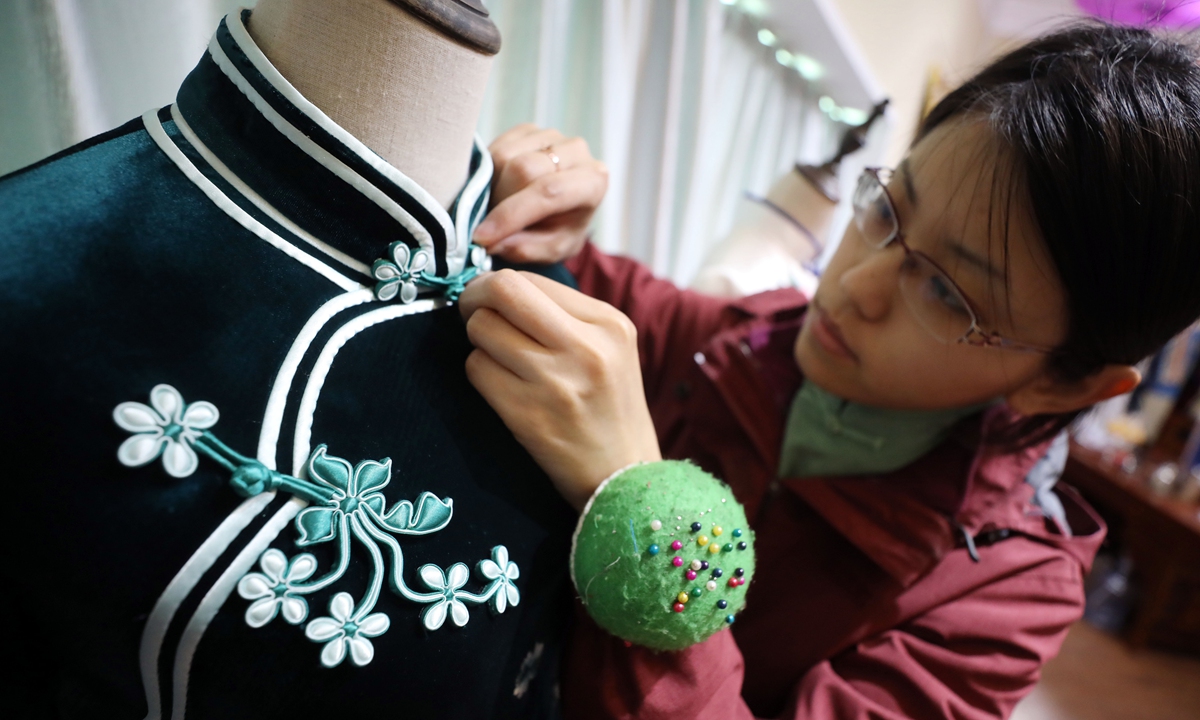
A designer stitches a qipao in her studio in East China's Shandong Province on April 10, 2019.Photo: IC
Zhou Zhuguang surveys his Shanghai workshop and rows of workers meticulously stitching high-collared Chinese dresses known as qipao, some of which sell for nearly $5,000.
"It's a highly skilled craft," said Zhou, co-founder of Hanart, one of China's most well-known qipao makers.
"Some of our tailors spend a lifetime learning to make qipao."
The price tag also reflects enduring demand for the qipao.
Drawing on traditional design elements, the dress was popularized in 1920s Shanghai.
A mass-produced qipao, sometimes seen at weddings or other formal occasions, can be bought today for as little as 100 yuan ($16).
But Zhou, 59, has found a market for higher-end designs among well-heeled Chinese fashionistas.
Zhou previously dealt in lower-priced qipao before founding Hanart in 1998 in partnership with Chu Hongsheng, a legendary qipao designer who fitted Chinese film actresses and the wives and daughters of Shanghai mafia bosses. Chu died in 2017 at the age of 99.
Cultural value
"(Low price) isn't the true essence of the qipao," said Zhou, who feels that such an iconic Chinese fashion staple requires more luxurious materials, bolder designs and hand-crafted precision, which inevitably push prices up.
Zhou displayed these at a Shanghai show in late 2021 which featured "modern, altered qipao" designs combining the classic Mandarin collar and body-hugging fit with less traditional elements such as lace, fringes, velvet, sequins and rich embroidery.
"We want more young people to wear qipao," Zhou said of his design re-boot.
To Yang Zhenzhen, who owns a Shanghai qipao shop and is an online influencer of the dress style, cracking the youth market is essential to keeping the tradition alive.
Her shop targets buyers aged 25-45 with qipao starting at around $600.
"Young people bring new life and energy" to the qipao, said Yang, 28, who has been smitten with the dress since childhood and began collecting them five years ago.
"If young people don't wear them, then by the time they grow old there won't be anyone wearing them," she said.
Yang admitted that youth acceptance suffers from a stereotype that qipao are for elderly women, or the belief that pop culture uses the dress to objectify Chinese women.
"These are deep misconceptions... so I want to popularize it as best I can and let people know the real meaning of qipao," she said. That includes the dress's role in breaking down gender norms for women during the 1920s. The sense of freedom associated with that will never go out of style, she adds.
RELATED ARTICLES