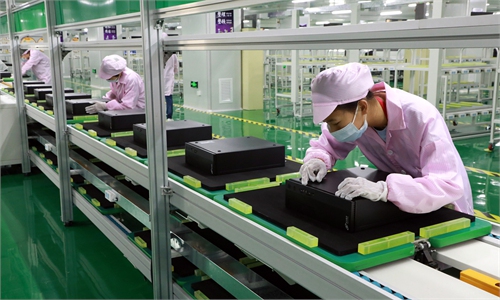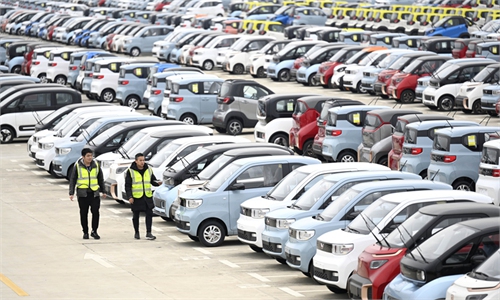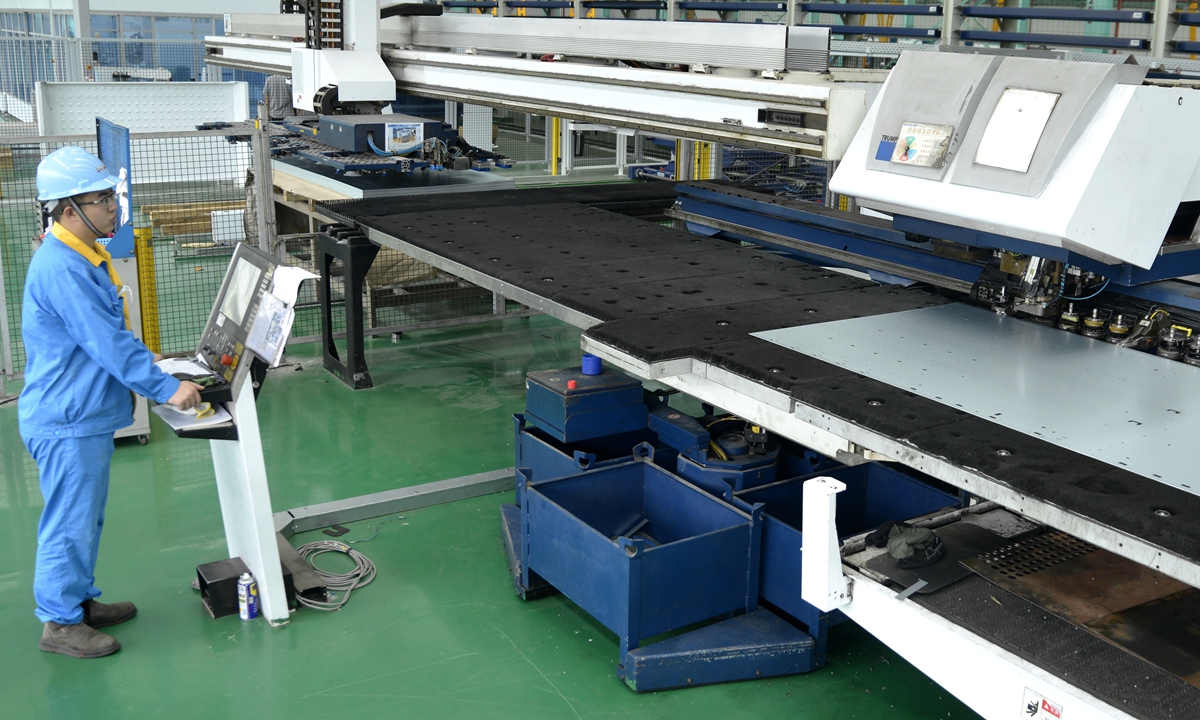
A worker at an industrial zone in Taizhou, East China's Jiangsu Province supports services for a German household appliance series. China's production resumption has stabilized global supply chains. Photo: cnsphoto
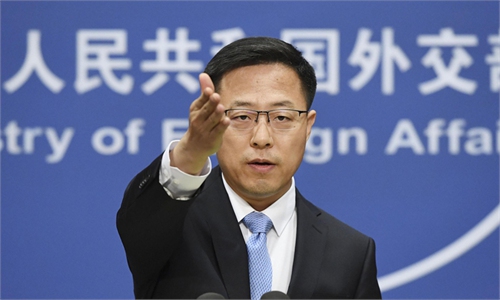
China's Ministry of Commerce (MOFCOM) said on Thursday that it will go all-out in further coordinating and solving difficulties, including transportation snags and production and operation resumption issues, encountered by foreign-funded firms in China while ensuring effective epidemic control.The Chinese government has actively taken targeted measures to help affected enterprises, including foreign-funded ones, to relieve their difficulties while doing a good job in epidemic control, MOFCOM spokesperson Gao Feng said during a regular press conference on Thursday, in responding to the Global Times' questions about how to maintain a balance between epidemic prevention and the operations of foreign companies in China.
Specific efforts, including smoothing transportation channels, optimizing epidemic prevention and control measures, organizing and ensuring emergency and key supplies, have been carried out, according to Gao.
The ministry, together with relevant departments and localities, is helping foreign-funded enterprises in various places, including coordinating and solving specific problems in the resumption of work and production, personnel entry, logistics and transportation, Gao said.
In a recent meeting between Commerce Minister Wang Wentao and foreign business representatives in China, issues on the supply chain disruption posed by the epidemic were also being addressed as part of the Chinese government's active response to foreign business' concerns.
American Chamber of Commerce in China (AmCham) was invited to the in-person roundtable with Wang on Monday, where the US business group explained challenges its member companies are facing due to the recent COVID-19 outbreaks, according to a statement on Friday.
The AmCham described the meeting as open and constructive and centered on important topics to the business community, including supply chain logistics, cross-border personnel movement, and return-to-work timeline and protocols, the statement said.
During the meeting, the chamber representative offered support to the government in a wide range of areas, including relaying reliable and timely information from the Chinese government to the American business community, supporting the donation of relief goods and services from member companies in the epidemic-hit areas, while exploring ways to help to ensure a steady supply of daily necessities to the Chinese and expatriate staff of member companies.
Wang welcomed the information shared by the AmCham while stressing that China will take stronger measures to protect the supply chain and businesses.
European Chamber president Jörg Wuttke, who also participated in the meeting along with several representatives of other foreign chambers of commerce, outlined at the meeting the logistical and operational challenges being faced by European companies operating in China as a result of the lockdowns that have been imposed in different cities to contain the Omicron outbreak, the chamber said in a statement to the Global Times on Thursday.
In the interview, Wuttke extended his appreciation to the special attention given by Wang to this matter.
In the face of the logistics disruptions, the Chinese government has taken steps to ensure production resumption, despite lingering pressure from the flare-ups.
The Shanghai government recently issued a "whitelist," allowing 666 companies to restart operations or to obtain guarantees for re-opening on Wednesday.
These 666 companies are mainly from the pillar industries in Shanghai, covering key industries such as integrated circuits, automobile manufacturing, equipment manufacturing and biomedicine.
In the statement, the European Chamber welcomed the fact that a significant number of its member companies are included in the "whitelist," particularly in crucial sectors, describing it as "a strong signal that China is striving to get Shanghai and the Yangtze River Delta back up and running as soon as possible."
However, the chamber also noted that many companies still face logistical challenges.
"As a result of stringent regulation of the issuance of access permits, coupled with a severe shortage of trucks, little improvement has been seen in logistics networks compared to a week ago," the chamber noted.
"Labor shortages also persist, including for companies operating closed-loop management systems as they have not been able to rotate their teams due to COVID-19-related restrictions," the chamber said.
"Foreign-funded enterprises in China are also Chinese enterprises and play an important role in promoting the high-quality development of the Chinese economy and maintaining the stability of the global industrial chain and supply chain," Gao said on Thursday.
To further tackle the difficulties of foreign firms, the MOFCOM will facilitate a special working group for serving key foreign-funded projects in China, Gao said.
RELATED ARTICLES