State Council stresses further efforts to boost demand, consolidate recovery
Factory activity rebounds as stimulus policies take effect
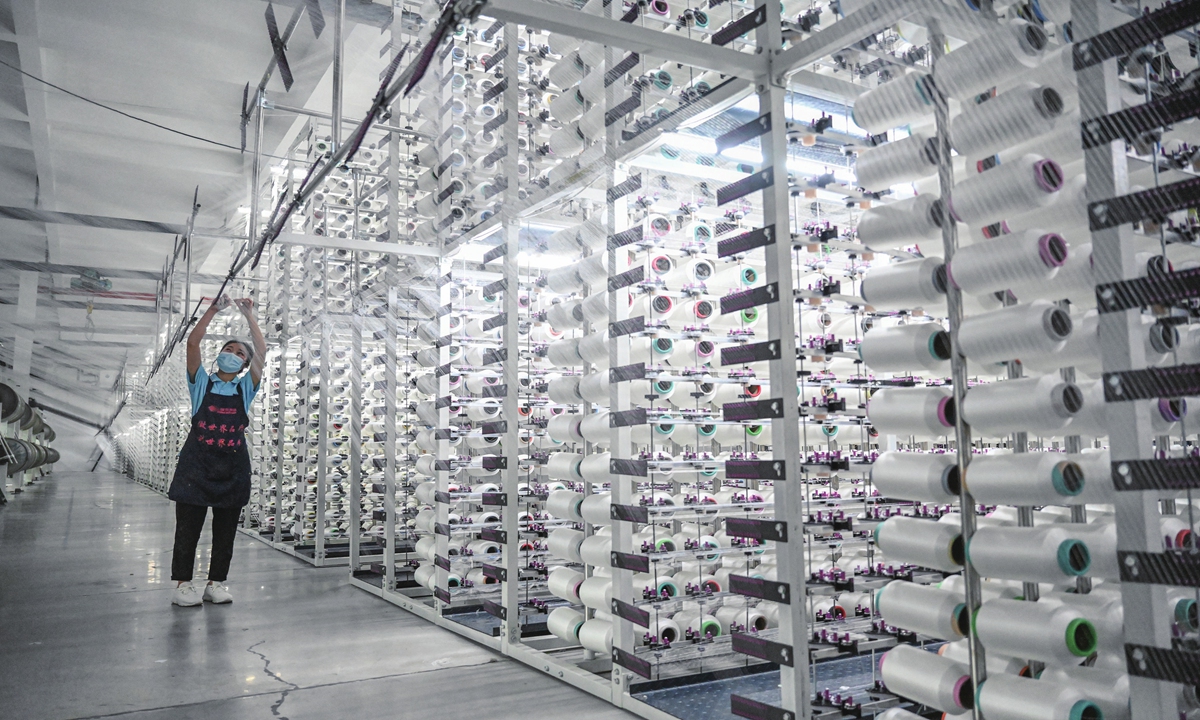
An employee works at a textile enterprise in East China's Fujian Province. Photo: Xinhua
An executive meeting of the State Council, China's cabinet, on Wednesday stressed the implementation of a slew of stabilization measures to expand effective demand and consolidate the foundation for economic recovery.
The meeting, which was presided over by Premier Li Keqiang, stressed that the package of 33 stabilization measures should be fully functional, and details of the follow-up 19 measures that were announced last week should be finalized by early September.
The meeting also called for localities to make good use of policy tools to address the problems in the property market, based on the city-specific principle, making flexible use of phased credit policies and special loans aimed at ensuring home delivery.
The meeting also pledged to improve the business environment and reduce institutional transaction costs to reduce the burden on companies and inject vitality into market entities. It also vowed to crack down on illegal fines and excessive taxes and fees.
The intensive rollout of measures by the State Council lately reflected the great urgency and the effort of the government to stabilize the economy and lift the expectations amid downward economic pressure, Tian Yun, a veteran macroeconomic observer, told the Global Times on Wednesday.
Wednesday's meeting came after China's manufacturing sector showed improving signs in August, with the official manufacturing Purchasing Managers' Index (PMI), while remaining in contraction territory, rebounding from July, according to official data on Wednesday.
The official PMI reached 49.4 in August, slightly up from 49 in the previous month, the National Bureau of Statistics (NBS) said on Wednesday, which, according to experts, shows that the economy is warming up despite lingering pressure.
The index remained below the 50-point mark that separates contraction from growth, but it was still higher than market expectations. A Reuters poll had placed the PMI at 49.2.
Demand is recovering at a better-than-expected pace on the manufacturing side, showing that China's economic stimulus policies are gradually taking effect, experts noted, although production was still restrained by factors like power shortages and COVID outbreaks.
According to NBS senior statistician Zhao Qinghe, the Chinese economy continued a recovery trend, as various regions and departments implemented national stabilization measures, while companies addressed adverse factors like the COVID-19 and extreme weather.
Tian said that judging from the August PMI data, China's economy is gradually stabilizing, and third-quarter economic data might show a moderate rebound from the second-quarter base.
"This is a good sign, although the rebound might not be as sharp as people expected," Tian said.
Some PMI sub-indexes showed that demand recovered in recent weeks in the manufacturing sector. For example, the new orders index rose from 48.5 in July to 49.2 in August. New export orders also rose from 47.4 in July to 48.1 in August.
The improvement in manufacturing demand showed that China's stimulus policies are effective, experts said.
"The rebound in manufacturing orders has a lot to do with China's policies for stimulating bulk commodity consumption," Feng Mohan, a research fellow at economic research and consulting firm Beijing Fost Economic Consulting, told the Global Times on Wednesday.
For example, tax breaks for vehicle purchases in the first half of this year had an evident effect in pushing up automobile production, Feng said. China's supply chain stability and the yuan's depreciation in recent months also supported export demand.
China recently announced 19 new policies aimed at beefing up economic growth, including more than 1 trillion yuan ($146 billion) in new funding to boost investment and consumption, as well as more flexibility for local authorities to support the real estate market.
Previously, the country unveiled a package of 33 measures covering fiscal, financial, investment and industrial policies to revive the COVI-19-hit economy.
The August PMI data also showed that the economy was still under pressure. For example, factory production was a little weak due to unexpected factors like hot weather-triggered power rationing and sporadic coronavirus outbreaks, experts said.
The production index stood at 49.8 in August, the same as in July.
Also, the PMI for China's non-manufacturing sector came in at 52.6 in August, down from 53.8 in the previous month. This reflected that sectors like services and construction are still facing downward pressure, as recent virus outbreaks in multiple cities are hindering services businesses like catering, tourism and entertainment.
Wu Chaoming, deputy head of the Chasing Research Institute, noted that as the earlier stimulus policies continue to propel market demand, and as energy supply guarantees lend further support to factories, the PMI will hopefully rebound back to about 50 in the next few months.
RELATED ARTICLES