Illustration: Xia Qing/Global Times
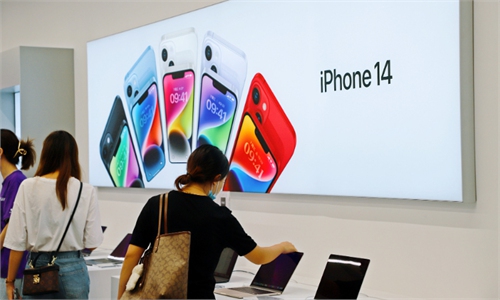
Shares of Apple Inc dipped on Tuesday in the US after reports that the company is reducing production of its iPhone 14 Plus while it re-evaluates demand, US media outlet CNBC reported. One of Apple's manufacturers in China has been instructed to immediately halt production of the iPhone, CNBC reported, citing a report by technology publication The Information.Shortly after the debut of the iPhone 14 series in September, market analysts said that sales of the series in China had declined by 11 percent compared with the previous-generation iPhone 13 series a year earlier. The rare double-digit percentage drop indicated that sales of the iPhone 14 series may not be as strong as indicated by pre-orders.
Although some observers said an objective assessment of the iPhone 14 series' performance in the Chinese market may not be totally formed until December, comments from Chinese consumers on the new Apple handsets are currently mixed.
The "iPhone 14 may become the worst-selling model ever" topped the search list on China's Twitter-like social media platform Sina Weibo at one point last month. Some consumers think the iPhone 14 lineup is not innovative enough compared with the two previous generations, and others believe the series has failed to meet changing market needs.
The iPhone series products have become the only Apple products that have seen growth, according to the fiscal third-quarter earnings report the company issued in July. As iPhone products have become the lifeblood of Apple, the sales of the iPhone 14 series are very important for the company's prospects.
The success of the iPhone in the consumer market mainly relies on major innovations in technology and design.
As a longstanding device that has shifted from offering revolutionary innovations to incremental improvements, whether it is in China or other markets, iPhone's future lies in its innovation and understanding of market trends.
Although the West has been hyping Apple's "reduced dependence" on China's industry chain, the indisputable fact is that China's resilient supply chain and industrial upgrading have provided strong support for Apple in the past decade.
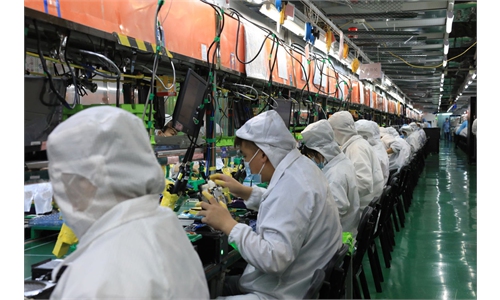
The development of Apple products in the Chinese market has formed a huge, complex and intricate industry and supply chain. Apple's reliance on Chinese manufacturing has been supporting it through the COVID-19 pandemic.
Apple suffered multiple shutdowns in other countries due to the pandemic in 2020 and 2021, but stable production in China has helped Apple expand its smartphone market share, and iPhone sales hit new highs. It is believed that the resilience of China's supply chain will further support Apple and help it cope with fluctuations in market demand.
If the California-based tech giant has indeed decided to cut production of iPhone 14 Plus, its decision will inevitably have an impact on its supply chain in China.
It's hard to find out exactly how many workers on the assembly lines of Apple's suppliers are designated for its iPhones, but some media reports suggested that a manufacturing base in Zhengzhou, Central China's Henan Province that makes items including iPhones has some 350,000 workers. In response to the potential production adjustment of Apple, relevant companies need to make swift adjustments.
The Chinese supply chain is fully capable of coping with the impact of the potential Apple production cut. There is no doubt that China has tightened its grip on the smartphone supply chain as Chinese companies have moved toward the upstream of the supply chain. With the upgrading of China's mobile phone industry chain, it has a strong ability to adapt and adjust.
Fortunately, Chinese smartphone brands such as Huawei, Xiaomi, Oppo and Vivo have gained increasing popularity in the Chinese and global markets over the past decade, and their successes have created new space for the smartphone manufacturing chains in China to deal with a decline in iPhone sales and gradually shift their focus to the rising Chinese domestic brands.
Transformation is always a complex process, but we believe that China's iPhone supply chains are resilient enough to complete the process.
The author is a reporter with the Global Times. bizopinion@globaltimes.com.cn
RELATED ARTICLES