Premier Li lauds 'ASEAN+3' cooperation system
China calls for regional economic integration, supply chain stability
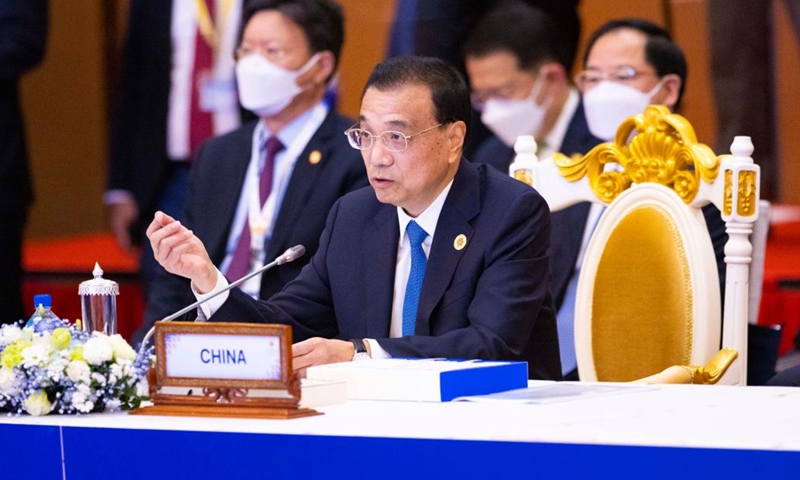
Chinese Premier Li Keqiang attends the 25th China-ASEAN Summit in Phnom Penh, Cambodia, Nov. 11, 2022.(Photo: Xinhua)
Chinese Premier Li Keqiang on Saturday called on members of the Association of Southeast Asian Nations (ASEAN) as well as China, Japan and South Korea to keep up the process of regional economic integration and work on the stability of industrial and supply chains, while reiterating China's opening-up policy, when attending the ASEAN, China, Japan and South Korea ("ASEAN+3") Summit.
The commitment by "ASEAN+3" to open and integrated development, and its efforts to optimize and upgrade regional industrial and supply chains in a stable way, serves the common interests of all countries and injects new impetus into the world economy, experts said.
Li noted that countries should keep the process of regional economic integration going, promote the full effectiveness and implementation of the Regional Comprehensive Economic Partnership (RCEP), and release the maximum dividends of the free trade agreement, the Xinhua News Agency reported.
Li also called for countries to maintain the stability of the industrial and supply chains, and adhere to opening-up and coordinated development to push the optimization and upgrading of regional industrial and supply chains always in smooth operation.
While building a solid foundation for supply chain cooperation in Asia, the RCEP promotes trade and investment convenience in Asia and helps the formation of a unified market in the region, Shen Minghui, a research fellow at The National Institute of International Strategy of the Chinese Academy of Social Sciences, told the Global Times on Sunday.
Thanks to the RCEP, Asia's regional economic integration will be strengthened, Shen said, urging member countries to actively participate in cooperation so as to contribute more to global economic and trade development.
Premier Li also made remarks on improving crisis response cooperation, deepening cultural and people-to-people exchanges, and promoting sustainable development in the region.
China's economy is deeply integrated into the region and the world, and China will stick to the basic national policy of opening-up, Li said, adding that China is willing to bring new opportunities to other partners with its own development and inject new impetus into regional cooperation.
He said that in the past decade, China had initiated more than 130 cooperative proposals or projects under the "ASEAN+3" cooperation framework, most of which have been completed now.
Premier Li's remarks at the conference sent positive signals to international community that the Chinese economy is not only deeply integrated into the world, but will also contribute to global economic growth and the stability of industrial and supply chains, Chen Jia, an independent analyst on international strategy, told the Global Times on Sunday.
China's economic development will bring more opportunities to ASEAN, and provide new and sustained driving forces for the world's growth, in contrast to the US' reckless "decoupling" move that goes against the trend of globalization and will result in supply bottlenecks and market disorder, Chen said.
The participating leaders at the summit said that China, Japan and South Korea are major partners of ASEAN countries, noting that the "ASEAN+3" is the ballast of regional cooperation and economic development, and safeguarding regional peace and stability, Xinhua reported.
They called on all sides to be closely united and strengthen cooperation in areas such as agriculture, interconnectivity, digitalization, financial security, public health, environment protection and cultural exchanges.
Digitalization, new-energy and services trade are some of the important sectors in which China, Japan, South Korea and ASEAN may strengthen their cooperation, Chen said.
"With digital tools being an innovative way to overcome the instability of industrial and supply chains amid rising uncertainty and COVID-19, the economies have a strong willingness to cooperate in digital trade and new types of infrastructure," Shen said.
Experts noted that East Asia and ASEAN has become an important engine of world economic growth.
Thanks to their deeper integration and industrial complementarity, the region is deepening the division of labor and cooperation and improving their industrial production network, which will provide more impetus for regional economic growth, Chen said.
"The ASEAN+3 model will continue to play a positive role in exploring new solutions to international economic and trade cooperation, and in handling international affairs in a fair and just manner," Chen said.
RELATED ARTICLES