ARTS / ART
Textbooks for China’s first batch of interdisciplinary ICH all-rounders on the way

Chinese shadow puppetry, UNESCO Intangible Cultural Heritage Photo: VCG
Aiming to bring students from various backgrounds into China's numerous cultural villages, the country's first ever Master's degree in comprehensive Intangible Cultural Heritage (ICH) research kicked off at Tianjin University, Tianjin, in August. Now, the major has received its first update, and a set of textbooks tailored to the special degree are currently being compiled.
The textbooks will include chapters on subjects such as oral history, Feng Jicai, an acclaimed Chinese scholar and the course's initiator, told the Global Times, noting that the production of the textbooks "is laying the first brick for the Chinese ICH educational high-rise."
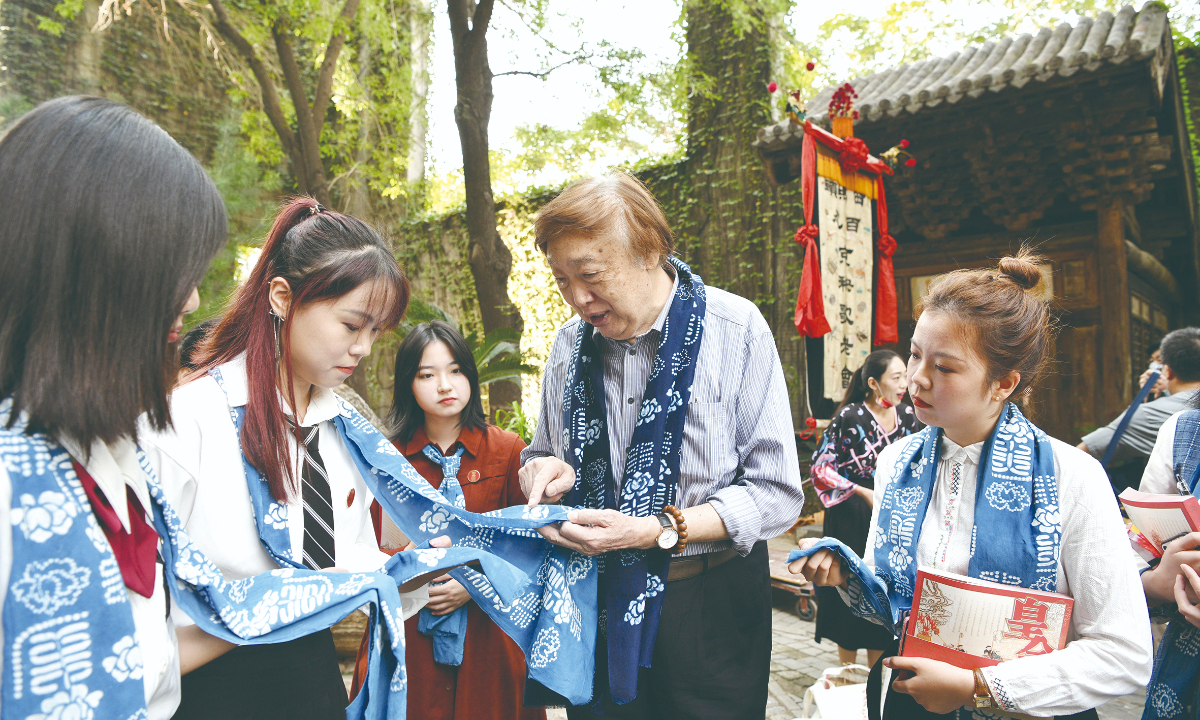
Feng Jicai (second right) with students majoring in comprehensive ICH research Photo: VCG
Building a foundation
The titles of three textbooks have been revealed so far.
The General Theory of Intangible Cultural Heritage aims to provide students with a theoretical underpinning for ICH research and will be especially useful for newcomers in the field. The Book of Folk Literature and Art and the Oral History of Inheritors are designed with case study examples attached to each subject.
Feng revealed to the Global Times that the three textbooks are the first batch of 14 textbooks that are currently being worked on.
While no details have been revealed just yet, Feng said that the remaining textbooks will touch upon subjects such as the protection of traditional villages, visual anthropology and field studies, which he considers to be the best pathway to ICH research.
"Folk culture [ICH] is different from elite culture. It weaves into life; it is a living heritage. Fieldwork is also our main way to conduct research," Feng noted.
The textbooks are being worked on by leading experts in the field. Twenty years ago, Chinese pioneering scholar Xiang Yunju published a book called Oral and Intangible Heritage of Humanity.
The book has become a basic guide for world as well as for Chinese scholars to establish a comprehensive ICH system.
UNESCO representative Yasuyuki Aoshima called the book "the world's first study of ICH."
Currently, Xiang is working as the chief editor of the new General Theory of Intangible Cultural Heritage textbook.
While the first set of textbooks is still in development, some of the included content is already being given out as handouts in courses within the major.
Pu Jiao, director of the Academic Committee at the Feng Jicai Research Institute of Arts and Literature, the center behind the course, told the Global Times that these teaching materials will be used in curriculums such as ICH management.
"We are very much focused on developing courses such as ICH management and ICH and the law," Pu said.
"Following up on these, we also want to focus on developing paths such as archival science for ICH."
Pu emphasized that these courses aim to present students with an "open-minded" view of ICH while also teaching how China's ICH goals have changed over time.
"Our aims have changed from 'rescuing' to more creative and science-oriented management, thus we need talents who can carry on such work," Xiang Dinglong, an ICH researcher in Beijing, told the Global Times.
Xiang noted that the recent inclusion of Chinese traditional tea-making on UNESCO's World ICH list in November shows just how important such work is.
"ICH is a great but non-renewable cultural treasure of a nation and a country. What we're doing here, it's like building a high-rise, and we're laying down the bottom layer of bricks," Feng told the Global Times.
Training plan
Rewinding the clock back to August, a group of seven students at Tianjin University started on the path to receive a degree in the interdisciplinary discipline of ICH.
Nearly a year ago, in October 2021, China's Office of Academic Degrees, Committee of the State Council approved the establishment of the degree in Tianjin University.
According to Feng, the establishment of the interdisciplinary degree shows the fact that China's ICH talents have entered a "high-level, professional and new historical age."
Although the course is not the only Master's degree in China to touch upon the subject of ICH, but unlike other "cultural heritage" courses that see ICH as a sub-discipline, the newly established course attempts to provide students from different backgrounds the most targeted training possible.
Pu told the Global Times that the first-batch seven students came from backgrounds such as architecture, cultural industry management, urban planning, design as well as fine arts.
Such an "interdisciplinary" training course led Su Junjie, a Chinese ICH scholar with years of teaching experience at Deakin University in Australia, to call it "innovative" and "world-leading."
He noted that though he had never heard of an ICH program such as this, he predicts China will cultivate talents who can act as a bridge between ICH inheritors, communities, governments, social institutions and academies.
"This to me is a plan for educating ICH all-rounders, who know Chinese ICH history but can bring this knowledge to other fields, and even promote China's ICH on international platforms, especially when it comes to the management and legal aspects," Xue Zhen, a Chinese ICH researcher in the UK, told the Global Times.
Taking courses four and a half days a week, the first batch of "all-rounders" are set to study for two and a half years before they graduate.
RELATED ARTICLES