Financial regulator vows to accelerate payment of insurance claims over heavy rains
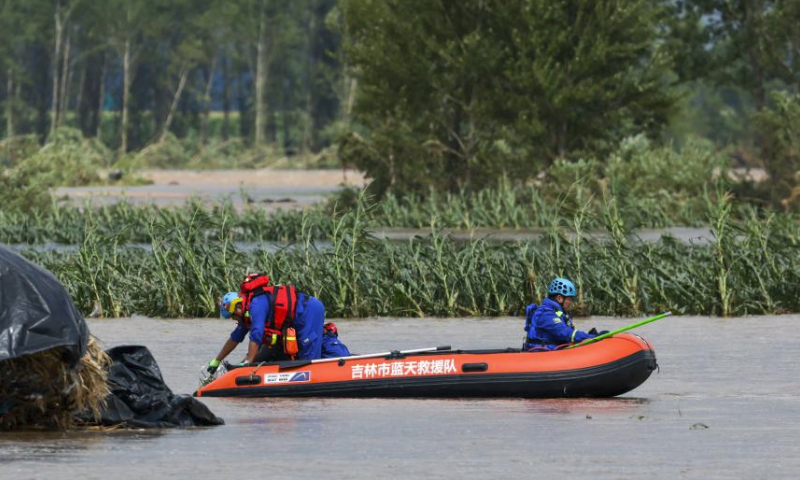
Rescuers carry out rescue and relief operations in Qili Township, Shulan City, northeast China's Jilin Province, on August 5, 2023. About 134,000 people have been affected, with more than 14,300 people evacuated, according to the flood control and drought relief headquarters of Shulan. Continuous heavy rainfall caused flooding, bridge collapses and road damages in several towns of Shulan. Jilin Province have dispatched many rescue reinforcements to Shulan to offer disaster relief support. Photo: Xinhua
The National Administration of Financial Regulation (NAFR), China's newly integrated financial regulator, has asked insurance companies to accelerate payment of claims related to the recent torrential rains in multiple places across the country.
The regulator required insurers to open green channels for disaster claims, accept reports through various channels, and maximize the simplification of claim procedures, according to a report by the China Media Group (CMG).
Several insurers have already launched green channels in the disaster-hit areas.
Cao Yang, general manager of Ping An Insurance (Group) Co's Beijing subsidiary, said that the company has waived requirements for meteorological certificates, and restrictions on designated hospitals and drug use have also been abolished, according to CMG.
"For enterprises that have sustained serious damage and financial difficulties, we paid part of the compensation in advance after the loss is determined. For farmers whose land was damaged, claims personnel will investigate and determine the loss, and pay the agricultural insurance indemnity in advance," Cao said.
As of 10 am on Sunday, 16 disaster-hit areas including Beijing, North China's Hebei Province and Northeast China's Heilongjiang Province had reported 189,100 claims with damage worth 6.24 billion yuan ($868 million). A total of 50,600 claims have been paid, and the amount of compensation came in at 264 million yuan, data from the NAFR showed.
Claims for cars accounted for the majority at 61 percent of the total.
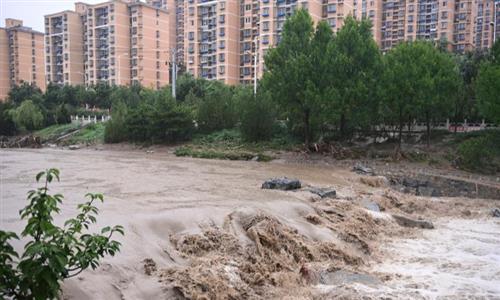
Beijing broke a 140-year-old rainfall record in the days between July 29 and August 2 with extreme rainfall of 744.8 millimeters, as it was lashed by heavy rain from Typhoon Doksuri. Suburban districts of Mentougou and Fangshan in southwestern Beijing were hit the hardest by the natural disaster.
In a self-rescue plan issued by the provincial government of Northeast China's Heilongjiang on Monday, it said that speeding up field drainage should be given top priority to minimize the amount of time that crops were waterlogged.
"If there are field drainage projects, or dredging measures such as deep excavation and expansion, these should be used to speed up the progress of draining the water. For those without field drainage projects, we should try our best to dig drainage ditches and puddles according to the direction of the water flow," the notice read.
Vast areas of paddy fields remained waterlogged in the city of Wuchang, Heilongjiang, which is a major commodity grain base and home of the famous Wuchang rice.
Weather risks remain omnipresent and unpredictable, according to a note that S&P Global Commodity Insights sent to the Global Times.
The Ministry of Agriculture and Rurual Affairs has warned in late July that Typhoon Doksuri could cause widespread damage to Chinese rice and corn crops.
Ma Wenfeng, a senior analyst at the Beijing Orient Agribusiness Consultancy, told the Global Times on Monday that the flooding will wreak havoc on the output of pure Wuchang Daohuaxiang rice this year, as the plants were in the key flowering phase.
"But for the overall rice yield across the country, the impact will be quite limited, given the tiny share of Wuchang rice on the market," Ma noted.
Global Times
RELATED ARTICLES