China’s economy continued to runon the expansion trajectory in July, with the output of industrial enterprises above the designated size up by 5.1 percent year-on-year, while retail sales rose by 2.7 percent year-on-year, data from the National Bureau of Statistics (NBS) showed on Thursday.
Observers said the slew
of key indexes underscored that the world’s secondlargest economy has been
stabilizing and improving in July, after edging slightly down in the second quarter.
The recovery momentum
is fueled by a bunch of factors, the analysts noted, including the pull-up
effect from the government’s more pro-growth policies, a summertime consumption
peak, as well as a pick-up in high-tech manufacturing investment.
The 5.1-percent value-added
industrial output growth in July compared with 5.3-percent growth recorded in
June. Growth of retail salesin Julygained 0.7 percentage point from the 2-percent growth
rate seen in June.
In the first seven
months this year, fixedasset investment rose 3.6 percent year-on-year, compared with 3.9
percent in the first six months, NBS data showed.
Observers said that
the July performancereadings are largely stable and have shown some “palpable”
improvement from June, the retail sales in particular, which is expected to bolster
the prospect of the Chinese economy inthe second half year.
“July is
traditionally a peak travel season, which has led to a summer consumption boom.
In breakdown, the number of domestic flights jumped in July compared with the
previous month, while that of cultural and tourism-related consumption as well
as catering spending also rose. The low base effect of the same period last
year also providessupport,” said a research report released by China
International Capital Corporation (CICC).
In July, a list of
stimulus measures has been carried out to inject new impetus into the economy.
Meanwhile, the convening of a set of tone-setting government meetings have sent
out clear signals for the launch of more effective, strengthened measures to
buttress the country’s high-quality development.
Cao Heping, an
economist from Peking University, told the Global Times that fixed-asset
investment has maintained
stable growth in July aseconomic activityrevved up in the aftermath of
natural disasters such as flooding. State-owned enterprises, in particular, are
showing a notable increase in fixedasset investmentin the period, Cao said.
Analysts also noted
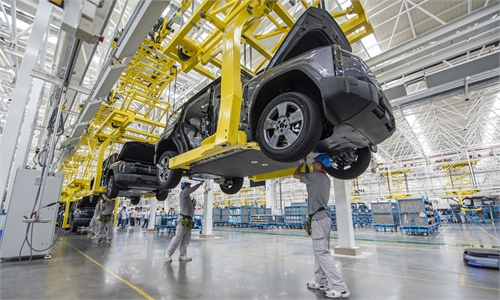
that investment in manufacturing has continued to gain pace in Julywith a rosy growth of 9.3
percent in the first seven months, and the field will likely to continue
to display innate strength and resilience throughout the second half, despite
sluggish investment in the real estate sector, which is undergoing a protracted
correction.
The brisk export in Julyalso bodes well for driving up the manufacturing sector investment, they added.
The July economic
data showed that industrial output remained relatively high, which is also supported
by strong growth in exports, Tian Yun, a veteran economist based in Beijing,
told the Global Times.
Observers said that
taking account of the GDP growth slowdown in the second quarter and the high
base of the second half of last year, it should be acknowledged that the
economy will face “considerable internal and external downward pressure” in the
July-September period.
But they voiced
confidence that the economy will reach the annual GDP growth goal of around 5 percent.
China’s GDP expanded
5 percent to reach 61.68 trillion yuan ($8.49 trillion) in the first half of
2024. In the second quarter, China’s GDP grew by 4.7 percent year-on-year,
edging down slightly from the first quarter’s 5.3-percent growth.
Cao said that he
expected the GDP growth rate to be around 5 percent over the coming months,
showing a steady trend. He noted that technological advancements and
consumption upgrades are poised to drive economic growth, with government
support for tech and innovative companies providing a new direction for growth.
Zhao Chenxin, deputy
head of the National Development and Reform Commission, China’s top economic
regulator, said in July that the country has “ample room for counter-cyclical
policy adjustments” in the second half of the year. He gave example of the
issuance of ultra-long special treasury bonds, local government special bonds,
as well as other initiatives to boost large-scale equipment upgrades and
consumer goods trade-ins.
While certain
policies that have been put in place show early signs of effectiveness in
driving up consumption and investment, Tian expects more measures to be rolled
out by the government to stabilize real estate investment.