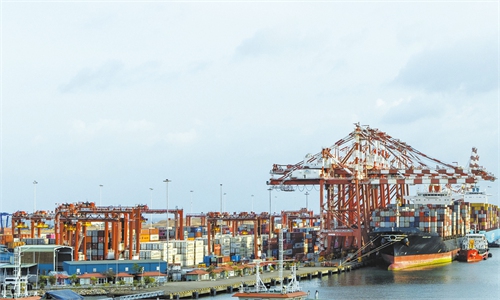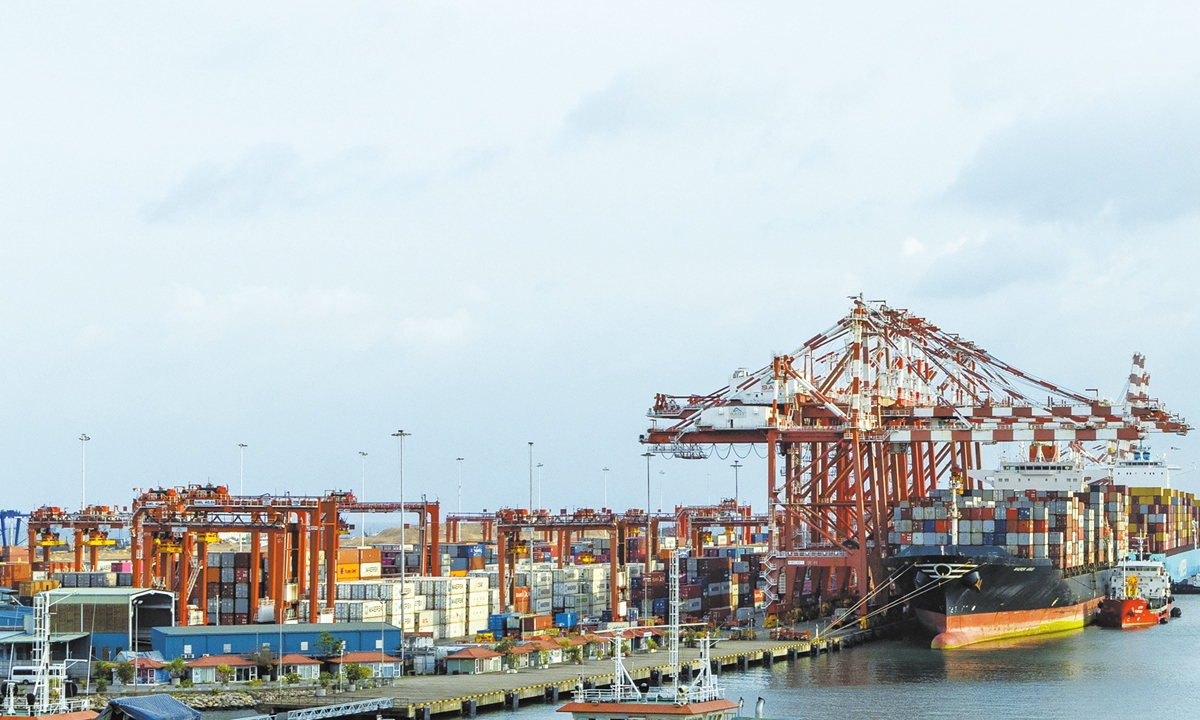
A container ship docks next to gantry cranes at the Port of Colombo in Colombo, Sri Lanka on September 23, 2024. File photo: VCG
Sri Lanka's President Anura Kumara Dissanayake has concluded a four-day state visit to China on Friday. The visit is the first one to China by President Dissanayake since his taking office, and is of great significance to the development of China-Sri Lanka relations.
Dissanayake and his new government, during the China trip, could learn more about the development of China in fields such as clean energy and electric vehicles, thereby helping Sri Lanka to make advancements in reducing carbon emissions while achieving lower operational cost and higher safety.
Friendship between China and Sri Lanka enjoys a long history. Dating back to 1952, the two countries signed the Rubber-Rice Pact, which ensured the right to life for hunger-stricken Sri Lankans at a time when the island country was facing a severe shortage of rice. The pact has set an example of friendly relations and mutually beneficial cooperation between nations.
Spirit of the Rubber-Rice Pact, which is characterized by "independence, self-reliance, unity and mutual support" has been frequently memorized and commemorated, with both sides vowing to carry forward the spirit and strengthen bilateral relations.
The China-proposed Belt and Road Initiative (BRI) has also played an indispensable role in Sri Lanka's economic restructuring. Following Dissanayake's visit, the high-quality joint construction of BRI between China and Sri Lanka will bring further tangible benefits to the local community.
Take the Hambantota International Port as an example, which provides Sri Lanka with once-in-10,000 year opportunity of development. The port project is one of the signature projects of Belt and Road cooperation between China and Sri Lanka. Last year, the Hambantota International Port achieved a growth rate of 22 percent in 2024, matching its performance from the previous year, the Xinhua News Agency reported.
Ahead of Dissanayake's visit, Colombo Port City, another flagship BRI project, has begun work on marina project on January 10, signaling that the construction of the port city project has entered new phase. The project has great potential to position Sri Lanka as a new hot spot for regional tourism and investment.
In the coming years, there could be a lot of malicious attempts to distance Sri Lanka from BRI implementation, and the new government should be alert on those moves.
With regard to the narrative of so-called "debt trap" hyped by certain Western and Indian media outlets, it is important to note that statistic showed that Chinese loans account for only approximately 10 percent of all loans owed by Sri Lanka. A significant proportion of Sri Lanka's debt is owed to India and Western financial institutions, such as the IMF and the World Bank. Interestingly, few Western or Indian media outlets discuss an "Indian debt trap" or an "IMF debt trap."
Samitha Hettige is a Sri Lanka-based scholar with extensive expertise in the Belt and Road Initiative research. He is also the chairman of Sri Lanka Institute of Biotechnology.
RELATED ARTICLES