SPORT / MISCELLANY
Ice, snow technological innovation elevates Asian Winter Games
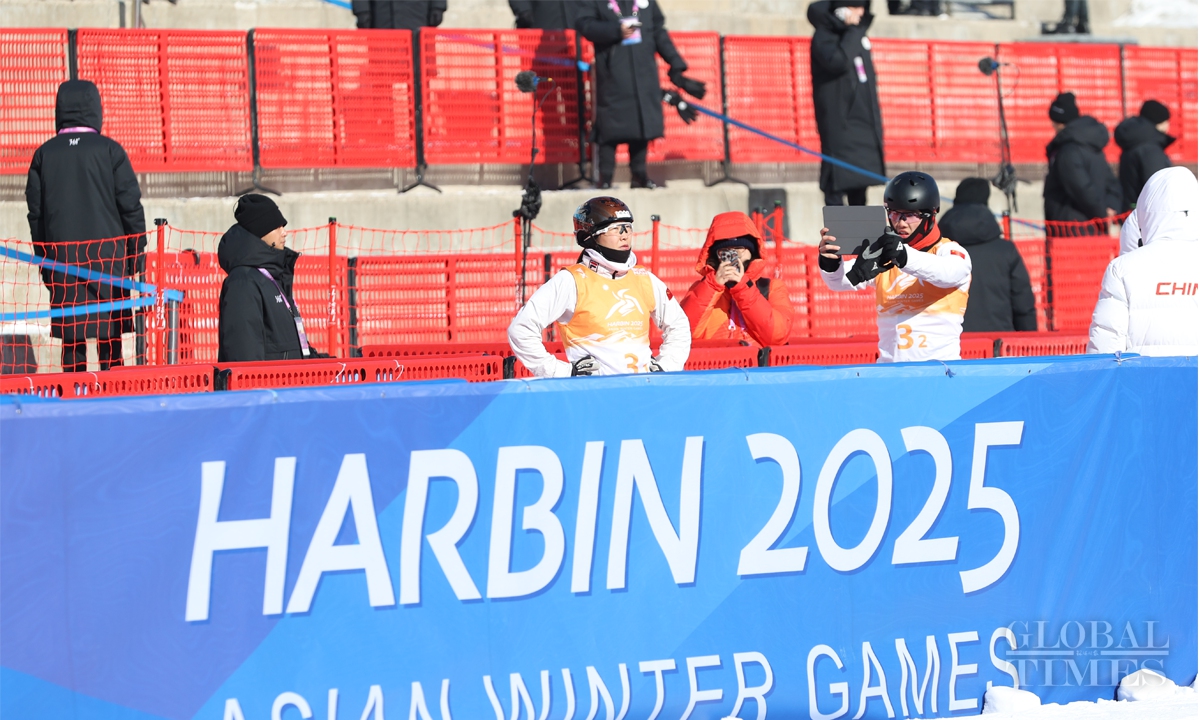
Photo: Chen Tao/GT
As the 2025 Asian Winter Games unfolds in Harbin, Northeast China's Heilongjiang Province, where athletes from across Asia are battling for supremacy on the ice and snow, an equally fierce display is taking place behind the scene, with technology working quietly to enhance the fairness, efficiency, and experience of the Games.One of the most nostalgic venues in this year's Games is the Harbin ice hockey stadium, which first hosted the event 29 years ago. Now, nearly three decades later, it welcomes another generation of competitors, this time backed by a wave of technological advancement.
A key upgrade to the stadium is the full deployment of 5G-A, a next-generation network that ensures seamless, ultra-high-definition broadcasting. But its impact goes far beyond the camera lens, it also plays a crucial role in AI-assisted officiating.
Song Wei, manager of the ice hockey venue at the Games, told the Global Times that the 5G-A network is smoother and offers a more stable experience compared to 5G.
"The network isn't just about faster speeds, but it enables real-time transmission of AI-assisted referee decisions within seconds," Song said. "The referee system can instantly capture every critical moment of a game, significantly improving the accuracy and fairness of rulings, not only in ice hockey but also in fast-paced events like freestyle skiing and short track speed skating."
With this network, these decisions are relayed to the command center and media hubs in mere moments, ensuring that what happens on the ice reaches audiences with minimal delay. This not only bolsters fairness but also enhances the viewing experience for fans, who can now witness crucial calls almost as soon as they are made.
Short track speed skating, a hit event during which athletes race around a 111.12-meter track at over 50 kilometers per hour, is another sport benefiting from technological intervention. According to a report from the people.cn, to eliminate the risk of human error in lap counting, an automated tracking system has been introduced, ensuring absolute precision. Meanwhile, a newly developed replay system adds a "straight track plus tracking" dual-screen feature, allowing referees to analyze footage more efficiently and issue rulings with greater accuracy.
Technology isn't just reshaping how the Games are judged, but it's also enhancing the way they are experienced. At the curling venue, engineers have meticulously designed an advanced acoustic system that integrates both centralized and decentralized speakers to eliminate echoes and create a crisp and immersive soundscape.
Inside the venue, phone calls held 10 meters apart become nearly unintelligible due to background noise. To address this issue, the stadium has integrated AI to develop noise-resistant voice communication technology. Professor Fei Zesong from the School of Information and Electronics at Beijing Institute of Technology explained that the system has been trained on over 100 types of noise - including the cheers of spectators, athletes' shouts, and stadium announcements - all blending together. Using advanced background noise reduction algorithms, the technology significantly enhances communication clarity, as reported by CCTV.
Beyond the sounds of competition, even the air itself is being monitored. In the curling venue, humidity control is a critical factor - the moisture in the air and condensation can form on overhead metal structures, eventually dripping onto the ice and affecting its smoothness. To prevent this, a network of meteorological sensors has been installed that work in tandem with phased-array radars and traffic weather stations across Harbin to maintain optimal conditions for competition.
Outside the stadium, you may find an unlikely figure moving methodically through the city's Central Avenue - a robotic dog that patrols the power cables to ensure seamless electricity supply to the competition.
"The application of these technologies will further upgrade sports venues, and their concentrated showcase at the Asian Winter Games demonstrates that our technological innovations are now mature enough for use in the sports industry," Luo Le, a sports commentator based in Beijing, told the Global Times. "The technological innovations and renovations in these venues will also be applied to future sporting events, helping to enhance event efficiency."
RELATED ARTICLES