ARTS / CULTURE & LEISURE
More than 300 pieces of Qin Dynasty pottery discovered in Suzhou
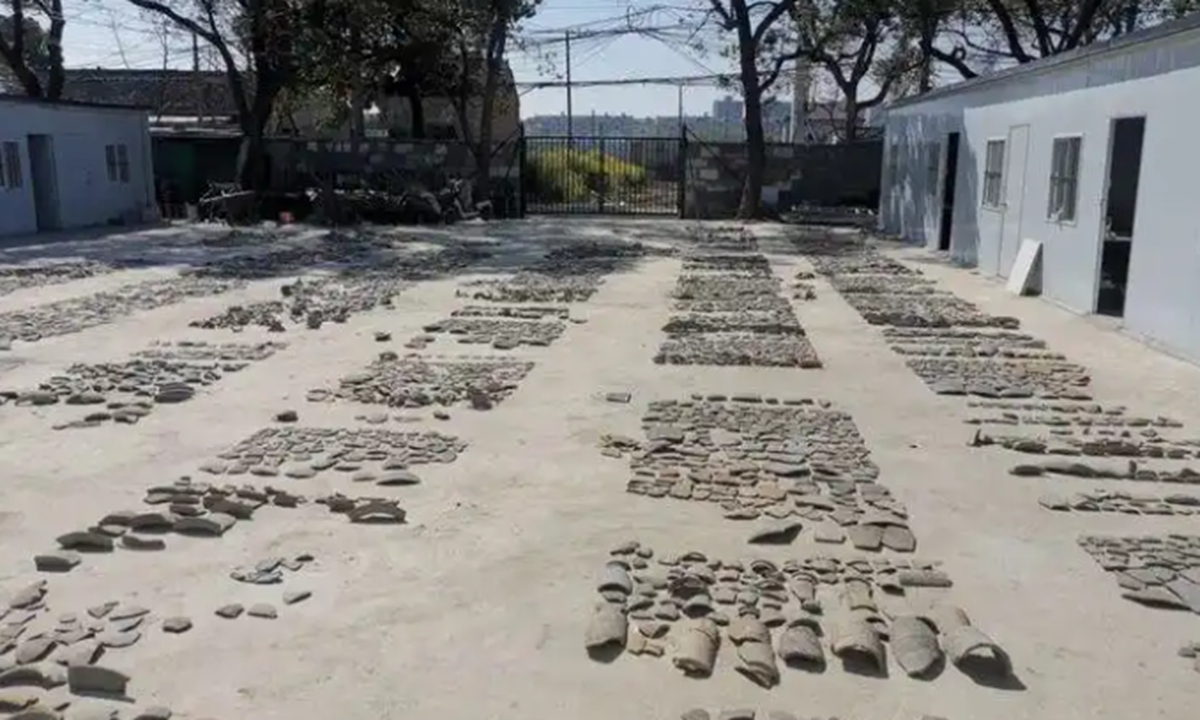
Photo: Courtesy of Suzhou Institute of Archaeology
Featuring relics such as ancient jar and eave tiles, known as wadang, pottery clusters have recently been excavated from three closely related archaeological sites in Suzhou, East China's Jiangsu Province.The three sites are the Jincheng Xincun Ruins, the Huntangxiang Bei Ruins and the Beiyuan Ruins. The more than 300 pieces of pottery objects include ancient daily-use items, as well as architectural remains such as flat tiles and pottery pipes.
The discoveries are significant for Qin Dynasty (221BC-206BC) historical research. The remains of high-grade ancient architecture, the remains indicate that the region around the Jingcheng Xincun site was "very likely" a major urban center during the Qin Dynasty, Cheng Yi, head of the Suzhou Institute of Archaeology, told the Global Times.
"More accurately, we believe that the government administrative center of the Qin period's Kuaiji county was built around the site," Cheng emphasized.
Three pottery artifacts that bear the stamped inscription "Wu Shi" have been unearthed from the Huntangxiang Bei Ruins and the Beiyuan Ruins. "Wu Shi," or "Wu Market," was a market in Wu county.
The engraved character shi [lit: market] was a mark used to identify a pottery workshop owned by the Qin imperial court. The mark served a function similar to today's product certification issued by the quality supervision department. A similar character was also found on pottery wares discovered in the Guanzhong region, the central area of Northwest China's Shaanxi Province.
"The discoveries of the 'Wu Shi' stamp reflects the effective and broad implementation of this handicraft marking system during the Qin Dynasty," Cheng noted.
He also added that the "Wu" character on the pottery from the Huntangxiang Bei Ruins and the Beiyuan Ruins shows different writing styles. The former uses typical Qin seal script, while the latter follows the calligraphic aesthetics of the Sixteen Kingdoms period (222-589).
"This difference provides an excellent example for studying how the 'Shutongwen' policy was implemented during the Qin Dynasty," said Cheng.
"Shutongwen," or "Writing the Same Script," was a policy implemented during the Qin Dynasty for unifying the different writing styles used throughout China at the time.
All three ruins are important for archaeological investigation into ancient Qin cities. The discovered relics are also the very first batch of Qin pottery wares that have been found in the Jiangnan region [the region south of the Yangtze River].
In addition to the discovery of a large number of pottery artifacts, bones from more than 10 species of animals such as water buffalo and deer, as well as northern species like cattle and horses have been unearthed from the Jincheng Xincun site.
"The presence of these northern animals indicates that people from the north had already settled and lived in this southern area for an extended period by the late Warring States Period [475BC-221BC]," Cheng noted.
RELATED ARTICLES