Japan’s maritime transport unit an attempt ‘to develop offensive operations,' experts warn
By Published: Apr 08, 2025 12:08 AM

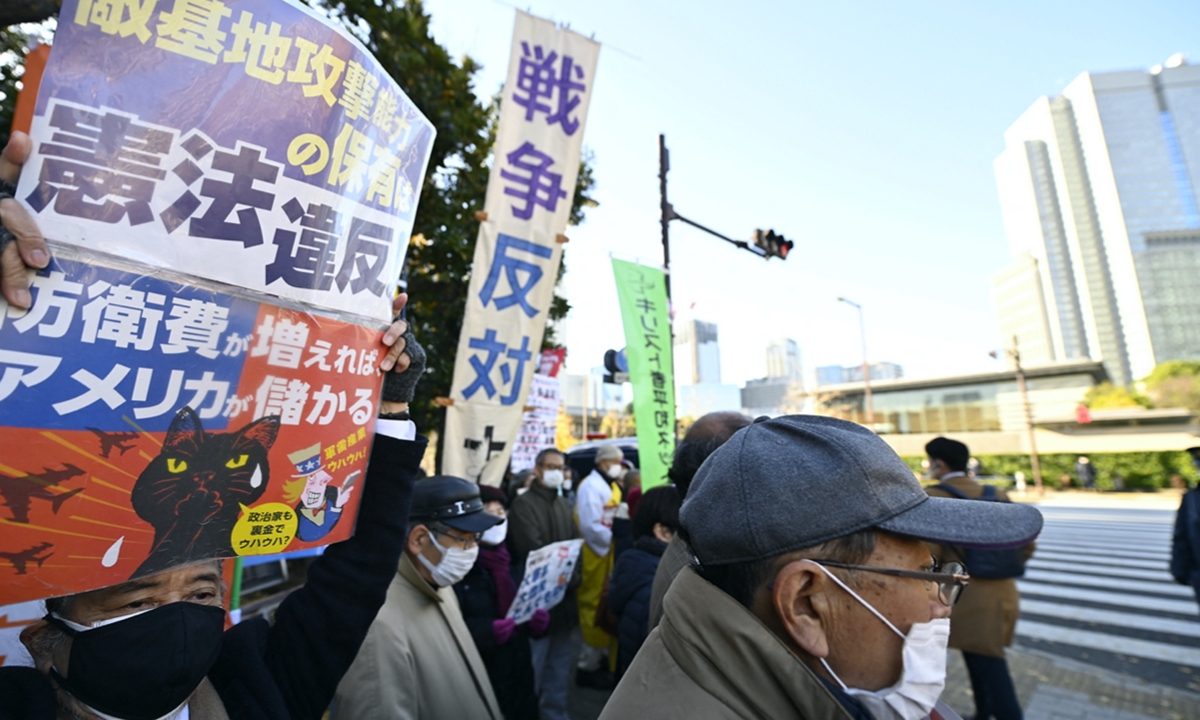
People gather outside Japanese Prime Minister Fumio Kishida's office holding placards denouncing the violation of Article 9 of the Japanese Constitution in Tokyo on December 16, 2022. They also oppose the increase in the military spending budget. Japan approved its biggest military buildup since World War II on December 16. Photo: AFP
Japan's Defense Minister Gen Nakatani pledged on Sunday to bolster the Self-Defense Forces' (SDF) transport capacity to remote southern islands through a newly launched unit called the Maritime Transportation Group, focused on maritime logistics citing so-called growing tensions over the Taiwan Straits, Japanese media outlet Kyodo News reported.
Some Chinese military affairs experts have criticized that despite the name tries to cover its true nature, calling the naming a self-deceiving word play, the move indicates an attempt of Japanese military to break the constitutional restraint.
Naming it this way is intended to obscure the fundamental shift in the capabilities of Japan's armed forces from self-defense toward offensive combat operations, the experts said, warning that Asian countries and the international community should stay alert over this trend.
The Maritime Transport Group is a joint unit of the Ground, Maritime and Air Self-Defense Forces. Most of the members are Ground Self-Defense Force (GSDF) personnel who are responsible for operating vessels that mainly transport GSDF equipment, Japanese media NHK claimed in a Sunday report.
The Japanese defense ministry plans to organize a total of 10 vessels, including small transport ships and high-speed boats, by the end of fiscal 2027 to enable docking at shallow ports and beach landings on remote islands, according to the Japanese media report.
Despite being officially named a "transportation group," the design and functionality of these ships clearly suggest amphibious landing capabilities. They can carry vehicles, troops, and equipment, essentially making them a landing fleet, Zhang Junshe, a Chinese military affairs expert, told the Global Times on Monday.
"The Maritime Transportation Group is specifically intended to enhance Japan's strategic deployment and amphibious warfare capabilities in the southwestern island chain, particularly in Okinawa and nearby islands such as Miyako, Ishigaki, and Yonaguni," Zhang said.
Media analysis also holds that Japan established the Maritime Transportation Group "with Taiwan contingency in mind."
This move represents a clear departure from the constraints of Japan's pacifist Constitution, especially its doctrine of "exclusive defense," and has raised significant concerns about Japan's expanding military ambitions in order to disrupt the stability of the Taiwan Straits, Zhang added.
Japan has recently established a Joint Operations Command, signaling a gradual alignment of its military and political structure with the US model, Song Zhongping, another military affairs expert, told the Global Times.
Japan activated a new military command that will take operational control of all three of its armed forces, as the country bolsters its defense posture amid rising regional tensions, the Stars and Stripes reported on March 24.
Japan's new command was initially expected to work closely with a US joint force headquarters in the country, but the future of that plan is unclear, according to the media report.
"The establishment of the so-called 'Maritime Transportation Group' reflects Japan's broader intention: to build a 'land-based amphibious force' rooted in the GSDF—primarily tasked with the transportation of troops and supplies," Song said.
While this force currently focuses on logistical and transport missions, its future trajectory is clear, Song noted. "Once Japan achieves what it calls 'military normalization,' this unit is likely to be transformed into a full-fledged amphibious combat force, enabling greater interoperability with US forces and paving the way for more advanced joint training and combined operations," Song added.
In response to China's recent joint exercises around Taiwan Island, Japan's Chief Cabinet Secretary Yoshimasa Hayashi said during a press conference on April 1 that the Japanese government has major concerns and is closely following the relevant situation. Japan has expressed its concerns to China through diplomatic channels.
Guo Jiakun, spokesperson of China's Foreign Ministry, said on Thursday that the Taiwan question is at the core of China's core interests, and bears on the political foundation of China-Japan relations and basic trust between the two countries.
Japan committed innumerable crimes during its colonial rule over Taiwan of more than 50 years, and bears serious historical responsibilities to the Chinese people. It should act all the more prudently, Guo said.
It is evident that Japan's so-called "Maritime Transportation Group" is not merely a logistical or transport-oriented unit, but rather a key component in building long-range power projection and offensive capabilities, Zhang noted.
As a nation that launched an invasion and was defeated in World War II, Japan is not supposed to develop offensive military forces. These recent moves not only challenge the post-war international order, but also pose a tangible threat to peace and stability in the Asia-Pacific region, Zhang said.
RELATED ARTICLES