Global spotlight on Beijing as humanoid robots run half marathon, garnering wide attention
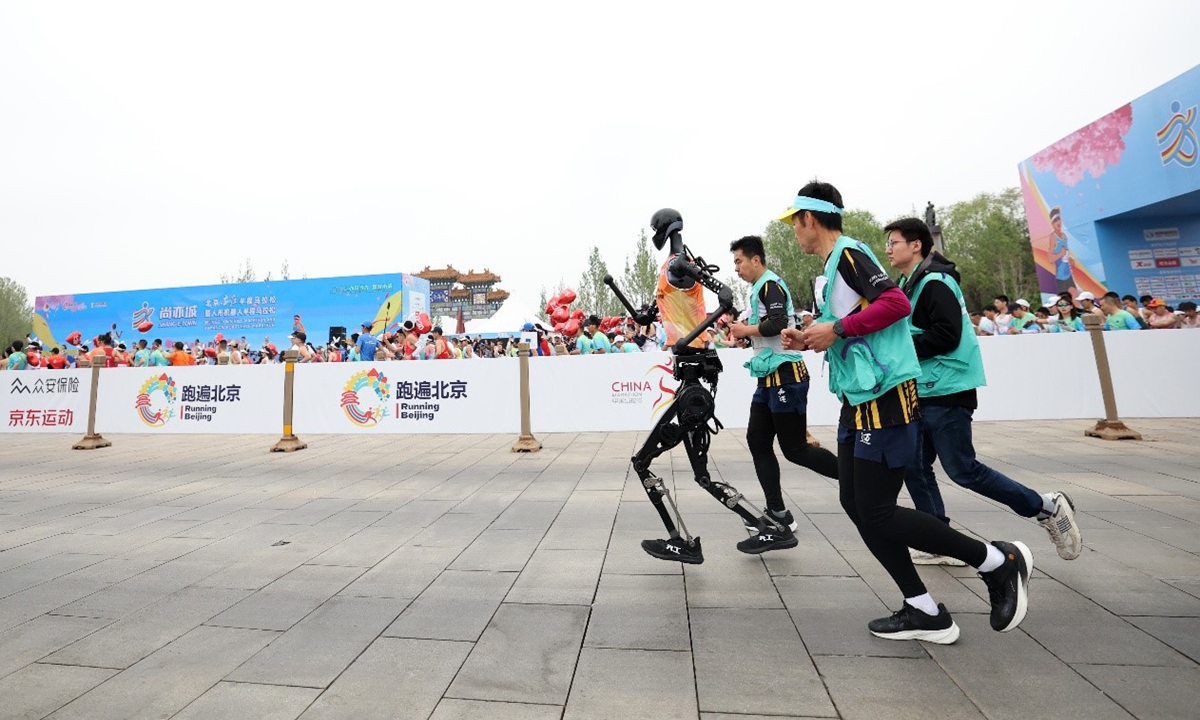
A humanoid robot races in the company of assistants at the humanoid robot half-marathon in Beijing on April 19, 2025. Photo: Courtesy of Beijing Innovation Center of Humanoid Robotics Co
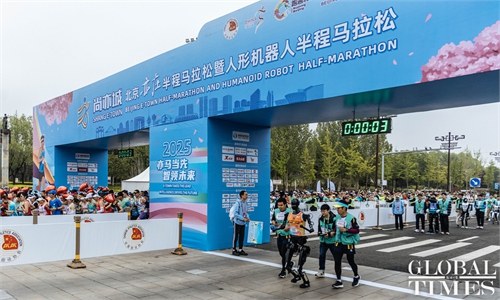
Beijing held the nation's first humanoid robot half marathon on Saturday. Although the race has concluded, buzz around the groundbreaking event continues to grow on Sunday, attracting widespread attention and sparking lively discussions among both domestic and international media as well as curious netizens.
The race featured an innovative "human-robot" co-run format spanning 21.0975 kilometers. A total of 20 humanoid robot teams from across China joined 12,000 human runners on the same course, blending technology and sport in a historic event, according to the Xinhua News Agency.
Among 20 competing teams, "Tien Kung Ultra" developed by the Beijing Innovation Center of Humanoid Robotics Co won the humanoid half marathon, crossing the finish line first with a time of two hours, 40 minutes, and 42 seconds.
Unlike typical humanoid robots that rely on handheld remote controls, "Tien Kung Ultra" utilized wireless navigation technology to perform guided tracking and long-distance path planning, the Securities Times reported.
Equipped with its own motion control algorithms and multimodal sensors, and combined with ultra-wideband wireless technology, the robot was able to track targets, calculate its position, and autonomously adjust its running direction and speed in real time - completing the journey from the starting point to the destination.
During the race, "Tien Kung Ultra" also used a quick battery swap system to ensure long-lasting performance, the report said.
The marathon garnered world attention with different opinions. The half marathon highlighted "China's drive to lead the global race in cutting-edge technology," AFP reported.
Times of India reported that "China's half-marathon makes history with the first humanoid robot race in a 21-kilometre racetrack," noting that "the competition attracted extensive coverage, showcasing advancements in humanoid robots and providing glimpses of future applications in other industries."
Singapore's Lianhe Zaobao claimed that although humanoid robots have rapidly advanced in recent years, they are still in the early stages of development. Being able to participate in a half-marathon marks a significant technological breakthrough, the report noted.
Other voices also emerged. CNN used a headline saying "Chinese robots ran against humans in the world's first humanoid half-marathon. They lost by a mile."
Of the 20 teams that took part in the robot marathon, only six finished the race. Regardless of whether the robot competitors finished or encountered unexpected challenges, the audience cheered them on enthusiastically, China Media Group reported.
On social media, clips of robots running into trouble, such as one whose head fell off and another that veered into the bushes, also went viral.
"China's humanoid robots have arrived!" an American podcaster who filmed the half marathon on site, wrote on X. "Some robots impressively soared by, some didn't make it, and some triumphed after setbacks," he said.
Liu Dingding, a veteran tech industry analyst who attended the competition in person, told the Global Times on Sunday that humanoid robotics is an extremely complex field involving contributions from many different sectors of industrial manufacturing.
He noted that the relevant technology is still in its early stages globally, which means mechanical issues remain common. For example, due to current limitations in battery life, several battery swaps were needed during the race to support the robots, which typically weigh dozens of kilograms, over a distance of several dozen kilometers.
"Even for those robots that completed the course, they did so only after multiple battery changes," Liu said.
In addition, because the race route was not a straight line, the robots had to make frequent directional adjustments along the way. This required accurate sensor-based navigation and strong support from both hardware and software systems, according to Liu.
"But overall, a race like this is very important and meaningful, as it shows developers not only how much they have achieved but also where improvements are still needed for future commercialization," Liu added.
During the 21-kilometer half marathon, humanoid robots faced prolonged running, uneven terrain, and unexpected challenges. This requires a high level of performance across multiple areas, including high energy-density integrated joints, effective heat dissipation for the robot's body, robustness of motion control algorithms, and the overall efficiency of the energy system, according to a statement sent to the Global Times by the developers of "Tien Kung Ultra."
The marathon served a comprehensive test of humanoid robots' performance in real-world conditions. In the future, the upgraded "Tien Kung" will not only have strong mobility but also capabilities like natural interaction, precise task planning, coordinated arm movements, and multi-skill execution. According to the "Tien Kung" developer, it could be deployed across manufacturing, logistics, specialized operations, and even home settings such as elderly care - offering greater convenience and support in daily life.
"I am sure there will be more of such events which will greatly push the robot technology forward. I strongly believe that the robot industry will be a replay of the solar or EV industries. The fierce competition will generate the most formidable players," a netizen commented on X.
As of July 2024, China held over 190,000 valid patents related to robotics, accounting for approximately two-thirds of the global total, according to China's Ministry of Industry and Information Technology.
RELATED ARTICLES