stock market Photo:VCG
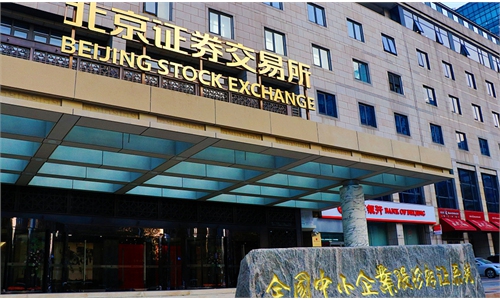
About 5,400 companies listed on China's Shanghai, Shenzhen and Beijing stock exchanges have reported first-quarter results, with more than 70 percent posting a profit. An analyst said on Sunday that listed companies' better-than-expected financial performance underscores their high-quality development and sends more positive signals about new progress in the Chinese economy.Chinese listed companies generated combined first-quarter profits of 1.49 trillion yuan ($205.89 billion), up 3.64 percent year-on-year, the Xinhua News Agency reported over the weekend.
About 50 percent of listed companies spent more on research and development (R&D), with "attaching importance to R&D" and "increasing R&D investment" frequently mentioned by STAR Market-listed companies.
Companies also reported the continuous unleashing of domestic demand amid policies to vigorously boost consumption, stimulate domestic demand across the board, and increase spending power by raising earnings and reducing financial burdens. For instance, home appliance conglomerate Midea Group said that its total revenue grew by 20.6 percent year-on-year to 128.4 billion yuan, with net profit surging 38 percent to 12.4 billion yuan, according to its filing with the Shenzhen Stock Exchange.
"The financial performance of listed companies is generally seen as a barometer of the economy. Overall, the better-than-expected earnings of many listed companies showcases market vitality as well as the strong momentum of China's economy," Xi Junyang, a professor at the Shanghai University of Finance and Economics, told the Global Times on Sunday.
Amid measures to expand domestic demand and boost the development of new quality productive forces, relevant listed companies are expected to post sound financial results for the rest of the year, Xi said.
In recent years, an increasing number of companies in strategic emerging industries have been listed in the A-share market, underscoring the contribution of the capital market to the country's high-quality development, Xi said.
The People's Bank of China (PBC) announced on Wednesday that it will combine the quotas of its two monetary policy tools to support the capital market. The Securities, Funds and Insurance Companies Swap Facility, with an initial scale of 500 billion yuan, and the re-lending facility of 300 billion yuan that supports stock buybacks and shareholding increases, will operate under a shared quota of 800 billion yuan, according to the PBC.
"The central bank's move sends a positive signal to the market and will help strengthen market confidence and stabilize expectations," Tian Xuan, president of the National Institute of Financial Research of Tsinghua University, told the Global Times.
By combining the quotas of its two monetary policy tools, the authorities could better allocate capital to meet the demand of various types of financial institutions, improve market liquidity and flexibility as well as the efficiency of capital utilization so as to maintain financial market stability and boost the development of the real economy, Tian said.
He said that supportive measures aimed at promoting the issuance of sci-tech innovation bonds will broaden the financing channels for sci-tech firms and equity investment institutions, effectively lower the financing threshold and cost for sci-tech firms, spark innovation vitality and boost the transformation and upgrading of the economic structure.
Amid the strong resilience of the Chinese economy and policy measures to stabilize the market, some foreign financial institutions have become increasingly upbeat on Chinese stock markets.
"We are mildly overweight on Chinese equities, with a preference for China's Innovation Champions, especially AI enablers and adopters," HSBC Global Chief Investment Officer Willem Sels wrote in a recent note.
RELATED ARTICLES