ARTS / CULTURE & LEISURE
Tracing Shanxi’s architectural wonders at Guangsheng and Xiaoxitian temples
Beyond ‘Black Myth: Wukong’
By Published: May 15, 2025 10:11 PM Updated: May 16, 2025 09:08 PM

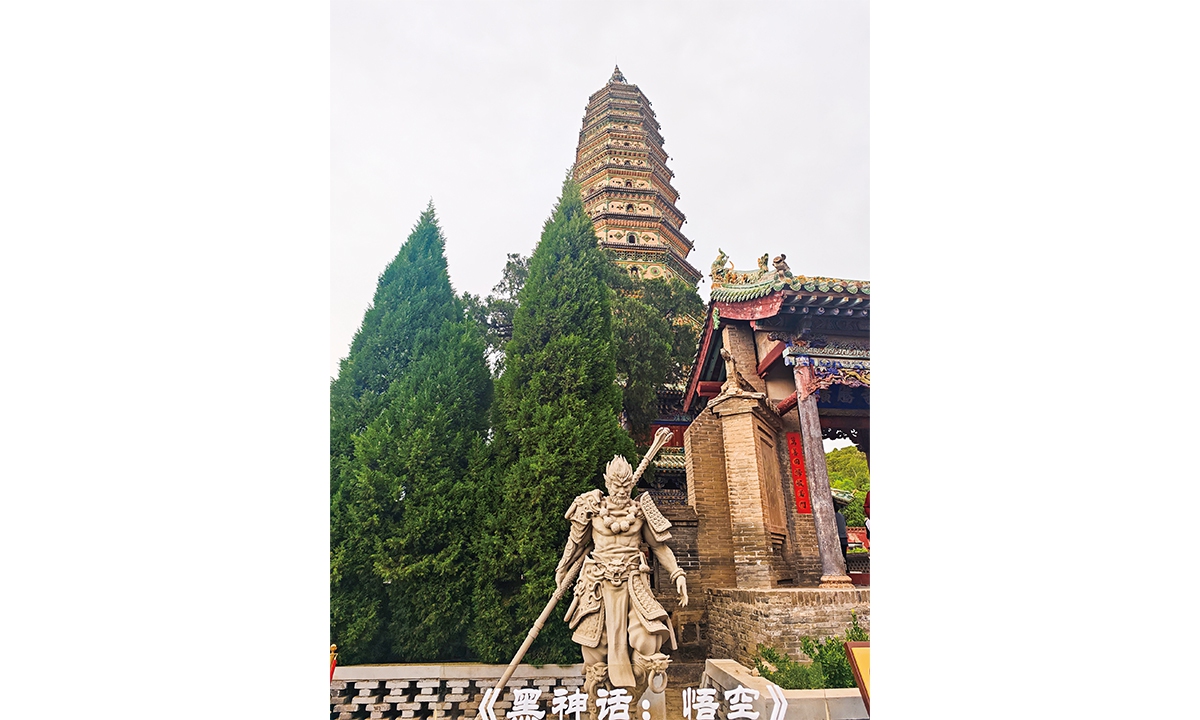
An exterior view of Guangsheng Temple in Linfen, North China's Shanxi Province Photo: Chen Xi/GT
Travelling through North China's Shanxi Province feels like stepping into a living history book where ancient temples and exquisite artworks whisper tales of bygone times.As a Global Times reporter, my recent exploration of Shanxi's architectural gems began with Guangsheng Temple and Xiaoxitian Temple, both of which have gained fame as filming locations for the popular game Black Myth: Wukong. However, the profound historical depth and artistic beauty I discovered there far exceeded my expectations.
Guinness-record splendor
Upon arriving at Guangsheng Temple, the first sight that greets visitors is the majestic Feihong Pagoda, a 13-storeied colorful glazed Pagoda that seems to pierce the heavens, standing tall among the mountains.
Founded in the Eastern Han Dynasty (25-220), Guangsheng Temple has weathered dynastic collapses and natural disasters, including two major earthquakes. Its current structures, dating to the Yuan and Ming dynasties (1279-1644), form a trinity - the Upper Temple, Lower Temple, and Water God Temple.
After a five-minute shuttle bus ride up the winding mountain roads, I reached the Upper Temple. There, the 47.31-meter-tall pagoda delivered a much more powerful visual impact. While its most striking feature is the diverse array of glazed components covering its entire surface.
Stepping onto the bluestone slabs and entering the temple, my camera lens repeatedly focused on the eaves' statues of the iconic pagoda.
The delicate and exquisite glazed brackets, along with components like coiled dragons, birds and beasts, are vividly life-like, causing visitors to stop and admire the mesmerizing ancient art.
As sunlight bathes the pagoda, it sparkles like a jewel, earning it a Guinness World Record as the world's tallest colored glazed pagoda.
A guide explained the miracle: "This pagoda danced through two magnitude-8 earthquakes. The secret? A 'zigzag' staircase inside - like a folded paper fan - that absorbs shocks."
I ran my hand over the bricks, imagining Ming artisans mixing clay and crushed gemstones to create these immortal hues.
Beyond the pagoda, Guangsheng Temple boasts more treasures.
Walking to the Water God Temple adjacent to the Lower Temple, I entered a dimly lit hall and spotted a visitor from Beijing using an advanced camera to photograph the murals on the walls.
That's when I clearly noticed the exquisite Yuan-dynasty opera murals.
These murals in the Water God Temple are the only ones in ancient Chinese temples not depicting Buddhist or Taoist themes.
The central parts of the east and west walls feature rain-praying and rain-sending paintings depicting water-realm deities, while the rest showcase historical stories, social figures, and scenes of daily life.
In fact, the murals in Guangsheng Temple are not limited to those in the Water God Temple.
The rear hall of the Lower Temple once housed several grand murals as well. However, two magnificent murals now housed in American museums due to some bitter historic reasons.
Looking at the empty walls from the Lower Temple, many visitors couldn't help but feel a sense of sorrow. This reminded me of the experience at the well-known Dunhuang Mogao Caves, where stolen murals now reside overseas.
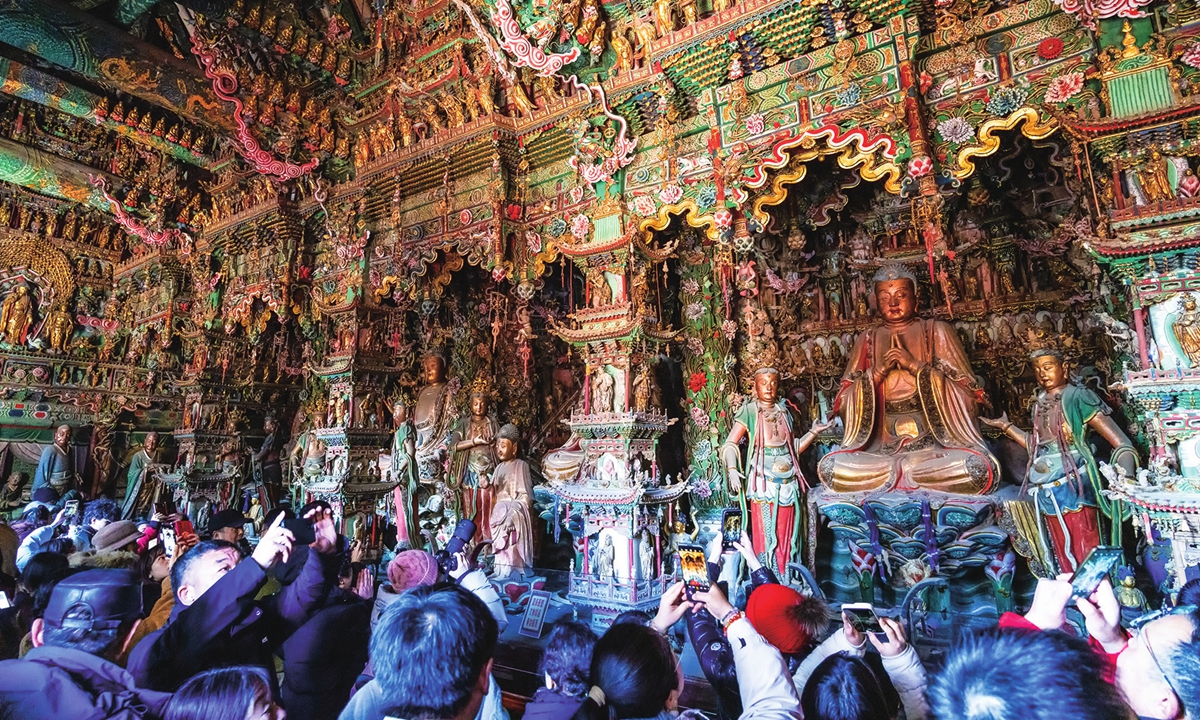
Tourists take pictures at Xiaoxitian Temple in Linfen, North China's Shanxi Province. Photo: VCG
A miniature heavenAfter a two-hour drive from Guangsheng Temple, I arrived at Xiaoxitian Temple, a Ming-dynasty Buddhist complex renowned for its extraordinary, suspended sculptures.
Despite hearing about the crowds drawn by its association with the game Black Myth: Wukong, the moment I stepped into the Mahavira Hall, I was spell-bound.
The entire space is a three-dimensional Buddhist world, with over 1,600 colored sculptures adorning every beam, wall, and ceiling.
Within a compact area of just 169.6 square meters, the sculptures range from towering 3.2-meter-tall figures to delicate pieces the size of a thumbnail, all well-arranged to avoid chaos.
The five-directional Buddhas, the 10 great disciples, the six young monks, and various other figures and scenes from Buddhist scriptures are all present, creating a harmonious and awe-inspiring atmosphere.
What sets Xiaoxitian apart is not just its artistic brilliance but also its unique architectural layout.
Covering an area of 1,100 square meters, the temple complex features two-story buildings arranged in a way that resembles a phoenix looking down from the sky. This layout combines the traditional temple structure with the charm of garden architecture, offering visitors a sense of spaciousness despite the limited space.
During my visit, I met an architecture enthusiast from southern China who was examining the sculptures with a magnifying glass.
"I had seen these in picture books but seeing them in person is an entirely different experience. These are truly treasures of Eastern sculptural art," he exclaimed.
One staff of the scenic spot told me that after the release of the game Black Myth: Wukong, the ticket orders for Xiaoxitian Temple once surged by 236 percent.
But as more visitors come here, their purpose of visiting this place is no longer just to check in at the game filming location. Instead, they genuinely appreciate the beauty of traditional Chinese architecture.
These centuries-old buildings and sculptures, with their unique charm, have become important windows for people to experience and connect with China's rich cultural heritage.
This journey through Shanxi Province's ancient architectural wonders has made me think that the best way to protect history is to keep it alive. It's a reminder of the incredible skills and artistic vision of ancient craftsmen, whose works continue to inspire and amaze people from around the world.
RELATED ARTICLES