Putin, Trump absent from Russia-Ukraine scheduled meet
Absence suggests relevant parties’ low expectation for talks, no substantial result likely in short term: experts
By and Shen Sheng Published: May 15, 2025 11:00 PM

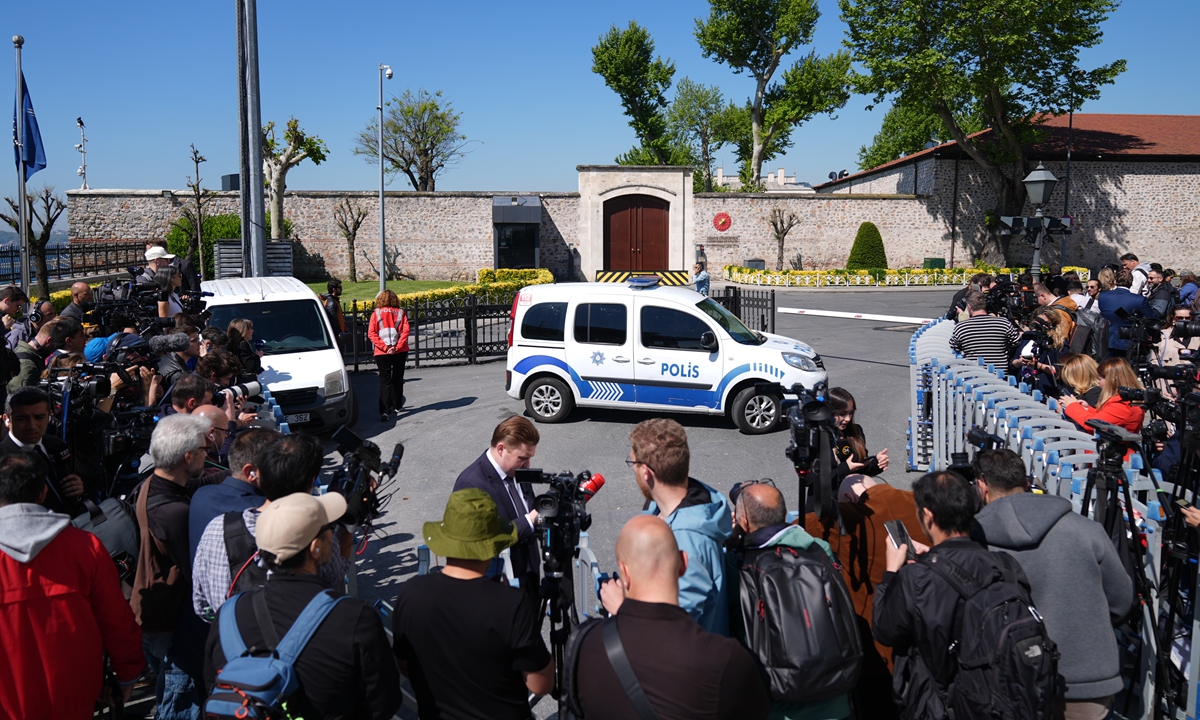
Journalists gather at the entrance to the Dolmabahce Palace in Istanbul, Turkey. The first direct talks between Russian and Ukrainian delegations in three years are expected to take place on May 15 at the same place as in 2022, in the working office of the Turkish presidential administration in downtown Istanbul. Photo: IC
Delegations from Russia and Ukraine were scheduled to sit down on Thursday in Istanbul for their first high-level face-to-face talks since 2022. Russian President Vladimir Putin was not on the Russian delegation list published by the Kremlin, and US President Donald Trump, who previously said he may also join the summit in Istanbul, also did not turn up.
Chinese experts said that the absence of both Putin and Trump signals the relevant parties' low expectations for the talks, which are unlikely to yield substantial results in the short term.
Putin on Wednesday approved the composition of the Russian delegation for upcoming talks with Ukraine, according to a Kremlin statement, Xinhua News Agency reported.
The delegation will be led by Russian Presidential Aide Vladimir Medinsky and include Deputy Foreign Minister Mikhail Galuzin; Igor Kostyukov, chief of the main directorate of the general staff of the Russian army; and Russian Deputy Defense Minister Alexander Fomin.
Medinsky led previous rounds of failed negotiations with Ukraine in early 2022, according to media reports.
The team of Russian negotiators arrived in Istanbul on Thursday for the first direct peace talks with Ukraine in more than three years, Russia's Foreign Ministry confirmed, adding that the officials were "ready for serious work."
Ukrainian President Volodymyr Zelensky on Thursday said Kiev sent a delegation of the highest level to Turkey to hold the first direct talks with Moscow in over three years, according to AFP.
"Our delegation is at the highest level the ministry of foreign affairs, the office of the president, the military, our intelligence agencies... in order to make any decisions that can lead to just peace," Zelensky said after landing in Ankara, AFP reported.
However, citing Turkish foreign ministry sources, the BBC reported that no meeting was confirmed yet as of noon local time on Thursday. A source told CNN that Zelensky is sending a delegation to Istanbul, but the Ukrainian leader opted against flying there himself after Russian President Putin decided not to come to the meeting.
After the Kremlin's delegation announcement, a US official said Trump, who is on a three-nation tour of the Middle East, would not attend. The US leader had said earlier that he was considering the option to participate, according to Reuters.
Later, the BBC reported that Trump said he might still go to the potential Russia-Ukraine peace negotiations in Istanbul on May 16 if there is progress toward a deal.
Kiev hopes to enhance its bargaining position at the negotiation table through increased pressure from the US on Russia. Meanwhile, Russian delegation signals its willingness to engage in talks without appearing to be overly passive, Cui Hongjian, professor of the Academy of Regional and Global Governance at Beijing Foreign Studies University, told the Global Times.
Putin's decision not to attend in person also shows that Russia does not wish to elevate the talks to the highest level, avoiding a potential "direct clash" and leaving room for maneuver in future negotiations, said Yang Jin, an associate research fellow with the Institute of Russian, Eastern European and Central Asian Studies at the Chinese Academy of Social Sciences.
Western pressure
On May 10, French President Emmanuel Macron, German Chancellor Friedrich Merz, UK Prime Minister Keir Starmer and Polish Premier Donald Tusk visited Kiev where, during talks with the Ukrainian side, they proposed a 30-day ceasefire beginning on May 12, according to Russia's Tass.
Speaking to reporters in the Kremlin in the early morning hours on May 11, Putin proposed to Kiev the resumption without any preconditions of the direct talks they had interrupted at the end of 2022. He suggested launching the negotiations in Istanbul on May 15.
This round of talks is not initiated on the basis of the full preparation and volition of both Russia and Ukraine, but facilitated by external pressure, especially the joint promotion of the US and Europe, Cui said.
The absence of both Putin and Trump suggests that all parties have limited expectations for the negotiations. As a result, it is unlikely that discussions regarding Russia and Ukraine will yield substantial outcomes in the short term. This round of talks, Cui said, is more about symbolic gestures and technical discussions.
European and US officials, including US Special Envoy Steve Witkoff, reportedly convinced Zelensky that attending the peace talks would reflect positively on Kive. He argued that if Ukraine attended the talks and Russia didn't, the Kremlin would appear to be unserious about a peace deal. If both sides showed up, there could be an opportunity to make a meaningful ceasefire agreement, according to Washington Post.
Moreover, the European Union agreed to impose a new round of sanctions against Russia on Wednesday, threatening to slap on another one if the country continues to refuse the 30-day unconditional ceasefire proposed by the White House and the "Coalition of the Willing."
China and Brazil issued a joint statement on the Ukraine crisis on Tuesday. The statement said China and Brazil welcome Russian President Vladimir Putin's proposal to start peace talks and Ukrainian President Volodymyr Zelensky's positive response.
Putin had a telephone conversation with Brazilian president Luiz Inacio Lula da Silva on Wednesday while the Brazilian special flight made a technical stop in Moscow on its way from China.
Putin expressed gratitude to the authorities of Brazil and China for their sincere willingness to contribute constructively to the search for solutions to the conflict, according to a readout published by the Kremlin.
Cui said that the joint statement issued by China and Brazil at this juncture represents the majority voice of the Global South, which is calling for a just and sustainable political resolution.
RELATED ARTICLES