ARTS / CULTURE & LEISURE
Exhibitions spotlight ancient Chinese and Syrian civilizations
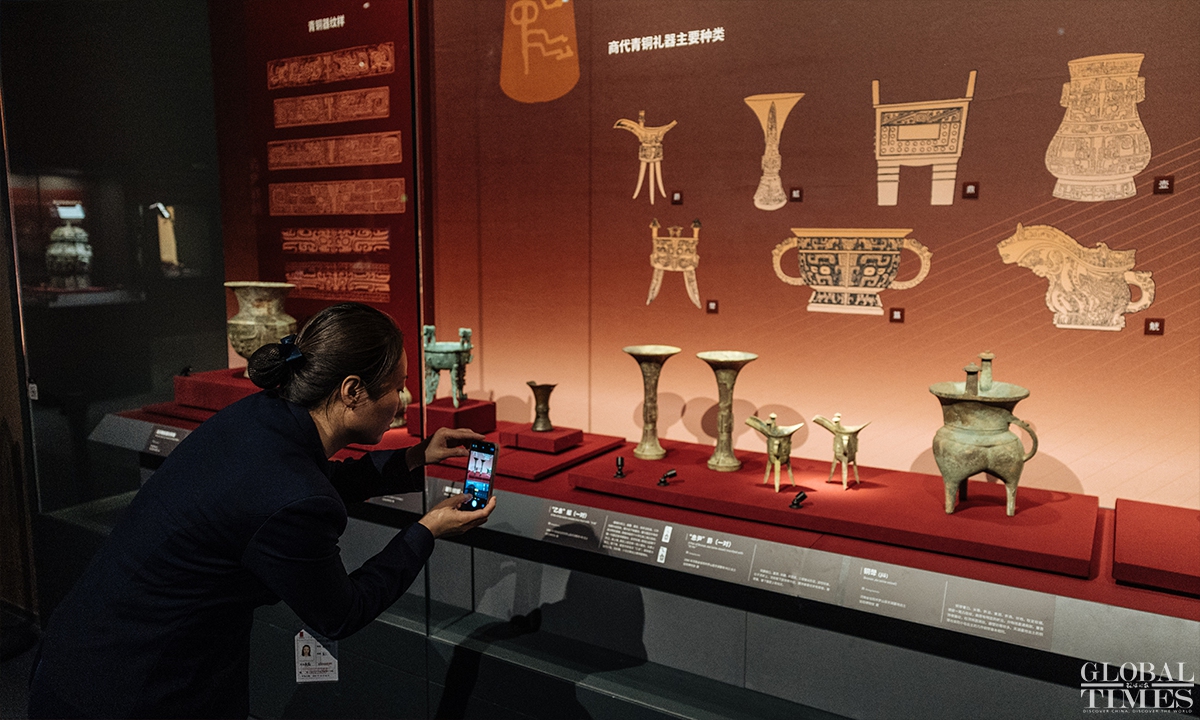
Photo: Li Hao/GT
Thanks to International Museum Day, two major exhibitions spotlighting ancient Chinese and Syrian civilizations are opening this month in Beijing, Ganzhou and Huzhou. Featuring hundreds of rare relics, the exhibitions give visitors the chance to witness the long and complex journey of these civilizations.In Beijing, a blockbuster exhibition titled This is the Shang: Exhibition Series on the Origins of Chinese Civilization opens on Monday at the Grand Canal Museum of Beijing (Capital Museum East Branch). Described as the largest display of Shang Dynasty (c.1600BC-1046BC) culture in recent years, it features 338 artifacts from 28 institutions across China, including over 50 first-grade national treasures.
From oracle bones to bronze owls, the exhibition unfolds the rise of Shang civilization in four parts, revealing its royal lineages, daily life, spiritual beliefs, and pivotal role in shaping Chinese civilization.
A curatorial highlight is the reunion of a pair of legendary bronze owl-shaped wine vessels and a pair of rare bronze axes, brought together for the first time in 50 years. Gao Hongqing, the curator of the exhibition, explained that the Shang people had a deep connection with birds - especially owls.
"Why birds appear so prominently in Shang culture is still an open question," he told Global Times on Sunday. "We see them in bronze, we see them in inscriptions, we even see them paired, as if in conversation."
Gao highlighted the discovery of bronze artifacts such as the owl-shaped wine vessels and pieces depicting two owls sitting face to face, as well as bird-like characters in bronze inscriptions, noting that they all provide compelling evidence for understanding how the Shang people perceived birds and possibly interacted with animals.
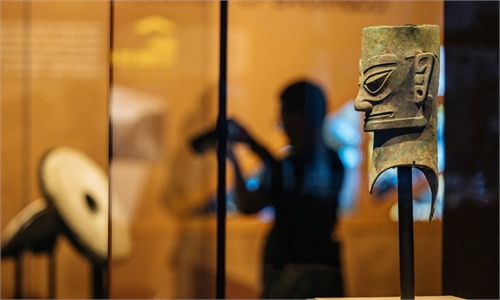
Blending high-tech immersion with historical awe, the exhibition also offers visitors a chance to walk the ancient Shang capital through VR, complete with motion-sensing floors and scent systems. One special feature includes a pop culture twist: props from the hit animation film Ne Zha 2 are matched with their real-life archaeological prototypes, like a bronze human-head statue with a gold mask from Sanxingdui, which inspired the film's guardian beasts.
While Beijing looks inward to explore China's ancient roots, two other cities - Ganzhou, East China's Jiangxi Province, and Huzhou, East China's Zhejiang Province - turn outward, spotlighting a different cradle of civilization: Syria.
The Face of Civilization and The Code of Civilization exhibitions, both branches of the Ancient Treasures from Syria project, opened last week in southern China. The two feature nearly 100 artifacts from eight Syrian museums, alongside contributions from Chinese institutions such as the Dunhuang Academy. Together, they trace a vivid cultural lineage from Paleolithic stone tools to Roman sculptures and Islamic ceramics.
The exhibits echo Syria's history as a vital crossroads of Africa, Asia, and Europe - a place where trade, warfare, and faith intermingled for millennia. One standout piece is The Woman in the Window, an Iron Age sculpture that captures both the anonymity and intimacy of ancient daily life. Others, like mosaic panels and terracotta warriors from the Assyrian and Persian eras, reflect the layered complexity of Syrian identity.
These exhibitions are the latest stops in a touring partnership between China and Syria that began in 2021, marking the 65th anniversary of diplomatic ties. That first show, delayed for months due to logistical challenges and border conflicts in Syria, eventually opened in Shenzhen in August 2021. "All the waiting was worth it," said Qi Xin, director of Nanshan Museum, which hosted the exhibition.
Since then, the exhibition has traveled to more than 10 cities across China. A Syrian influencer attending one of the shows noted that he was touched, saying "I've never thought a country is willing to spread and exhibit the history and culture of another country."
"Across cities and centuries, these parallel exhibitions offer more than beauty, they offer dialogue, resilience, and shared human legacy. On this International Museum Day, that message feels especially urgent," Liu Zheng, a member of the Chinese Society of Cultural Relics, told the Global Times.
RELATED ARTICLES