SPORT / BASKETBALL
Zhejiang Lions’ triumph could herald shifting focus on youth player cultivation
Youthful power prevails
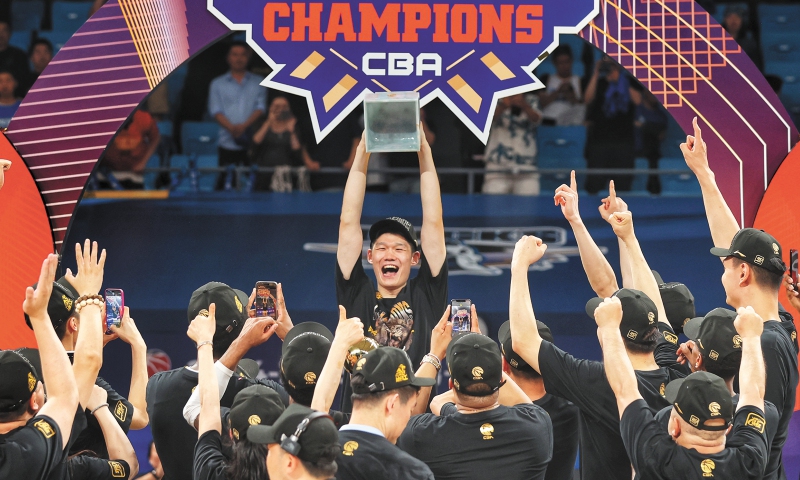
The Lions' Hu Jinqiu lifts the CBA trophy with his teammates celebrate for their win. Photo: Cui Meng/GT
Wearing shoes that bore the words "2024-2025 CBA Champion," dejected Sun Minghui kicked the ball up high after his team, the Zhejiang Lions, lost a home match, which could have initiated a celebration at home on Saturday.Sun was fined 30,000 yuan by the Chinese Basketball Association (CBA) for his unruly behavior. But his quest for the championship did not let him wait for too long.
Along with his teammates, the Lions weathered the storm to hold off the Beijing Ducks to win 4-2 on aggregate and clinch the CBA championship on Tuesday in Beijing, making the Zhejiang-based club the eighth team to win a CBA championship.
"This is my 10th year in the league, and I've finally achieved my dream. It's been a tough journey, but I've had a lot of brothers supporting me, and everyone has been very united," Sun said after Tuesday's match.
"Winning the championship is just the first step. Our team will go on even further [to win more titles] in the future," he added.
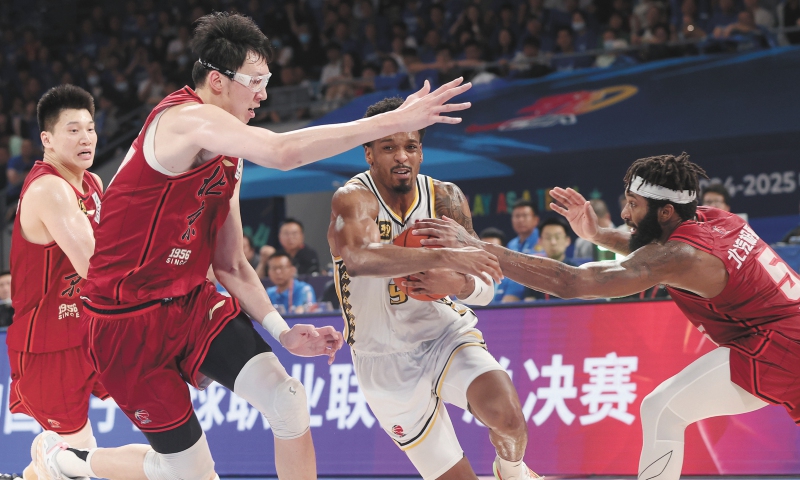
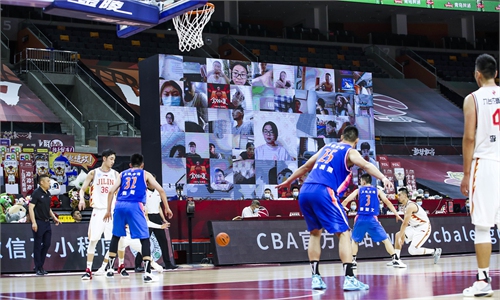
Barry Brown of the Zhejiang Lions (white) dribbles with the ball against the Beijing Ducks in Beijing during the sixth game of the best-of-seven CBA Finals on May 20, 2025. Photo: Cui Meng/GT
Homegrown champions
Sun's teammate, Hu Jinqiu, burst into tears after the win. The 27-year-old center, who joined the club in 2012, has been considered a cornerstone for the team thanks to his solid performance.
Both Sun and Hu are homegrown players from the Lions, as the club, founded in 2005, focuses on cultivating its own stars through youth training system rather than signing high-profile players.
Statistics from the governing body show that 16 of the Lions' first-team players are home-grown, while the team's domestic players are aged 22.6 years old on average this season, according to the CBA.
In terms of contributing youth players to the CBA league, the Lions have offered 24 players, the second-highest from a single club in the 20-team league.
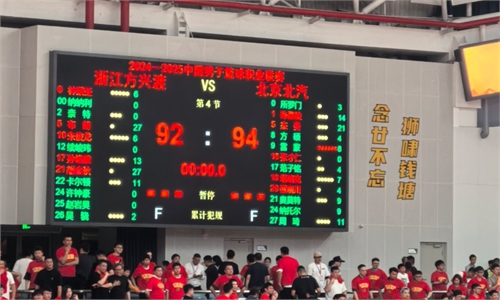
The Lions, playing their third CBA Finals this season, initially took a 3-1 lead in Saturday's games but did not have a home court celebration on that day after being denied by the Ducks 94-92.
"The psychological pressure on everyone during Saturday's game was indeed enormous. The players really struggled to control themselves," the Lions head coach Wang Bo said.
"I think this game fully demonstrates that our players have learned to believe in themselves and their teammates. They are able to surpass themselves and overcome their psychological burdens."
Previously, the Lions qualified in the Finals in the 2017-18 and 2021-22 seasons, but the results were bitter for the club as they were thrashed 4-0 by the Liaoning Flying Leopards twice.
En route to the finals this year, they met the Flying Leopards again. But the result shifted to a 3-0 win for the Lions.
Wang, a former Lions player who helped the team qualify for the CBA playoffs in 2009-10 and 2010-11 seasons, attributed his team's rise to his "mentally mature" players.
"After experiencing the ups and downs of some games in previous years, I think everyone's mentality has been particularly mature this year," Wang told reporters after the win.
Before facing Liaoning in the semifinals, the Lions had been trailing 2-1 behind the Qingdao Eagles, who finished the regular season in eighth place. But the Lions managed to bounce back to win the best-of-five semifinals 3-2.
"We were a bit lax against Qingdao, and we really found ourselves on the edge of a cliff," Wang noted about the team's near early elimination.
"But on the other side, players also benefited from trailing behind. Their stress tolerance, mental resilience, on-court decision-making and teamwork have become increasingly mature and better."
Gun for future
The Lions' success this season could herald some changes in the CBA, analysts said, especially for clubs that can't afford to sign high-profile star players.
The Lions' neighbors in East China's Zhejiang Province also feature young player-dominated squads.
Yiwu-based Zhejiang Golden Bulls made it to the CBA runners-up in the 2022-23 season, while Ningbo-based Ningbo Rockets, a club derived from the dissolved eight-time CBA champions Bayi Rockets, surprised many by defeating league giants the Shanghai Sharks twice.
Such teams, primarily comprised of young players, especially after the Lions' league win, could force other clubs to consider whether it is more efficient to develop their own squads, Zhang Bin, a Beijing-based sports commentator, told the Global Times.
"The success of the Lions has confirmed the long-term value of investment in youth training. Since its establishment in 2005, the club has built a pyramid youth training system, investing hugely in talent development," Zhang said.
"This continuous talent cultivation mechanism has achieved remarkable results such as Hu, Sun and (forward) Zhu Junlong, who all graduated from its youth academy."
Cao Yaqi, a vice-editor-in-chief of Titan Sports newspaper, told the Global Times on Wednesday that the growth of Lions players could also benefit the Chinese national team.
"The growth of Lions players could also benefit the Chinese men's basketball team's preparation for the FIBA Asia Cup this year," Cao said, referring to the intra-continental basketball tournament, which will kick off in August this year.
"The Lions trio of Hu, Sun and Zhu could offer the national team a framework, with Sun's speed and organizational skills being regarded as key supplements to address the shortcomings in the guard line, while Hu and Zhu could be the pivots in the team's offensive and defensive transitions," Cao said.
RELATED ARTICLES