China's massive transport system supports 640 million inter-regional passenger trips in 2024: Ministry of Transport
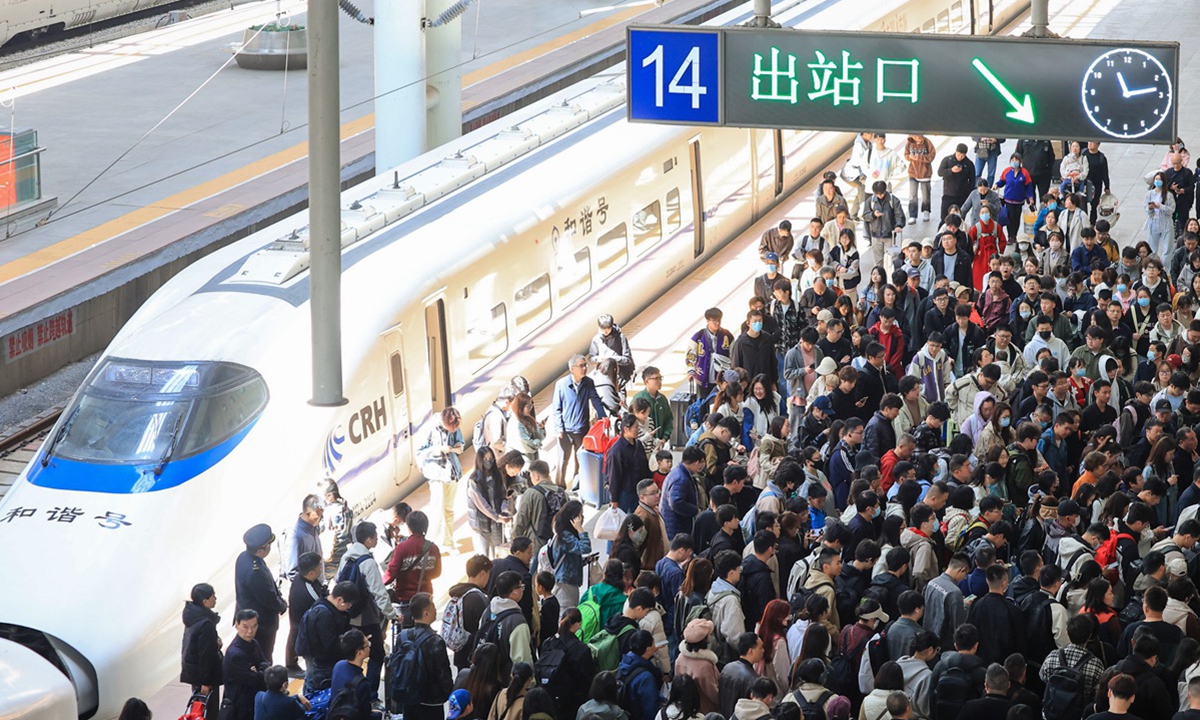
Passengers arriving in Nanjing Railway Station prepare to exit on April 6, 2025, the last day of the Qingming Festival holiday. The national railway system welcomed a peak in return travel, with an estimated 20 million passengers expected to be transported. Photo: IC
China's massive transport system consisting of rail, road, air and water ways handled 640 million inter-regional passenger trips, averaging 180 million trips per day, marking a 5.4 percent growth year-on-year, according to the 2024 China Transportation Industry Statistical Bulletin released by China's Ministry of Transport (MOT) on Thursday.
Freight transport also improved in efficiency and fluidity. Total business-related freight volume reached 56.9 billion tons. Among them, daily volume of commercial freight reached about 160 million tons, a year-on-year increase of 3.9 percent. Ports handled an average of 48 million tons of cargo and 900,000 TEUs daily, growing by 3.7 percent and 7.0 percent, respectively. The daily volume of postal delivery services also reached about 530 million items, a surge of 19.2 percent.
The China-Europe Railway Express surpassed 100,000 trips, while the annual number of sea-rail intermodal services on the new western land-sea corridor expanded its reach to 10,000 train services.
In the road transport, over 6,500 customized passenger routes have been launched. Additionally, there are now 12,700 rural passenger and freight-post cooperation routes. The on-time performance rate of civil aviation flights reached 87.1 percent, marking the seventh consecutive year above 80 percent.
In 2024, the total passenger volume reached 730 million, an increase of 17.9 percent from a year earlier.
The total passenger turnover amounted to 1,291.5 billion person-kilometers, a growth of 25.3 percent. Domestic routes accounted for 665 million passengers, up by 12.6 percent, including 9.5808 million passengers on routes to and from Hong Kong and Macao special administrative regions and the Taiwan island, marking a surge of 43.3 percent. International routes saw 65.55million passengers, an increase of 125.6 percent.
In 2024, the total port cargo throughput reached 17.595 billion tons, marking a year-on-year increase of 3.7 percent. Notably, the throughput of foreign trade goods increased by 6.9 percent to 5.397 billion tons, and that of domestic trade goods rose by 2.3 percent to 12.198 billion tons. The container throughput amounted to 332 million TEUs, up 7.0 percent year-on-year.
"As key indicators of the transport sector are one of the important references for economic development, the sector's performance in 2024 showed that China's economy maintained stability with vitality," Cong Yi, a professor at the Tianjin School of Administration, told the Global Times on Thursday.
Cong said that accelerating infrastructure construction will generate a multiplier effect. On the one hand, it will provide a solid material foundation for strengthening cross-regional communication; on the other hand, it will drive the development of many related industries, including the logistics sector.
Despite external pressures and internal challenges, China's transport sector made remarkable progress—advancing infrastructure, upgrading equipment, and improving services to build a stronger, globally competitive network. According to the MOT in a statement on its website on Thursday, the past year has seen notable achievements in infrastructure development, equipment upgrades, and service improvements, contributing to the nation's ongoing efforts to become a global transportation powerhouse.
A key takeaway from the report is the continuous building of a modern transportation network. In 2024, China completed a total of 3.8 trillion yuan in fixed asset investment in transportation sector, maintaining a high level of development.
The report highlights that the main framework of the national comprehensive 3D transportation network, referred to as the "6 Axes, 7 Corridors, and 8 Channels," has achieved remarkable progress. It now spans a total length of around 260,000 kilometers, with an investment completion rate reaching 90 percent.
New railway lines totaling 3,113 kilometers were put into operation, while highway mileage extended by 53,500 kilometers. The proportion of navigable inland waterways of Grade III and above rose to 12.4 percent. Additionally, 93 new berths with a capacity of 10,000 tons were added to ports. Four new civil aviation airports opened for traffic and 33,000 new postal outlets were added.
A robust transportation network and infrastructure development are important foundations to achieve long-term high-speed economic growth, Li chang'an, a professor at the Academy of China Open Economy Studies at the University of International Business and Economics told the Global Times on Thursday.
China has built the most comprehensive and fastest transportation network in the world, becoming a global transportation powerhouse. This achievement is closely related to the effective combination of government and market forces, Li said.
Meanwhile, the enhanced transportation network has not only spurred consumption but also reduced market transaction costs, making goods and services more accessible and affordable. Additionally, it has alleviated the travel burden for people, allowing them to enjoy more seamless and efficient journeys, according to Li.
Global Times
RELATED ARTICLES