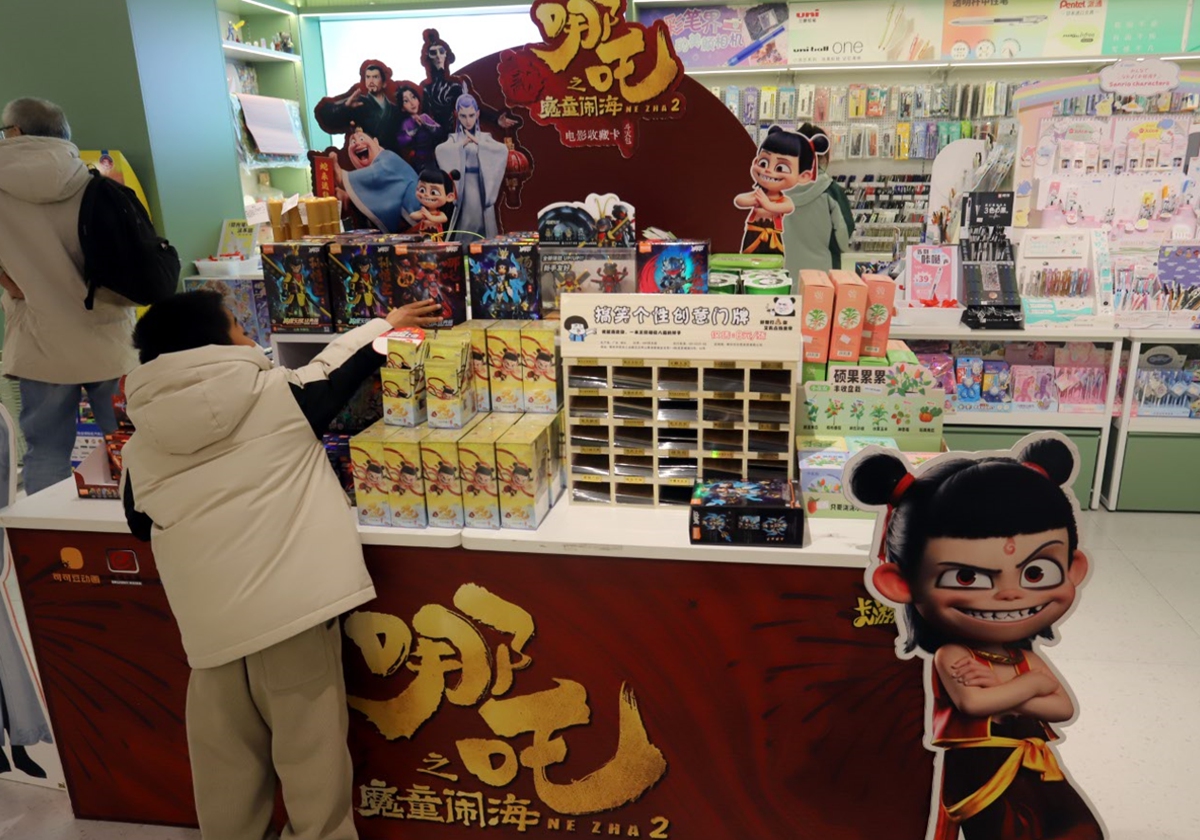
Customers purchase cultural and creative products related to the animated movie Ne Zha 2 at a bookstore in Suzhou, East China's Jiangsu Province on February 26, 2025. Photo: VCG
The derivative merchandise of Ne Zha 2 could surpass 100 billion yuan ($13.94 billion), a senior executive of Enlight Media said on Sunday.
Wang Changtian, chairman of Enlight Media, the major investor of the Ne Zha franchise, made these remarks at the Shanghai International Film Festival, reported the Shanghai Securities News.
The developers, manufacturers and sellers of derivative merchandise of Ne Zha 2 have gained a lot of market dividends, and may have achieved sales of several hundred billion yuan in genuine products, Wang said.
It is entirely possible that the sales of derivative merchandise will breach 100 billion yuan in the end, Wang said at a forum held at the festival.
The toys and games market in China has witnessed fast development in recent years. After watching newly released movies and popular TV series, buying trendy blind boxes, badges and acrylic pendants has become a new consumption preference for many young people.
More film and television companies have begun to make plans for intellectual property (IP) licensing and derivative product development.
On May 13, Enlight Media said that the majority of the company's Nezha IP licensing business involves sales sharing, and related derivatives cover most of the products such as blind boxes, plush figures, toys and acrylic products, totaling more than 30 categories and more than 200 products.
The company's IP operation business contributed hundreds of millions of yuan in revenue in the first quarter, and it is expected to continue to generate more related revenue, it said.
Labubu, a quirky, fuzzy, and big-toothed figurine, has ignited a worldwide craze. This phenomenon showcases how Chinese companies are transforming their global image through innovative design, cultural narratives and the international expansion of homegrown IP.
Pop Mart, the Beijing-based toymaker behind Labubu and other original-IP characters, is among those leading the shift. Propelled by international hype, the company registered year-on-year revenue growth of 165-170 percent in the first quarter of 2025, with overseas revenues soaring 475-480 percent, according to the Xinhua News Agency.
The explosive popularity of Labubu and similar creations has thrust China's cultural industry into the spotlight, positioning it as a new hallmark of the country's exports, Chinese experts said.
The success of trendy Chinese toys has demonstrated that Chinese brands have mastered a more astute understanding of global consumption trends and customer demand, after years of deep integration into the global toy industrial and supply chain, Bian Yongzu, an executive deputy editor-in-chief of Modernization of Management magazine, told the Global Times on Sunday.
Trendy toys with proprietary IP such as Labubu are a product of coordination and cooperation of the global toy industrial chain and have highlighted the benefit of market-oriented collaboration, Bian noted.
"The success of Chinese toys is also indicative of China's growing soft power and rising image in the world, and the scaling up of the value ladder by Chinese brands from just being an original equipment manufacturer. These proprietary toys have garnered international popularity by offering emotional value to consumers and formed a new consumption pattern," Bian said.
A report released by the National Academy of Economic Strategy under the Chinese Academy of Social Sciences predicted that the size of the toys and games market in China will hit 110.1 billion yuan by 2026, up from 50 billion yuan in 2023.
Global Times
RELATED ARTICLES