Saline-alkali land blooms with prosperity
Exploring China's beautiful, harmonious countryside along Xi's footsteps
Editor's Note:
China Rural Revitalization magazine has published a series of articles on the rapid development and transformation of rural China. The articles reflect the arduous efforts of rural revitalization across the country, which is an important and genuine solution to China's rural economic development. In the future, articles selected from this series will be published.
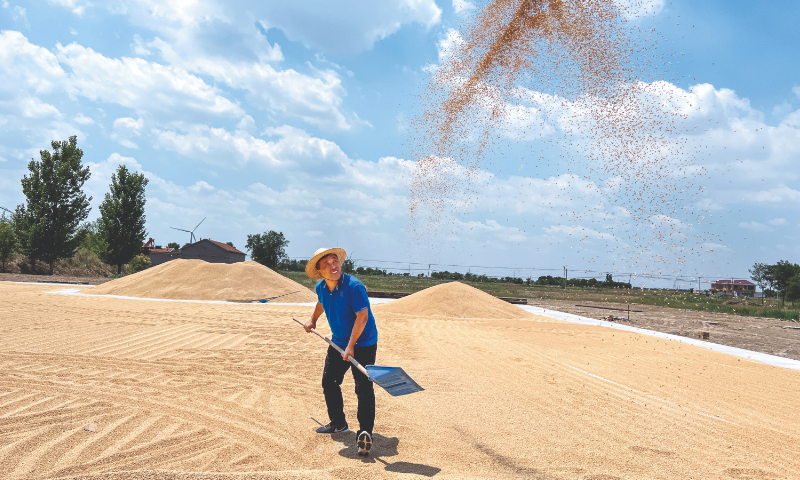
A farmer scatters wheat on a threshing ground in Cangzhou, North China's Hebei Province. Photo: Courtesy of China Rural Revitalization magazine
China has about 500 million mu (33.3 million hectares) of saline-alkali wasteland and saline-affected arable land, of which over 200 million mu is deemed improvable. If the 200 million mu of saline-alkali land are successfully transformed into fertile farmland, it would significantly bolster China's food security, and bring greater prosperity to villages located on saline-alkali land.On May 11, 2023, Xi Jinping, general secretary of the Communist Party of China Central Committee, Chinese president, and chairman of the Central Military Commission, arrived in Cangzhou, North China's Hebei Province. In a plot of saline-alkali wheat land in Xianzhuang area of Jiucheng Town, Huanghua City, he learned about how saline-alkali land has been harnessed, how wheat is planted in saline-alkali land and how the agriculture here has been industrialized, according to the Xinhua News Agency.
Xi said, it is a strategic issue to comprehensively utilize saline-alkali land, and great importance should be attached to it, Xinhua reported.
Hard work
Cangzhou, located south of Beijing and Tianjin along the Bohai Sea coast, has long been a major agricultural hub. It ranks first in Hebei Province for both cultivated land area and grain planting area. However, for centuries, saline-alkali land has hindered Cangzhou, limiting grain production.
The city's saline-alkali farmland spans 4.08 million mu, accounting for one-third of its total cultivated land. Until the founding of the People's Republic of China, the yield of drought-tolerant, saline-alkali wheat here was only about 100 jin (50 kilograms) per mu. This posed a significant challenge that Cangzhou must overcome to achieve comprehensive rural revitalization.
Xi's visit to Cangzhou brought great encouragement to local officials and residents. Cangzhou quickly set up a special working group to launch a tough battle against saline-alkali land.
During the following period, officials at all levels of Cangzhou led teams to Beijing to report on their work and seek policy support. Among various policy support, Cangzhou was included in the national pilot program for the comprehensive utilization of saline-alkali land, and became a pioneer and demonstration area for the comprehensive transformation and utilization of saline-alkali land in the country.
Cangzhou devised a clear and structured plan with "one base, one park, four systems, and multiple models." "One base" refers to the establishment of a national-level innovation center for saline-alkali land utilization, serving as a special industrial innovation base for drought-tolerant wheat. "One park" means to create a national rural industry integration development demonstration park in Huanghua City, Bohai New Area.
Under the "four systems," Cangzhou established and improved breeding, planting, promotion and processing systems for speciality crops in saline-alkali land, with drought-tolerant wheat as the focus. In addition, Cangzhou created eight demonstration sites across relevant counties and cities to showcase effective saline-alkali land utilization practices.
With the clear plan, Cangzhou went to work with a focus on scientific and technological innovation.
Since 2023, Cangzhou has successively built four "national" platforms, including the national salt-alkali land comprehensive utilization technology innovation center dry alkali wheat specialty industry innovation base. With these platforms, the high-quality scientific research force in saline-alkali land research across the country has gathered in Cangzhou to form a powerful synergy.
Seeds are the "chips" of agriculture, and Cangzhou focused on improving crop varieties by selecting those suitable for survival on saline-alkali land. Land is the foundation of agriculture, and Cangzhou enhanced soil quality by promoting innovative technologies to continuously improve the fertility of saline-alkali land.
Meanwhile, Cangzhou deployed 10 expert groups to villages and counties at regular intervals to promote technologies and guide farmers.
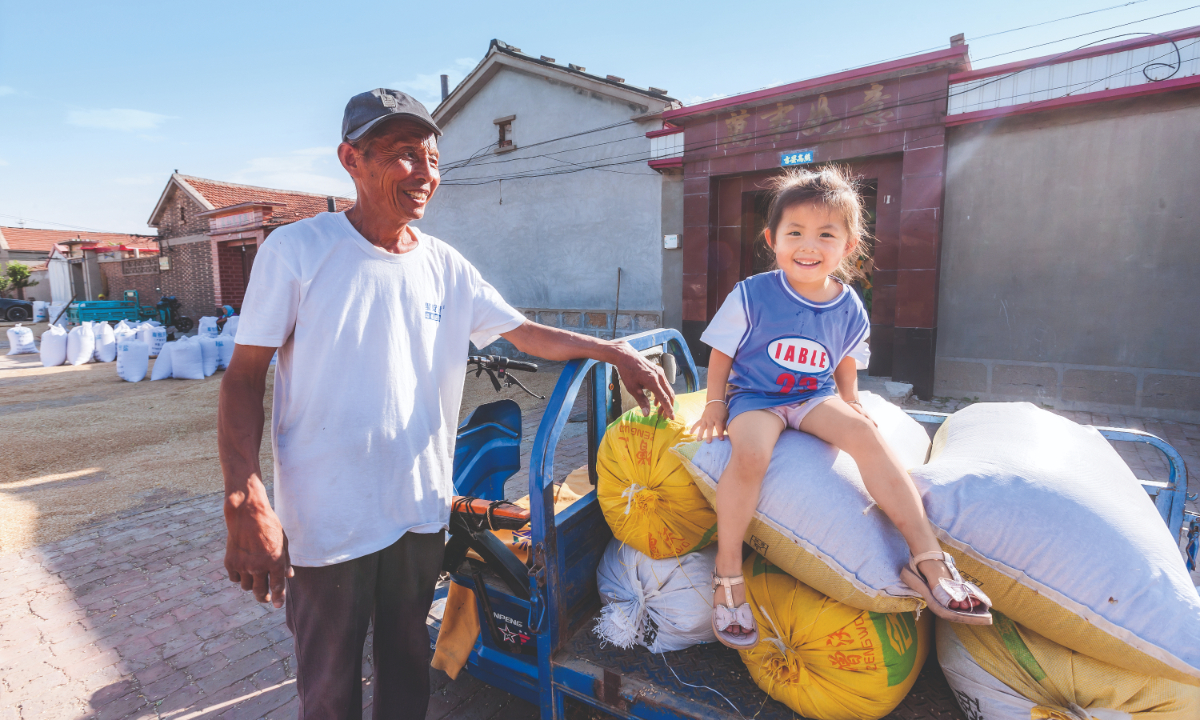
Villagers pose for a photo with newly harvested wheat in Cangzhou, North China's Hebei Province. Photo: Courtesy of China Rural Revitalization magazine
Great results
Through the efforts of agricultural experts, salinity levels in Cangzhou's saline-alkali land steadily declined, while the yield of drought-tolerant wheat continued to rise. In 2024, the average yield of saline-alkali wheat reached 260 kilograms per mu, an increase of 15 kilograms compared to 2023, which not only made great contributions to national food security, but also boosted farmers' income.
In another effort to boost income, in December 2024, at an intangible cultural heritage workshop in the Xianzhuang area of Huanghua, more than 20 villagers were hard at work making decorative steamed buns.
This workshop reflects Cangzhou's efforts to cultivate processing enterprises of saline-alkali land specialty products. Since 2023, the number of leading saline-alkali wheat processing companies at or above the municipal level in Cangzhou has grown to 14, with a combined annual production capacity exceeding 1 million tons and total sales revenue reaching 1.28 billion yuan ($178.1 million), up 25 percent year-on-year.
Cangzhou's saline-alkali land, once plagued by low crop yields, has been transformed into a source of high-quality agricultural products due to its mineral-rich soil. For instance, drought-resistant saline-alkali wheat boasts 2.7 times the potassium content of bananas, higher folic acid levels than kiwis, and significantly more protein than standard flour.
Cangzhou has turned its shortcomings into specialties and disadvantages into advantages, focusing on the special agricultural products resources of saline-alkali land, and highlighting the advantages of saline-alkali land products such as rich nutrition, green quality and unique taste.
In 2024, Cangzhou promoted its saline-alkali products nationwide, with several gaining national recognition. The growing popularity of Cangzhou's saline-alkali specialties has driven a total industrial output value of 13.61 billion yuan. The branding success also boosted regional agritourism, such as pick-your-own farms.
Once barren and unproductive, Cangzhou's saline-alkali land is now thriving in the dawn of the new era. It is delivering prosperity and happiness, and forging a new path toward ensuring China's food security.
-------
Wen Wei is a reporter for China Rural Revitalization magazine.
RELATED ARTICLES