Global corporations reaffirm strong confidence in Chinese market at Qingdao summit amid trade challenges
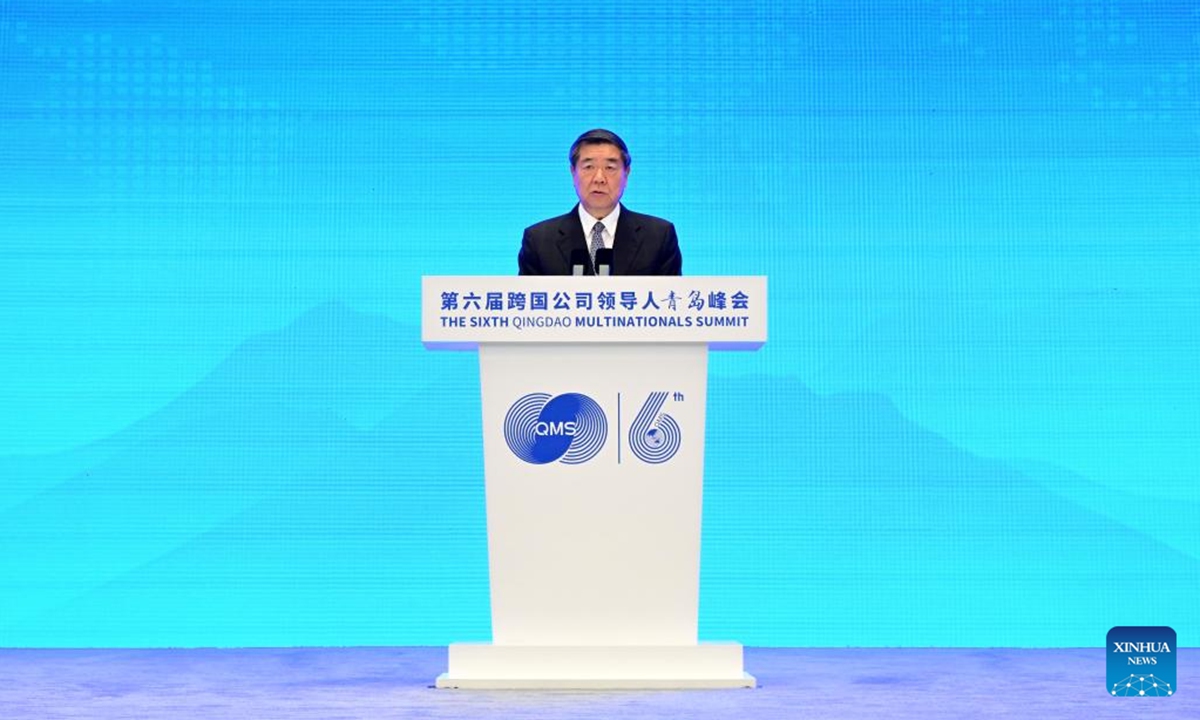
Chinese Vice Premier He Lifeng, also a member of the Political Bureau of the Communist Party of China Central Committee, addresses the opening ceremony of the sixth Qingdao Multinationals Summit in Qingdao, east China's Shandong Province, June 19, 2025. (Xinhua/Li Ziheng)
China possesses a super-large domestic market and the world's most complete industrial system, demonstrating strong economic resilience and growth potential, making it an ideal, secure, and promising investment destination for multinational companies, Chinese Vice Premier He Lifeng said when attending the opening ceremony of the Sixth Qingdao Multinationals Summit on Thursday, the Xinhua News Agency reported.
He, also a member of the Political Bureau of the Communist Party of China Central Committee, emphasized that China will steadfastly advance its high-level opening-up, create a world-class business environment, and firmly uphold the multilateral trading system.
He welcomed multinational corporations and entrepreneurs from across the globe to invest and develop in China, sharing opportunities as well as developing and creating a future together.
At the summit held in East China's Shandong Province on Thursday, multiple global business representatives conveyed to the Global Times their steadfast commitment to expand operations in China despite current international trade challenges.
Go Mimura, Itochu's CEO for East Asia Bloc, told the Global Times that as a trade-focused company, global supply chain stability is paramount for Itochu. Unfortunately, recent international political and economic instability has posed challenges for multinational corporations, Mimura said.
He added that he believes that close economic cooperation between China and Japan will lay a strong foundation for global trade stability. Itochu is committed to expanding cooperation in China, hoping to contribute to both nations and the global economy, Mimura noted.
Jack Wu, Penfolds' general manager for China, told the Global Times that trade relations between China and Australia enjoy strong complementarity, and there are many different industries from both sides that have mutual demand in each other's markets.
Amid the current complex international trade environment, Treasury Wine Estates, parent company of Penfolds, believes that the trade environment multinational companies pursue is a fair, transparent, and supportive business environment, it said in a separate statement sent to the Global Times, adding that it has participated in the China International Import Expo for five consecutive years and regards it as an exceptional platform for China's opening-up to global collaboration and promotion of shared prosperity. This environment minimizes trade barriers and fosters confidence for long-term investment.
Speaking on expanding investment in the Chinese market, Kevin Ray Meusch, general manager of Valmont Industries for China and Kazakhstan - a US-based agricultural company - told the Global Times that the company feels confident in keeping its investments in China with further growth, despite some tensions between the two countries, while highlighting China's stable environment and exceptional resources.
Against the backdrop of intensifying global geopolitical conflicts and trade barriers, the interactions between China and ASEAN have demonstrated remarkable resilience and vitality, showcasing a distinct "two-way convergence" dynamic. The increasingly diversified, in-depth, and balanced engagement between China and ASEAN, particularly, through deep supply chain integration and innovative cooperation models, has played a pivotal "ballast" role in today's highly uncertain global economic environment, Zhang Qi, chief executive of the Singapore-based SJ Group in China, told the Global Times on Thursday.
Besides highlighting the significance of stepping up deployment in the Chinese market, the corporate representatives also detailed some of their future plans and landed cooperation deals, with confidence in further deepening local operations.
The potential of the Chinese market is undoubtedly enormous. Maidelong has always been confident in the Chinese market and has formulated clear future development strategies and plans to fully utilize this potential, the company's CEO Tino Zeiske told reporters, including the Global Times.
Zeiske noted that the company will deeply cultivate the Chinese market and expand its business territory, with plans to further increase coverage in major cities and emerging markets by opening more new sites in the coming years.
Zhang said that the Singaporean company has been expanding cooperation in China, focusing on key aspects such as green and sustainable development as well as deepening collaborating with Microsoft on the AI Pinnacle Programme to develop AI tools, build infrastructure, and promote female participation in tech.
Also on Thursday, a report released by the Chinese Academy of International Trade and Economic Cooperation on multinational corporations in China at the summit showed that foreign enterprises have been bullish on increasing investment locally.
From 2013 to 2023, the full-time equivalent of research and development (R&D) personnel in large-scale foreign-funded industrial enterprises in China increased from 629,000 to 838,000 now per year, a rise of 33.2 percent. R&D expenditure rose from 201.51 billion yuan ($28.03 billion) to 375.76 billion yuan, an increase of 86.5 percent, CCTV reported.
Themed on "Multinationals and China: Connecting the World for Win-Win Cooperation," the summit attracted 465 multinational companies, including 135 Fortune 500 firms and 330 industry leaders, from 43 countries and regions, with more than 50 percent from emerging market economies, according to media reports.
RELATED ARTICLES