BYD rolls out first vehicle from Brazil plant, to realize 'made by Brazilians, for Brazilians' goal


"BYD has achieved fruitful results in Brazil, but though the journey has not been without challenges," said Li Tie, President of BYD Brazil, in an exclusive interview with the Global Times on July 1, as the company rolled out the first vehicle from its first passenger car plant outside of Asia, located in Camaçari in Northeast Brazil's Bahia State.
Li described the rollout as a milestone in BYD's global strategy, representing deep trust in Brazilian employees. The new factory will build a highly localized team to support the entire production chain, with the ultimate goal of "made by Brazilians, for Brazilians."
BYD identified early opportunities in Brazil, initially entering the market through electric buses. Today, the company has built a diversified industrial presence in the country, spanning electric buses, solar energy, monorail systems, and passenger vehicles. The plant is located in Camaçari, a key industrial and economic hub in the Salvador metropolitan area. The city also boasts a well-developed automotive supply chain and mature port logistics infrastructure. In July 2023, BYD announced the establishment of a major production complex comprising three factories, with a total investment of 5.5 billion reais ($980 million).

Li Tie gives an interview to the Global Times inside the BYD passenger-car factory in Camaçari, Bahia, Brazil, on July 1, 2025. Photo: Lin Xiaoyi/GT
"The Camaçari factory is designed for an annual production capacity of 150,000 vehicles when fully operational, and that can be increased based on market demand," Li told the Global Times. He emphasized that the rollout is not only an important boost for BYD's sales in Brazil but will also help meet growing demand across Brazil and Global South countries.
Sales data shows that BYD has maintained strong momentum in Brazil, with more than 76,000 vehicles sold in 2024. The company currently has over 180 dealerships in Brazil and plans to expand that number to 240 by 2025.
According to Li, BYD has already entered the top 10 in Brazil's auto market. He attributed this success to two key factors: first, BYD's products align well with local needs. Its new energy vehicles-super hybrids and pure electrics-have quickly gained popularity with their high efficiency, zero emissions, advanced features (such as vehicle-to-load output, NFC technology, and smart cabins), and competitive pricing. Second, BYD has actively integrated into local society, enhancing its brand image and acceptance through local production and community engagement.
As China transitions from "Made in China" to "Intelligent Manufacturing in China," BYD is seen as a trailblazer in Brazil. "Chinese automakers hold a competitive edge in smart features and advanced driving technologies," said Li. BYD plans to develop intelligent driving vehicles locally, aiming to reshape perceptions of Chinese brands. "We want Chinese brands abroad to be viewed as high-tech and premium - not cheap and low-quality," he said.
Regarding team-building, Li said that BYD is committed to fostering a cohesive workforce in Brazil. "Brazilian employees are open-minded and highly creative. They are meticulous and dedicated, though the work pace differs from that in China. We've adapted by actively listening to local feedback."
"We have full confidence in our local team," Li added. "With the start of production in Camaçari BYD vehicles in Brazil will be made by Brazilians, for Brazilians."
Meanwhile, BYD is working to integrate Chinese culture and corporate values with Brazilian traditions, aiming to build deeper ties with local communities. According to Li, the company helps Chinese employees better understand Brazil and adapt globally while also introducing Chinese culture to local employees to promote mutual understanding.
Li cited the development of a flexible-fuel engine as an example of the value of localization. "Brazilian workers understand the local market, while Chinese engineers provide technical expertise. This complementary model ensures our products meet both technical standards and local demand."
He added that such collaborative innovation boosts market competitiveness and deepens BYD's integration into Brazilian society. "Developing local talent, adapting technologies, and creating market-tailored products are at the core of our international strategy. These efforts not only increase our adaptability, but also bring tangible value to local industrial upgrading and job creation."
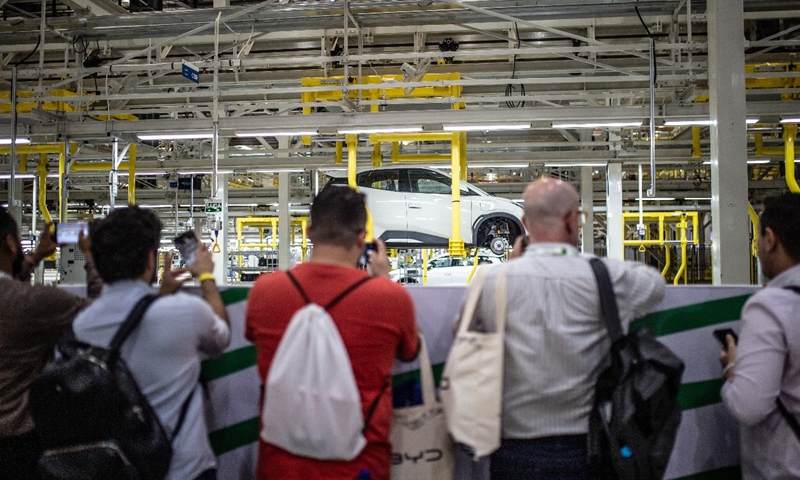
Guests take photos inside the factory during the first vehicle rollout ceremony at the BYD passenger-car plant in Camaçari, Bahia, Brazil, on July 1, 2025. Photo: Shan Jie/GT
At the ceremony on July 1, Luiz Carlos Caetano, mayor of Camaçari, warmly stated that BYD's factory would generate substantial local employment, earning enthusiastic applause from those in attendance.
The Global Times learned that the Camaçari plant currently employs approximately 1,000 workers, about 80 percent of whom are local Brazilians. Once the plant is fully built and operating at full capacity, the total employment is expected to reach 20,000.
"Chinese companies going global should not merely rely on relocating production lines. Brazilian workers have a better understanding of local market needs and are capable of developing products that better suit the market," Li said.
In addition, to further boost talent cultivation and empower innovation, BYD plans to establish a research and development center in Brazil, focused on technologies for solar products, electric buses, and passenger vehicles.
According to Li, the Brazilian R&D center will fully leverage local resources and gain in-depth insights into market demand, allowing engineers to stay close to the market trends and develop solutions suited to local needs. "Our goal is to make Brazil BYD's 'Silicon Valley' in South America."
Currently, BYD plays an key role in Brazil's decarbonization and energy transition. The company is a pioneer in pure electric public transportation in Brazil and has successfully helped major cities like São Paulo draft full electrification plans for their bus systems. Moreover, its new energy passenger vehicles and solar energy operations contributes to Brazil's green development.
A flagship BYD R&D project in Brazil is developing a hybrid flexible-fuel engine for plug-in hybrid vehicles. The technology combines Brazil's widely used green fuel, ethanol, with electricity to offer a sustainable, tailored solution for the local market. The engine was jointly developed by over 100 Chinese and Brazilian engineers, received praise from Brazilian President Luiz Inácio Lula da Silva, and is scheduled to be showcased at COP30.
Li acknowledged that BYD's development in Brazil has not been smooth and that the company once faced smear campaigns from competitors who worried about job losses caused by imported vehicles. "Some claimed that BYD's imported cars lacked after-sales support or that our local production was not real. That's because they saw our competitive edge - our technologies are more advanced and efficient, and our production is greener and more environmentally friendly. This kind of industry pressure is one of the major challenges we face," Li said. In reality, "we are not just selling or assembling cars - we are here to bring technology, jobs, industrial chains, and ecosystems, and aiming for full integration into local development."
Reflecting on BYD's 12-year journey in Brazil, Li said, "Every step BYD has taken in Brazil has been supported by the hard work and dedication of our local team. From a handful of employees in a rented office to building our own factory, we have grown together with Brazil."
Looking ahead, he said, "The road ahead is bright, though full of challenges - but we are full of confidence."
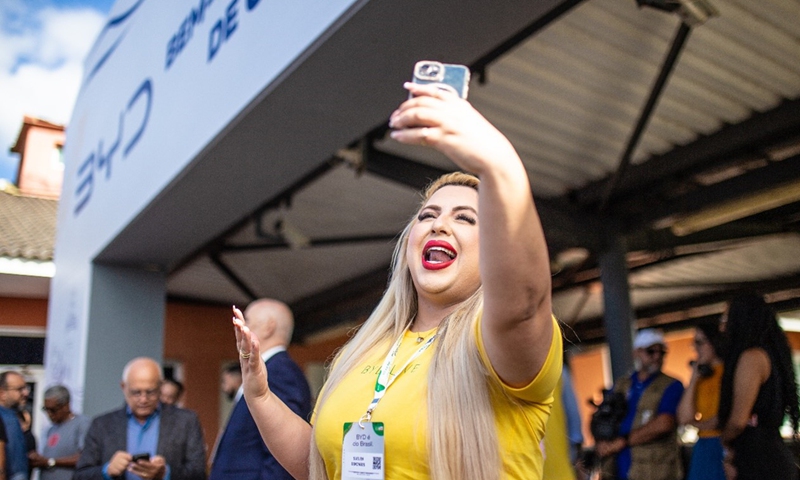
A guest takes a selfie at the first vehicle rollout ceremony at the BYD passenger-car factory in Camaçari, Bahia, Brazil, on July 1, 2025. Photo: Shan Jie/GT
RELATED ARTICLES