ARTS / CULTURE & LEISURE
RoboCup 2025 AI robot training match held in Beijing
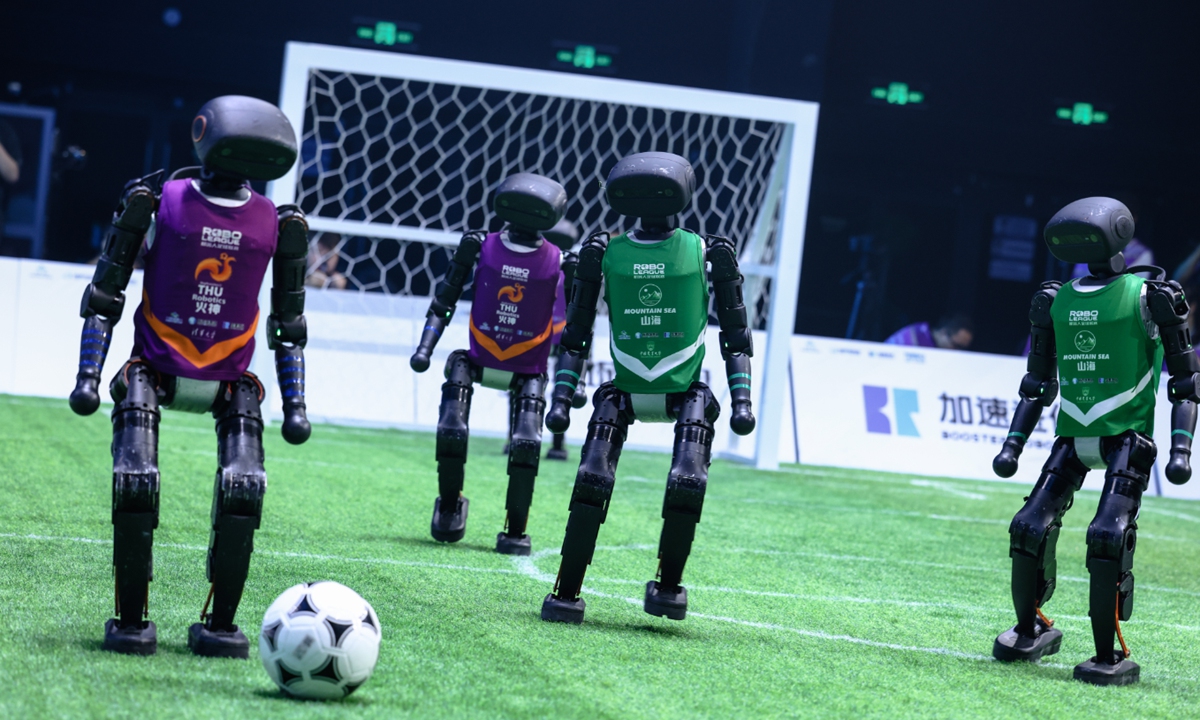
AI robot football match Photo: VCG
On Wednesday, a fully autonomous 3v3 AI robot football training match was held in Beijing between THU Robotics from Tsinghua University and Shanhai from China Agricultural University, as they gear up for RoboCup 2025 - the world's most influential robot competition, set to take place in Salvador, Brazil, from July 15 to 20.
"This year, THU Robotics and Shanhai will all compete using the Booster T1 platform produced by Booster Robotics. This marks the first time a Chinese hardware platform is being adopted as standard equipment for a global elite robotics competition," Chen Hao, CEO of Booster Robotics, told the Global Times on Wednesday.
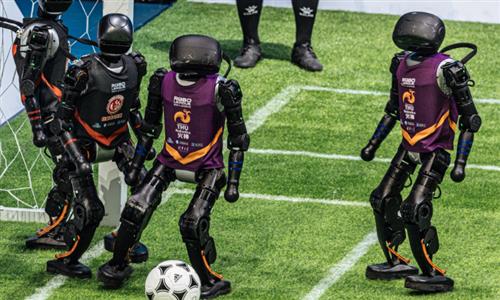
On June 28, China's first 3v3 AI robot football league match kicked off in Beijing. During the competition, some robot players fell during physical clashes. Most were able to get back on their feet autonomously, while those that couldn't were carried off the field by "medical staff" using stretchers, then returned to the game after quick adjustments. Video clips of the robots falling went viral online and sparked widespread discussion.
"All teams were using the same open-source motion large model, that means the robots have essentially identical sensing, walking speed, acceleration, and decision-making capabilities," Dong Hao, VP of AI robotics technology at Booster Robotics, told the Global Times on Wednesday in response to the viral scenes of frequent tumbles.
"That's why the robots tend to cluster together. Just like human athletes scrambling for the ball, when everyone converges at the same spot, falling is inevitable," Dong noted.
According to Dong, AI-controlled robots react extremely quickly, which often requires constant posture adjustments and makes them more prone to losing balance. In contrast, remote-controlled robots rarely fall.
When asked why some robots could stand up on their own while others had to be stretchered off the field, Dong explained that getting up requires robots to assess their body posture and that they must avoid actions that could damage their structure during recovery.
"For example, if a robot's legs are tangled, the AI determines it's unsafe to stand up automatically. Over 99 percent of the cases where robots can't rise aren't due to hardware issues. That's why you often see them rejoin the match quickly after a brief adjustment off-field."
"Through the last match, we indeed identified some areas for improvement," Yang Shaoshuai, leader of the Mountain & Sea team from China Agricultural University, told the Global Times on Wednesday.
"Our path planning still lacks sufficient intelligence, which led to collisions with opponents. Meanwhile, our vision system showed some fluctuations in tracking targets under excessive or insufficient lighting conditions. We'll be fine-tuning our algorithms to address these issues."
"The T1 is lightweight, agile, and quite intelligent. Its 1.2-meter height, 30-kilogram weight, and 23 degrees of freedom enable it to walk, run, kick, squat, and recover from falls very smoothly. That makes it an excellent candidate for football... Its sensing and mobility capabilities are very strong," Yang said.
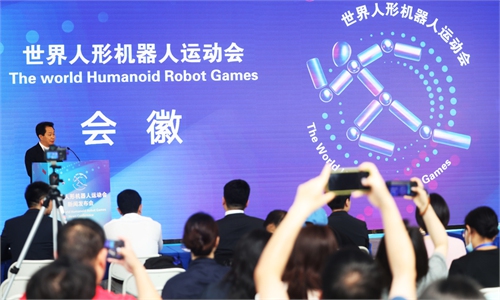
Looking ahead to both the upcoming RoboCup 2025 in Brazil and the Games, Yang noted that while the competitions share similarities, they also present unique challenges.
"The 5v5 match will be the first of its kind at the Games. They feature a larger field and more robots, which poses significant challenges for visual and positioning algorithms. But we're confident we can prepare well and strive for strong results," he said.
"Ultimately, all these football matches are about making humanoid robots more intelligent - that's our shared goal," Yang stressed.
RELATED ARTICLES