ARTS / BOOKS
Young Colombian poets in Beijing attend poetry recital event
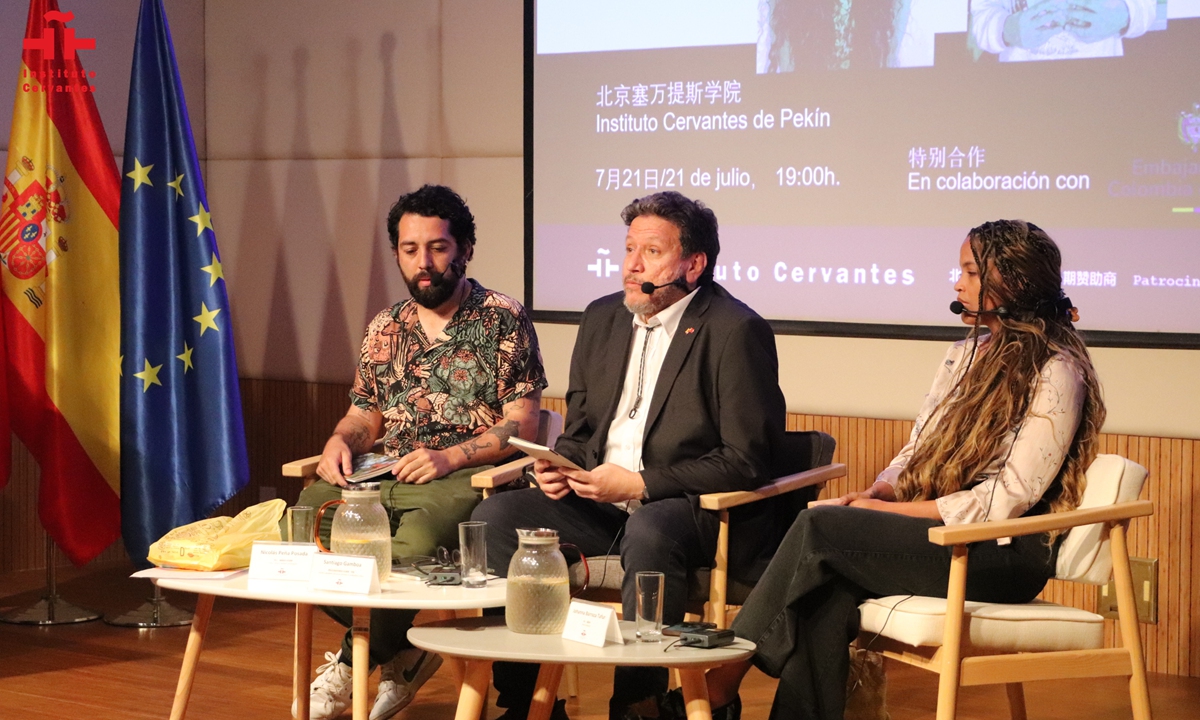
Santiago Gamboa, writer and minister counselor of the Embassy of Colombia in China chairs a session titled Recital: Poetry and young poets in Colombia in Beijing's Instituto Cervantes, on July 21, 2025. Photo: Courtesy of the Beijing's Instituto Cervantes
Highlighting a long tradition of poetry in Colombian literature, the Embassy of the Republic of Colombia staged a poetry recital event in Beijing's Instituto Cervantes on July 21.Santiago Gamboa, writer and minister counselor of the Embassy of Colombia in China chaired the session titled Recital: Poesía y jóvenes poetas en Colombia or (Recital: Poetry and young poets in Colombia).
With about 100 attendees, two young and award-winning poets from Colombia - Johanna Barraza Tafur and Nicolás Peña - discussed the long tradition of poetry, starting with José Asunción Silva in the 19th century, and continuing with classic poets such as Porfirio Barba Jacob, León de Greiff, and Eduardo Carranza, as well as schools of poetry that focus on the art of poetry.
Tracing the legacy of independent poets such as María Mercedes Carranza, Piedad Bonnett, Juan Manuel Roca, and William Ospina, the three writers explored questions such as where new Colombian poetry will go in the first quarter of the 21st century, and how it relates to and inherits the country's poetry tradition and the broader Spanish poetry tradition.
Colombian poetry has helped build the country's identity and the idea of nationality. The history of Colombian poetry is the story of a long journey, Gamboa noted.
"A language, Spanish, arrived by ship from Spain and, upon reaching South America, encountered a new reality that it had to name. The language grew in America, becoming more complex and richer. It was enriched by the indigenous languages of the people, adapting to this new reality. Colombian poetry comes from this new, enriched language. Poetry helped it find its new identity," the minister counselor said.
Zooming out from the human history and development view, Gamboa concluded the changes over the past two centuries.
Our nation has only been independent for 215 years, and poetry has been a part of that independence. It has taken over a language that arrived on ships and is now our own, he added.
Colombian poets Johanna Barraza and Nicolás Peña recited poems and shared their insights on poetry.
Barraza, also a photographer, elaborated her understanding of the poets' role in sharing the poetic spirit in the world.
"Poetry helps me understand the world I live in. We poets are part of a great collective spirit, that of poetry, and that's why we're connected to all other poets around the world, in every language. Although we're from distant countries and different cultures, Chinese and Colombian poets are part of the same poetic spirit," said Barraza.
Nicolás Peña Posada, a poet, editor, and university professor, shared his story with poetry.
"I came to poetry through music. I discovered that words had a rhythm of their own, and I could find poetic meaning in that music. Poetry gives us a sense of belonging. Poetry has helped me cope with the loss of loved ones and overcome difficult times. Poetry protects our souls," Nicolás Peña said.
Barraza's first collection of poems, Sembré nísperos en la tumba de mi padre (or "I sowed loquat in my father's grave,") won the 2019 "Germán Vargas Cantillo" poetry prize and has been published in Argentina, Colombia, and Brazil. Her poems have been translated into English, Portuguese, Russian, and Polish. In 2024, she received the Afro-Colombian Creation Grant from the Ministry of Culture in Colombia with an unpublished collection of poems.
Nicolás Peña, also a member of the rap group Amigos Imaginarios, has published five books of poetry and has been a finalist for several national and international awards, including the "Francisco Ruiz Udiel" Hispanoamerican Poetry Prize and Colombia's "Eduardo Cote Lamus" National Poetry Award. In 2025, he received the Reverso Prize for his book En agosto el cielo era un país de cometas rojas (or "In August the Sky Was a Country of Red Kites.")
The poets also shared the Chinese translations of their poems with the audience.
RELATED ARTICLES