ARTS / CULTURE & LEISURE
Partnership between Chinese and US archaeologists unlocks secrets of ancient settlement hierarchy in Shandong
Three decades of trowels and trust
By Published: Jul 29, 2025 10:01 PM

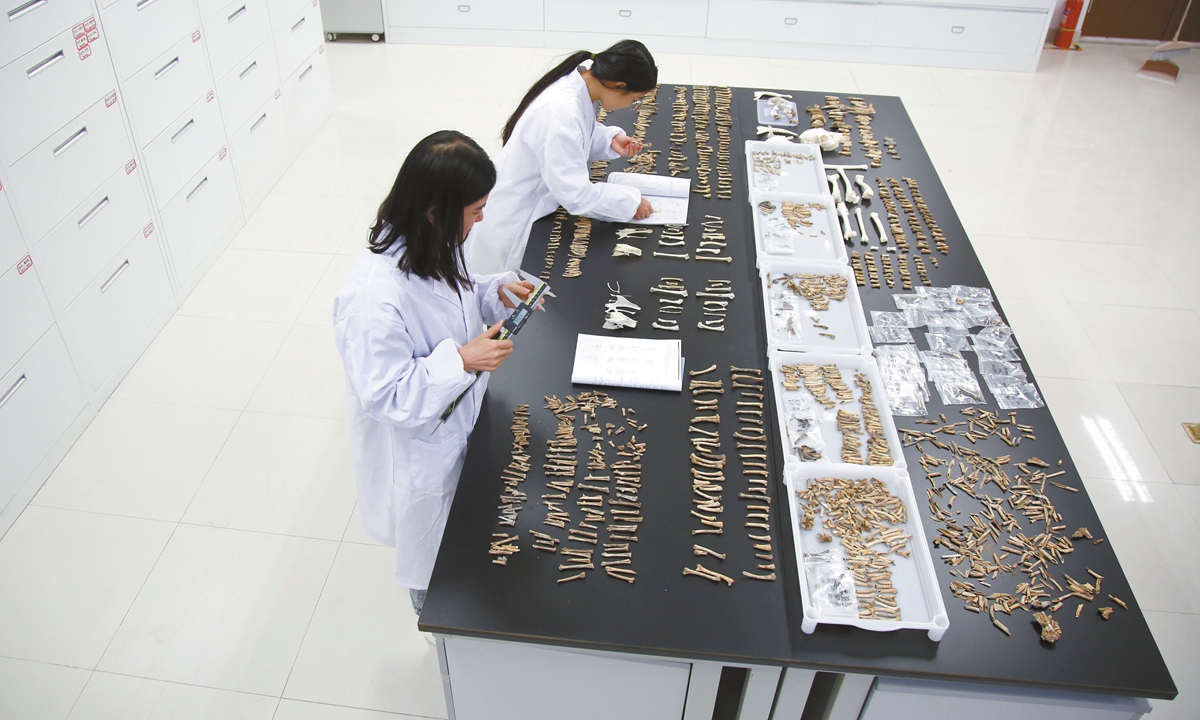
Archeological researchers conduct inspections on excavated animal bones on the Qingdao campus of Shandong University in 2020. Photo: Courtesy of Shandong University
A symposium marking 30 years of joint efforts between Chinese and US archaeologists in East China's Shandong Province was held in Shandong University earlier this month, bringing together over 130 scholars from more than 60 institutions worldwide, including those from the US, the UK and France, People.cn reported on Monday.
Spanning three decades, the project has surveyed 3,800 square kilometers and documented over 6,000 settlements dating from the Neolithic period to the Qin and Han dynasties (221BC-AD220).
Experts said these discoveries provide invaluable evidence for studying early state formation, the unification process of Qin-Han empires, and the integration of diversity of Chinese civilization.
Bridging divides
Fang Hui, dean of the Institute of Cultural Heritage in Shandong University, traced the partnership's origins to a regulation in opening the door to foreign archaeological collaborations on Chinese soil issued by China's National Cultural Heritage Administration (NCHA).
In 1995, with the NCHA's approval, Shandong University, Yale, and The Field Museum in Chicago launched systematic regional surveys and excavations at the Liangchengzhen site in Rizhao, East China's Shandong Province. It is one of the earliest China-foreign collaborative projects that got off the ground in China.
Why was the Liangchengzhen site chosen?
According to Fang, the site is a core site of the late Neolithic Longshan Culture, dating back 4,500-3,800 years ago.
Initially excavated in 1936 (disrupted by war later), the site offered robust academic foundations. As a coastal reform-era hub, the city of Rizhao also provided practical infrastructure for international teams.
"Location was no accident…Its archaeological value, combined with practical conditions, made it the ideal choice," Fang told the Global Times.
However, carrying out the project was not easy at first.
Fang recalled that in the early stages of the project, the two sides held differing academic perspectives. Chinese teams prioritized site discovery, while US partners emphasized settlement hierarchies and social complexity through settlement archaeology.
Through persistent dialogue, the teams reached a consensus: To conduct both surveys and excavations simultaneously.
Discussing how gaps were bridged, Gary Feinman, a MacArthur Curator at Chicago's Field Museum of Natural History and pivotal figure in the collaboration, credited institutional support and mutual respect.
"A tremendous amount of credit goes to professor Anne Underhill for the people she put together in formulating our team and also especially to Shandong university, which has always been so welcoming to the foreign scholars," Feinman told the Global Times.
"I think each of us has great respect for all the other members of the team and I think that also has helped us stick together and work together despite the fact that we come from different backgrounds and sometimes have different academic viewpoints," he added.
Such cooperation soon validated a theory: Surveys revealed a complex Longshan-era social structure centered on the Liangchengzhen site, surrounded by tiered settlements.
By 1998, excavations commenced at this regional hub, confirming hypotheses about resource networks, including seafood, timber and salt, and social organization in early complex societies.
Science empowered
The year 2017 was a transformative year in upgrading the cooperation with technology and multi-discipline approaches after the two universities jointly established the "International Joint Laboratory for Environmental and Social Archaeology."
According to Fang, early Chinese applications focused on basic analyses, including animal and human bones, while US scholars implemented systematic soil sampling for multi-dimensional environmental and subsistence studies, including phytoliths and pollen.
Teams integrated strengths. Fang explained that Chinese expertise in earthen architecture identification and pottery dating complemented US excellence in detailed spatial documentation and multi-source data collection. Though slower, this approach exponentially increased information yield.
The two sides continuously invited top global experts to participate in specialized research.
For example, Professor Gary Crawford from the University of Toronto led work on plant archaeology, and Professor Patrick McGovern from the University of Pennsylvania studied ancient wine residues, yielding multiple breakthroughs, such as the discovery of ancient alcohol.
This interdisciplinary model proved highly effective, prompting the upgrading of collaborative platforms.
Thanks to the support of technology and interdisciplinary model, the cooperation has achieved fruitful results.
Feinman noted that one of the most striking revelations was the hierarchical structure of early settlements along the Shandong coast.
"I think the thing that surprised me the most was how large some of the early Longshan and even late down coast sites were, and how they were not all the same size. Some sites were much bigger and had features that other sites did not have so that there was a clear hierarchy of settlement on the Shandong coast," he explained.
This challenged the long-held view that early Chinese civilization radiated outward from the Central Plains. "We found relatively independent developments along the coast, distinct from the supposed central diffusion model," he added.
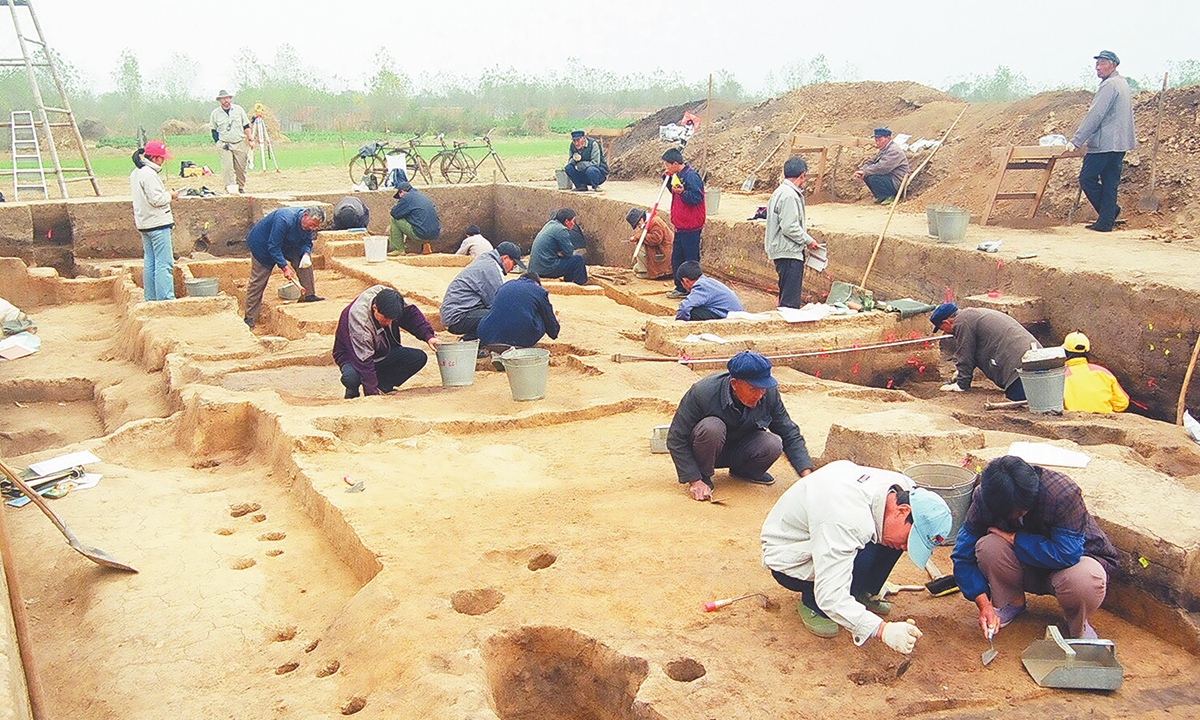
Excavational work at the Liangchengzhen site in Rizhao, East China's Shandong Province in 2001 Photo: Courtesy of Shandong University
Humanity beyond scholarship
Currently, the collaboration has expanded from the two universities to include academic communities in Europe, Russia, Japan, South Korea and beyond, with frequent personnel interactions, three to six teachers and students visit each other annually.
Joint talent cultivation and shared laboratory resources have become the norm, shifting cooperation from "project-driven" to "natural collaboration."
Fang noted US colleagues' extraordinary advocacy beyond academia, which include combating artifact trafficking, facilitating repatriation of looted antiquities and securing the US-China memorandum restricting illicit cultural imports.
Reflecting on the journey, Feinman observed: "Thirty years ago, I never thought that I could look ahead three decades and so many survey projects were being implemented in so many different regions of China."
He expressed his hope that these archaeological results could inspire more young archaeologists to prioritize surveys in unraveling regional histories.
RELATED ARTICLES