SPORT / MISCELLANY
Argentina working to get football team to play friendly in China: Argentine official
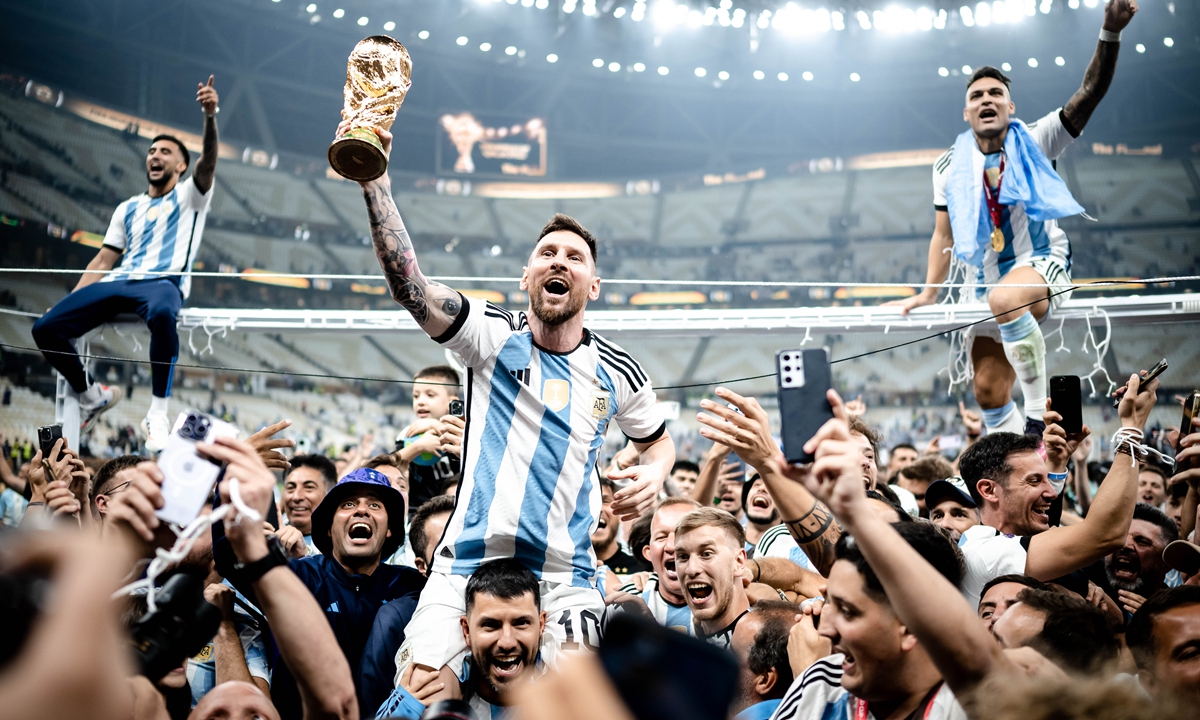
Lionel Messi of Argentina celebrates victory with the trophy after winning the World Cup final match between Argentina and France at Lusail Stadium on December 18, 2022 in Lusail City, Qatar. Photo: VCG
Argentina is working to get its national football team to play a friendly match in China before the 2026 FIFA World Cup, a senior official with the country's high-performance sports agency told the Global Times on Tuesday.Philippe Oudinot, the subdirector of Argentina's National Agency for High Performance Sports (ENARD), told the Global Times through an interpreter on Tuesday that he discussed with officials from the Argentine Embassy in China efforts to strengthen ties between the two nations through sports before the 2026 FIFA World Cup, including having the national team play in China as a gateway.
"I had a meeting with our embassy here in China, where we discussed their efforts planned for the end of this year and next year before the World Cup," Oudinot told the Global Times on the sideline of a sports development forum for Global South economies hosted by the Cheung Kong Graduate School of Business on Tuesday in Beijing.
"There is the possibility of a friendly match that may take place in October," Oudinot said, before stressing that the priority will not be simply staging a senior national team friendly.
"The aim isn't just to create a bond through the national team but also to promote exchanges between coaches and referees, sharing experiences," he noted.
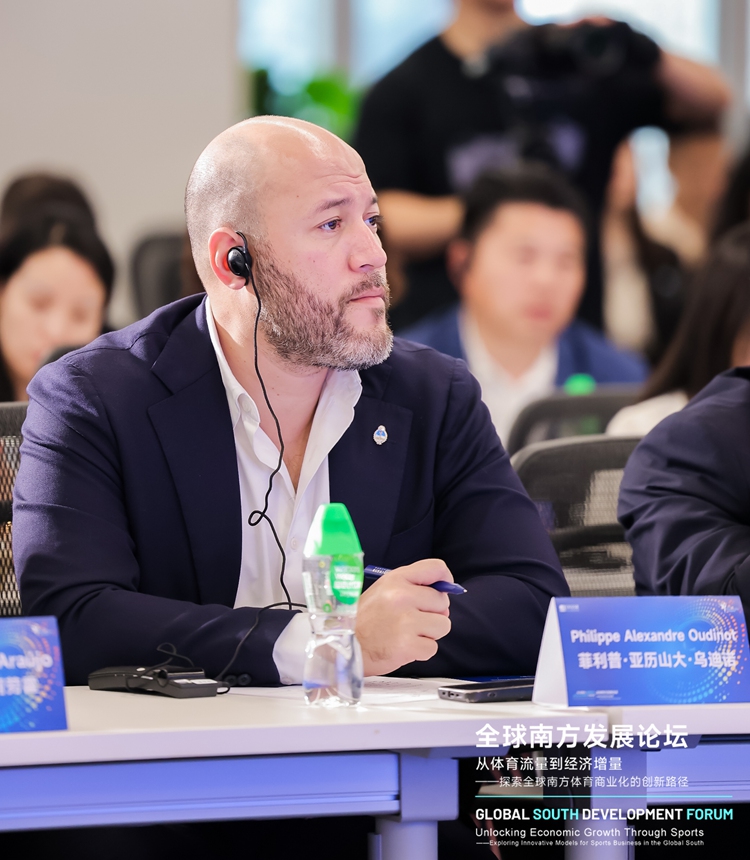
Philippe Oudinot Photo: Courtesy of CKGSB
Argentina played a friendly against Australia in Beijing in June 2023, their first international match outside of Argentina after La Albiceleste won the 2022 FIFA World Cup. Over 51,000 people braved the scorching heat in Beijing to watch the Argentine players, including megastar Lionel Messi, play.But Messi's no-show on the field for a friendly match played by his club Inter Miami in Hong Kong in February 2024 drew ire from many Chinese fans, who accused him of not respecting Chinese fans.
Two originally planned friendlies featuring Argentina in March 2024 - Argentina versus Nigeria in Hangzhou and Argentina versus Cote d'Ivoire in Beijing - were canceled by local Chinese sports authorities amid controversy over Messi's absence from the Hong Kong match.
The Hangzhou Sports Bureau cited the event conditions as "not mature," and the Beijing Football Association stated it had "no plans, for the moment, to organize any match involving Messi."
The Chinese Football Association (CFA) then tightened supervision of procedures to get foreign teams playing in the Chinese mainland in April 2024, which later resulted in no high-profile international football teams playing in the mainland afterwards.
The CFA issued a notice last week soliciting host cities for Chinese national team friendly matches in October and November, but no opponents have been decided yet.
The Chinese football authorities have been seeking international cooperation to strengthen domestic football development, with several football powerhouses reaching deals with the CFA to cultivate domestic talents.
Reflecting on Argentina's strengths in football cooperation, Oudinot drew on the nation's deep cultural identification with the sport.
"We've got a huge base at the bottom of the football pyramid, and from there we professionalize players. We can pass on that football identity," he said.
He also acknowledged the potential value of learning from China, particularly in women's football and sports technology.
"In turn, we can learn from China, particularly in women's football. Also, China's cutting-edge technology is something we can definitely capitalize on. It could be a great exchange, really," he said.
Touching on broader structural issues, Oudinot acknowledged that people often look first to government for sports solutions. However, he argued the state should instead act as a catalyst.
"Often, people expect the government to provide all the solutions, but the state should be responsible for building the ecosystem," he said.
RELATED ARTICLES