India, Brazil reject US demands to halt buying Russian oil: media
Move stems from economic needs and independent foreign policy: expert
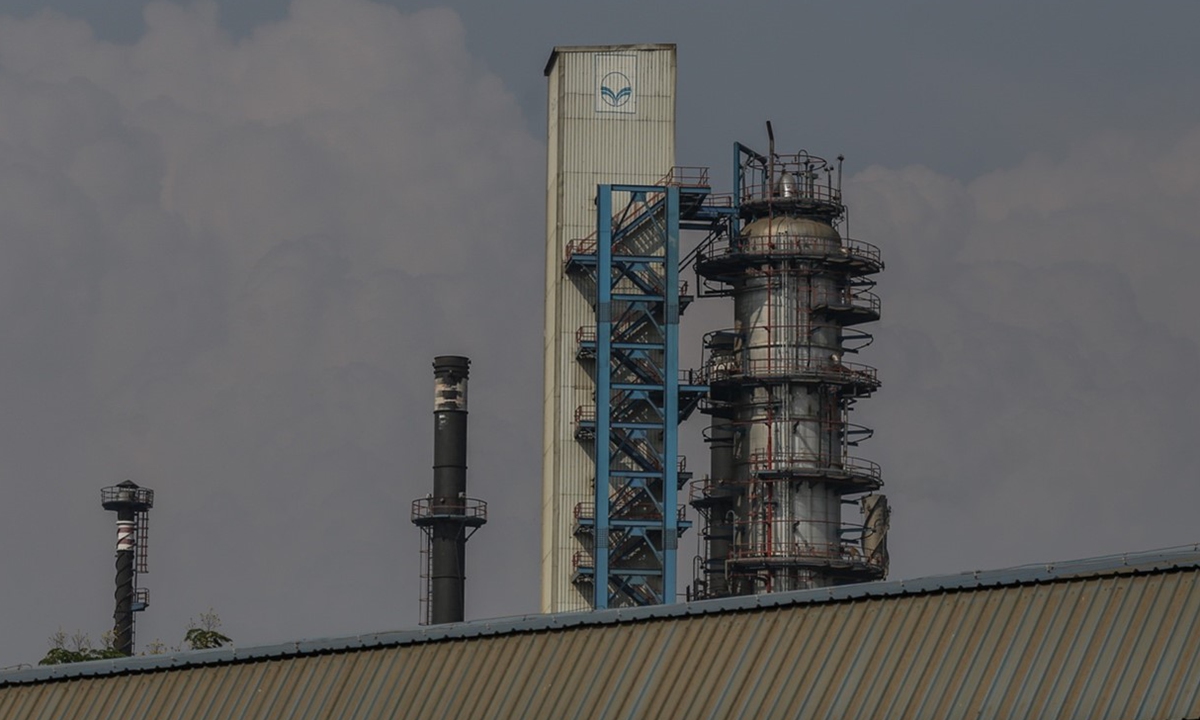
An oil refinery operated by Hindustan Petroleum Corp., in Mumbai, India. Photo: VCG
Indian sources said that "there would be no immediate changes" to purchase oil from Russia despite a threat of penalties from the US, Reuters reported on Saturday. Commenting on the decision, a Chinese expert said India's move stems from dual considerations of economic interests and adherence to an independent foreign policy.
India will keep purchasing oil from Russia despite US threats of penalties, Reuters reported on Saturday, citing two Indian government sources who don't wish to be identified due to the sensitivity of the matter.
Trump said last week that as part of his latest round of tariffs, he would impose an unspecified penalty on India in addition to a tariff rate of 25 percent if the country did not cut off its imports of Russian crude oil. On Friday, Trump told reporters that he had heard that India "is no longer going to be buying oil from Russia." He said that he doesn't know if that's right or not, but noted "That is a good step."
However, Indian sources have refuted this, stating that "there would be no immediate changes," according to Reuters.
"These are long-term oil contracts," one of the sources said. "It is not so simple to just stop buying overnight."
The New York Times cited two senior Indian officials on Saturday who said there had been no change in policy. One official said the government had "not given any direction to oil companies" to cut back imports from Russia, the report said.
Brazil also hit back on Saturday at the US demand that it stops importing oil from Russia. Celso Amorim, special advisor to the president of Brazil, stated, "We oppose economic sanctions under any circumstances unless authorized by the UN Security Council."
Consideration of dual reasons
Qian Feng, director of the research department at the National Strategy Institute at Tsinghua University, told the Global Times on Sunday that India's purchase of Russian oil is based on certain economic considerations and will not be abandoned due to US' pressure.
He said India is an oil-deficient nation, and Russian oil offers the advantages of being cost-effective and high-quality, enabling India to secure its petroleum reserves and provide robust safeguards for its economic development.
Given that Russian oil is cheaper and the Indian customers will benefit from such imports, India will continue to import oil from Russia, Srikanth Kondapalli, a professor in Chinese Studies at Jawaharlal Nehru University, told the Global Times on Sunday.
India imported about 1.75 million barrels per day of Russian oil from January to June this year, up 1 percent from a year ago. Russia accounts for about 35 percent of India's intake, Reuters reported.
Lü Xiang, a research fellow at the Chinese Academy of Social Sciences, told the Global Times on Sunday that Brazil and India's decisions embody their adherence to an independent foreign policy.
"Trump's tariffs have inflicted heavy blows on various nations; rather than awaiting doom passively, it is better to stand firm to mitigate losses," Lü said. Every country has the right to safeguard its legitimate interests, and Brazil and India are acting on this principle, he noted, adding that Trump administration now treats tariffs as a "panacea" for all the difficulties it confronts, yet reality tells a different story.
Indian officials and commentators also exposed the double standards of the US as it continues to import Uranium from Russia and the European Union imports oil from Russia, according to Srikanth.
Impact on India-US ties
Meanwhile, Indian Prime Minister Narendra Modi on Saturday urged Indians to prioritize locally made products and stand united in the face of growing global economic uncertainty.
Speaking at a public meeting in his Varanasi Lok Sabha constituency, Modi warned that the world economy is entering a phase of instability and unpredictability, the Times of India reported.
Modi urged shopkeepers and traders to take a pledge to sell only Indian-made goods, especially with the festive and wedding seasons around the corner, the report said.
"At a time when the world is going through uncertainty, let us take a pledge to sell only Swadeshi goods from our shops and markets. Promoting made-in-India goods will be the truest service to the country," Modi said.
Modi's remarks are driven by the imperative to decrease domestic public discontent toward the government's pro-US tilt, particularly amid mounting opposition following Trump's imposition of a 25 percent tariff on India, Hu Zhiyong, a professor from Zhejiang International Studies University and also research fellow at the Institute of International Relations at the Shanghai Academy of Social Sciences, told the Global Times on Sunday.
Indian Congress leader Jairam Ramesh took a dig at Modi over the 25 percent tariff announcement. Ramesh "mocked the bonhomie shared between the two leaders, referencing the 'Howdy Modi' event and other moments of camaraderie, saying, 'All that tariff between him and Howdy Modi has meant little," according to India Today.
Modi's primary objective is to shore up public support by demonstrating resilience against US pressure, thereby laying groundwork for next year's elections, Hu said.
If the US persists in applying unilateral pressure on India, it may prompt India to reassess its foreign policy and could also push the country to further revert to a policy of balancing among major powers, Qian noted.
RELATED ARTICLES