ARTS / CULTURE & LEISURE
‘Stele of the Emperor’s Northern Tour,’ possibly of Northern Wei, discovered in N.China
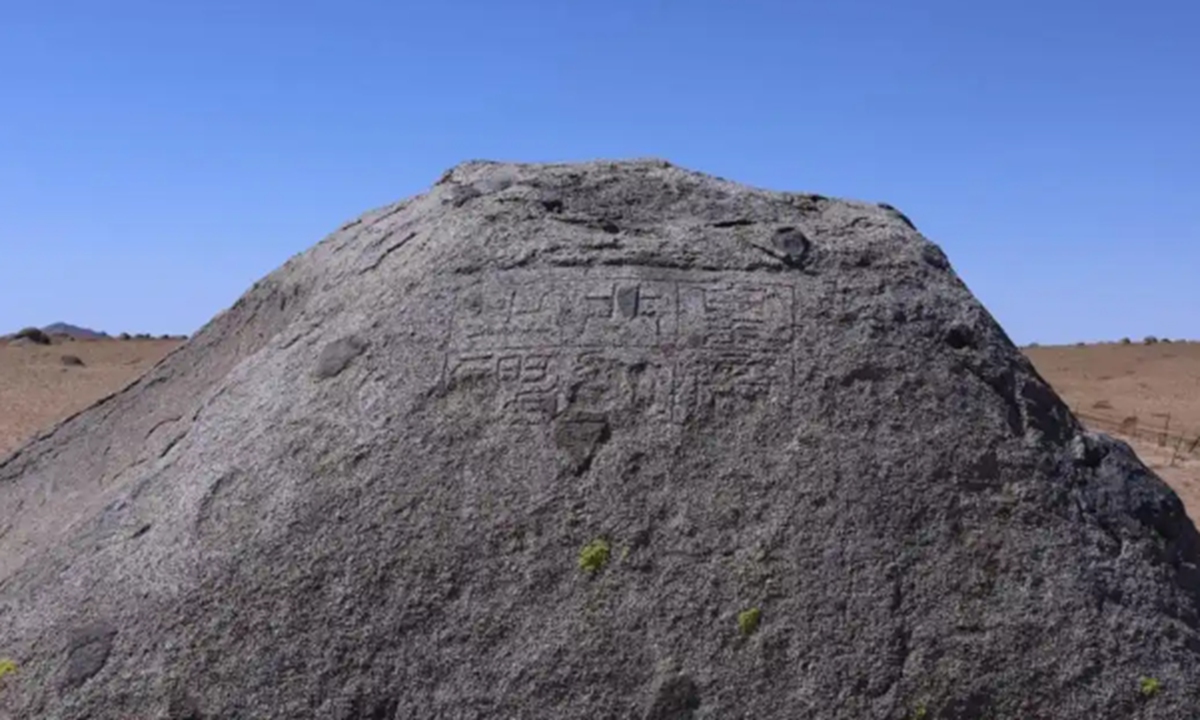
Photo: screenshot
A previously undocumented Chinese stone inscription has been discovered on a naturally formed granite boulder in the hilly grasslands of Ulanqab, North China's Inner Mongolia Autonomous Region, thepaper.cn reported.The discovery was made during a field survey jointly conducted by the Inner Mongolia Institute of Cultural Heritage and Archaeology and local cultural heritage authorities in Ulanqab. At the top of the inscription, the characters "Stele of the Emperor's Northern Tour" are carved in seal script. "We have conducted digital scanning and created ink rubbings of the 'Northern Tour Stele,' and are organizing on-site investigations and expert assessments to further analyze and authenticate the inscription," Sun Jinsong, director of the Inner Mongolia Institute of Cultural Heritage and Archaeology, told the Global Times on Sunday.
The inscription spans a 1.9-meter-wide and 2.6-meter-high section of the granite surface. Despite heavy weathering, the stone's embedded basalt inclusions have preserved over 50 legible characters, including phrases such as dai (dynasty), yiyue (first month), zhuguozixiyushang (sons of various states, merchants from China's Western Regions), and Mofu, the latter of which appears at least seven times. Scholars note that Mofu was a title commonly used by tribal leaders of the Eastern Hu lineage in northern China.
However, the surviving text lacks key chronological markers such as dynastic era names, personal names, or geographic references, making precise dating difficult.
Based on the calligraphic style, the use of the term Mofu, and the stele's proximity to Northern Wei-era defensive lines and ancient cities such as the Kliment Fortress, experts tentatively suggest that the inscription may date to the Northern Wei Dynasty (386-534). It may be a commemorative stele linked to Emperor Daowu's 399 northern campaign against the Gaoche tribe, bearing similarities to the "Bushan Commemorative Stele" carved during the same campaign. Further analysis is still underway.
Researchers say the newly uncovered stele can offer unique insight into Northern Wei frontier governance and cultural exchange. Emergency preservation measures are being planned, and authorities aim to secure its inclusion in China's list of nationally protected cultural relics.
Historical records like Zizhi Tongjian (or Comprehensive Mirror in Aid of Government) noted that in 399, during the first month of the Chinese calendar, Emperor Daowu departed Pingcheng (ancient name of Datong, North China's Shanxi Province) for a northern expedition against the Gaoche tribes. Dividing his army into eastern and western forces, the emperor personally led the central column of the main eastern force. His campaign achieved decisive victories, defeating nearly 40 Gaoche clans. The following month, the Northern Wei troops returned south of the Gobi desert and conducted a grand hunt in Niuchuan, during which they inscribed the Bushan Commemorative Stele.
Previously confirmed imperial stelae from the Northern Wei era include the "Stele of the Emperor's Eastern Expedition" and the "Ode to the Emperor's Southern Gobi Expidition." The former survives as a rubbing, while the latter is a fragmentary monument that has been preserved following relocation. It is considered one of the most important inscriptions in the ancient capital of Pingcheng.
"The Stele of the Emperor's Eastern Expedition was documented in the Commentary on the ShuiJingzhu, or Commentary on the Water Classic. Although the original has been lost, rubbings still exist. The Ode to the Emperor's Southern Expedition was relocated for preservation and now stands as a major historical artifact in Datong," Liu Zheng, a member of the Chinese Society of Cultural Relics, told Global Times on Sunday.
According to Jin, the discovery has drawn significant scholarly attention, and experts are working to determine the stele's precise age and historical context. Findings will be made public as soon as possible.
RELATED ARTICLES