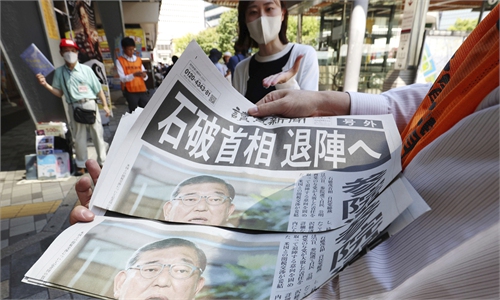
With no plan for official war anniversary statement, Ishiba says comment 'necessary'; expert says confronting history vital to avoid repeating mistake
By and Xing Xiaojing Published: Aug 04, 2025 11:33 AM

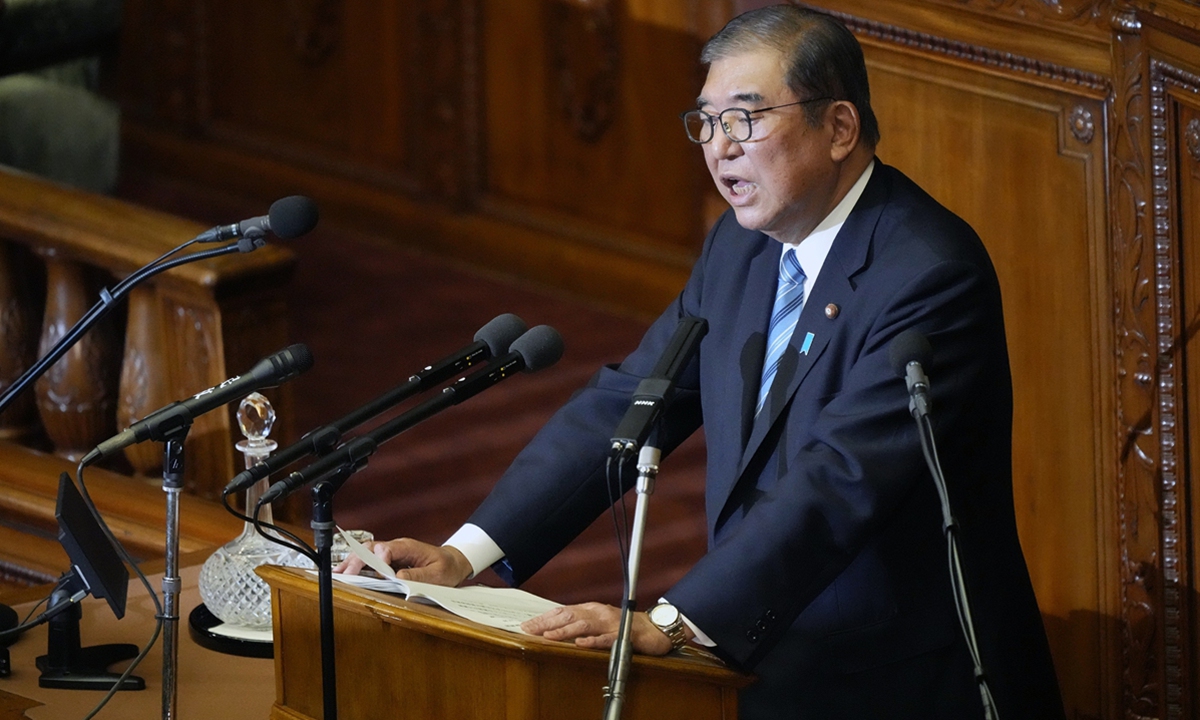
Japanese Prime Minister Shigeru Ishiba delivers his policy speech at the extraordinary session of parliament's lower house Friday, Nov. 29, 2024, in Tokyo. (Photo: VCG)
After media reported that Japanese Prime Minister Shigeru Ishiba would not issue an official war anniversary statement, Ishiba reportedly said at a meeting on Monday that "it is necessary" to issue a prime minister's comment on the 80th anniversary of the end of World War II (WWII), according to Japan's Jiji Press."Whatever the format, I believe it is important to release something so as to avoid the fading (of World War II memories) and to never go to war again," Ishiba told a session of the Budget Committee of the House of Representatives, Kyodo News reported on Monday.
According to Kyodo, he also said Japan must show "what we can do" to prevent another war, instead of "simply expressing thoughts," adding that he will make a decision by examining the past statements in detail.
The report noted that Ishiba has already decided not to issue another war anniversary statement, a decision which was approved by the Cabinet.
Unlike the official statements issued on previous decennial anniversaries, this potential personal message by the Japanese prime minister represents a compromise shaped by the growing right-wing influence within the Japanese ruling Liberal Democratic Party (LDP) and society at large, which reflects, to some degree, a regression in Japan's historical stance, Da Zhigang, director of the Institute of Northeast Asian Studies at the Heilongjiang Provincial Academy of Social Sciences, told the Global Times on Monday. Nevertheless, should Ishiba ultimately release such a message despite mounting pressure from ultranationalist factions, it would still constitute a commendable step, the expert added.
The back-and-forth media reports over whether Ishiba will issue an 80th postwar anniversary statement continues to seesaw.
Previously, multiple Japanese media outlets including Asahi Shimbun, Jiji Press and The Japan Times had claimed that Ishiba may not issue a personal message to commemorate the 80th anniversary of the end of WWII.
Since the 1995 "Murayama Statement," it has become customary for successive Japanese governments to issue statements on historical issues during decade anniversaries.
Japan had issued a prime minister's statement to mark each of the 50th, 60th and 70th anniversaries of the country's surrender in the war, according to the Jiji Press report on Saturday.
On the 50th anniversary in 1995, then Japanese prime minister Tomiichi Murayama expressed "deep remorse" and offered a "heartfelt apology" for Japan causing damage and suffering to the people of many nations, Kyodo reported Monday.
However, in 2015, then prime minister Shinzo Abe, a conservative, retained key phrases such as "aggression" and "colonial rule" from the statement and acknowledged Japan's past apologies without offering a new one of his own, Kyodo said.
As reported by the Asahi Shimbun on Monday, Ishiba's decision not to issue a special "Ishiba Statement," as his predecessors did, reflects deference to the conservative wing of the ruling LDP, which has argued that such statements have been unnecessary since the "Abe Statement" issued by then prime minister Abe 10 years ago.
"The development stems principally from LDP pressure," Da told the Global Times on Monday.
Sankei Shimbun reported on July 30 that former Japanese economy and industry minister Yasutoshi Nishimura, also a senior member of the former Abe faction, said on July 29 that he believes the "Ishiba statement" regarding the 80th anniversary of the post-war period is "unnecessary" and would "cause unnecessary confusion," urging that it should not be issued.
Those former Abe faction members who are still active in the Japanese politics and more other conservative forces in Japan are seeking to move beyond "apology diplomacy" toward its aggression history, Da warned.
Da stressed that maintaining the decennial statement tradition and confronting history and apologizing for Japan's past aggression is vital to preventing the repetition of historical mistakes. He warned that breaking this tradition or sending ambiguous signals on historical issues would erode trust with neighbors, compound security anxieties when viewed alongside Japan's military expansion and create destabilizing uncertainties for East Asia.
Chen Xingyu contributed to this story.
RELATED ARTICLES