ARTS / CULTURE & LEISURE
Author Wang Shiyue experiments AI in literary visualization
From Darkness to the Wheat Field
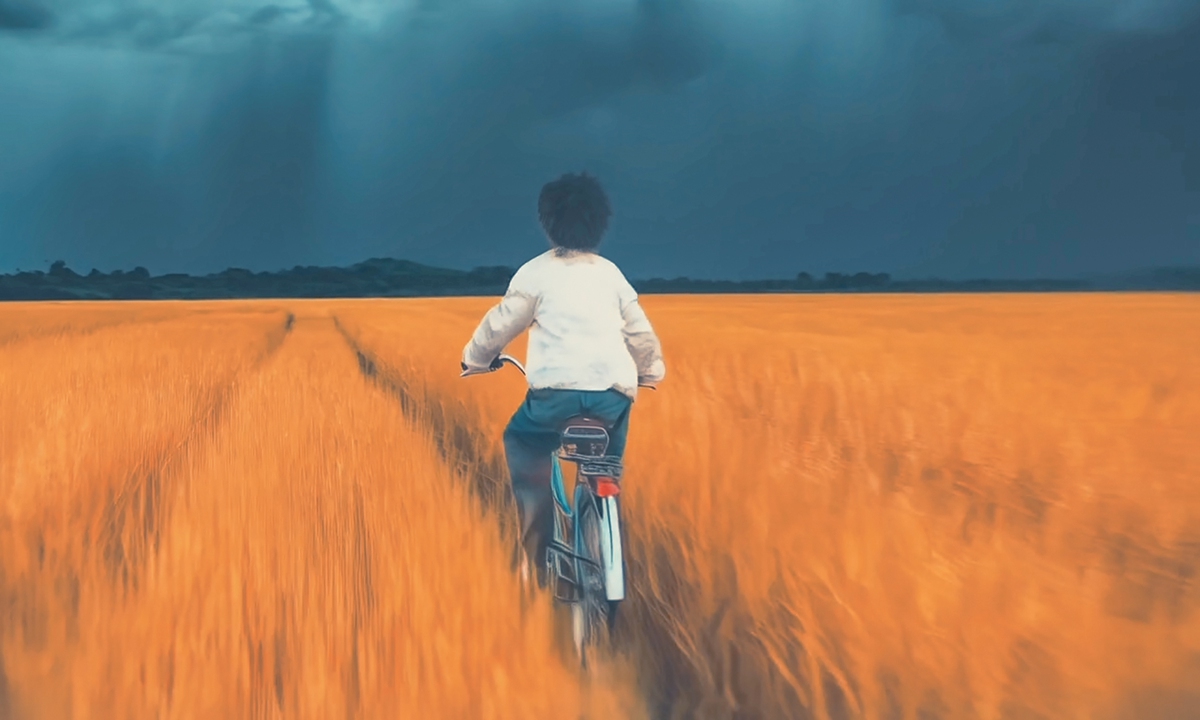
The golden wheat fields in Wang Shiyue's AI short film Photo: Courtesy of Wang Shiyue
Unlike many realist writers who often keep a cautious distance from digital platforms, Wang Shixiao - better known by his pen name Wang Shiyue, actively engages with the online literary community. He converses with emerging authors on social media, maintains a personal blog exploring AI-assisted creation, and, most recently, puts theory into practice: An AI-generated concept short film based on his latest novel For you, Day and Night was unveiled at the Chongqing International Expo Center on July 25.The short film, a bold attempt at visualizing literature through artificial intelligence, marks a rare intersection of the contemporary Chinese realism and experimental digital aesthetics. Produced over several months beginning in late 2024, the project was born from both necessity and curiosity. "It was simply not feasible to shoot a live-action adaptation of the book, and animation would have cost too much," Wang said in an exclusive interview with the Global Times. "AI gave us a way in."
But when realist literature encounters AI, will it dissolve the seriousness and pain of life?
A wild try
Though the decision was initially made fast, Wang described the creative process as filled with uncertainty. The earliest version of the film, he recalled, bore little resemblance to the novel's spirit.
Indeed, if you've read the book, you will feel the Herculean task of capturing it in its entirety in less than two minutes: The novel is both intimate and expansive, tracking protagonist Wang Duanwu's evolution through sweat, migration, disappointment, and fleeting moments of joy from the 1970s through to the present.
Each chapter pays subtle tribute to different literary voices, from Kafkaesque absurdity to the existential echoes of Camus. In the final chapter, Wang Duanwu becomes a livestreaming "failure scholar," speaking candidly about his life's missteps.
"It wasn't just about feeding the manuscript into the machine. I had to design the narrative description carefully - what kind of emotional arc it should express and what kind of tone it should evoke," he said. The current version mentions the protagonist, Wang Duanwu, lying on a white hospital bed, descending into a black vortex, and eventually emerging in a golden wheat field. "That transition of color and rhythm after a long time of adjustment," Wang noted, "finally brings out the essence of his life."
The film, composed of dreamlike sequences and textured sounds capes, in his words, does not aim to replicate the novel's plot. Instead, it functions as a poetic counterpart, an abstract extension of the novel's emotional terrain. Wang believes AI excels in precisely this domain. "It's better at the expressive, impressionistic parts. For realistic, human images, live-action still wins. But when it comes to evoking mood, symbolism, and ambiguity - AI can surprise you."
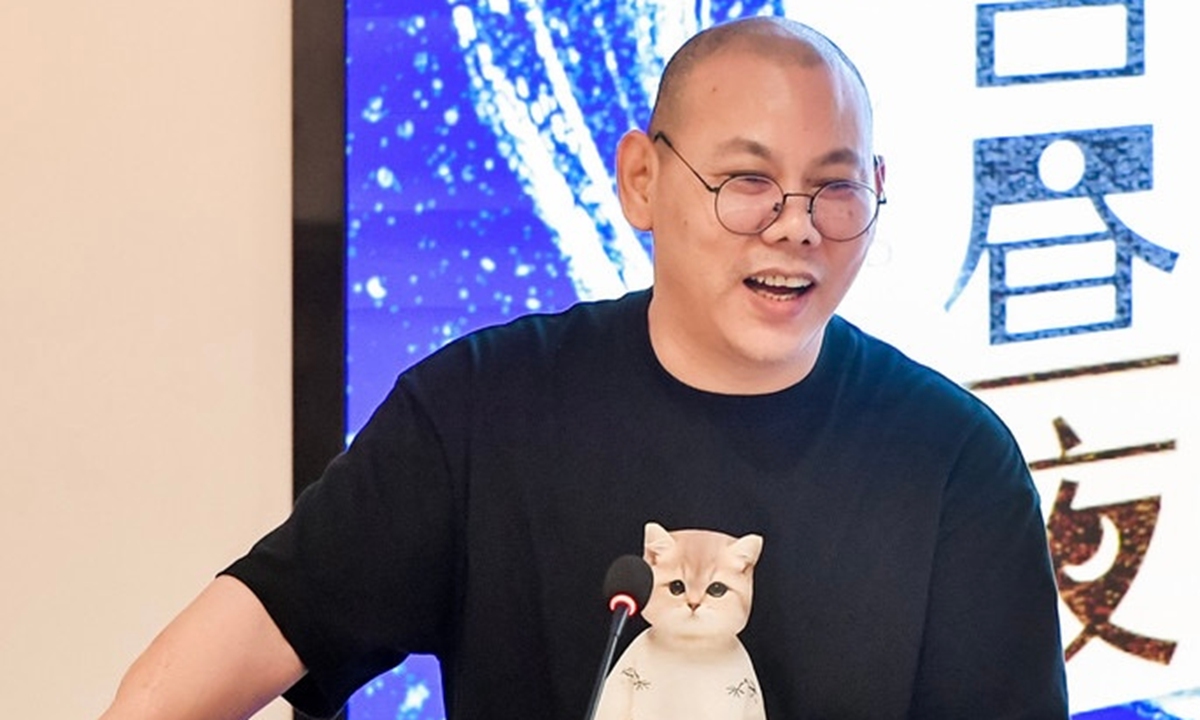
Lu Xun Literature Prize winner Wang Shiyue Photo: Courtesy of Wang Shiyue
AI-graded literature?The film, having made its debut at the Chongqing Book Fair, received an enthusiastic reception. An attendee remarked that the AI short film opened a new dimension for literary engagement. "Usually, reading is a solitary process where you imagine scenes inside your head," said the attendee. "This gave me an auditory experience that deepened my understanding."
But this is far from the first time AI's role in literature has been debated, though few writers have taken it upon themselves to initiate and experiment on their own terms. Wang had been exploring this question long before the public screening. "When DeepSeek first came out, I invited other writers to sit down and discuss AI's creative boundaries," Wang said.
He does not worry that an AI film will dilute the depth of realist literature. "Just like the protagonist in my film, when you tell AI to generate 'a child riding a bike through a wheat field,' it produces the image, but doesn't understand the way that the wheat field unfolds in Wang Duanwu's heart."
For Wang, AI is neither a threat nor a savior - it is a new tool, to be understood and handled with care. "I've never rejected AI as a tool, but I also know exactly where it stops." His approach stands out in a literary landscape often wary, even anxious, about artificial intelligence.
This stance may echo the foundation of his writing and his theme of the book. He brings with him the authority of experience - of people navigating their lives within sweeping currents of history.
In the book, Wang Duanwu was haunted by the accidental death of his younger brother, whose presence lingered in his mind and disrupted his thoughts, leading to his early departure from school to do grueling labor cutting reeds. Then he struggled through factory closures, betrayal, lost love, and divorcing, finally became a livestreaming drifter known as the "Wandering Master."
Born in rural Shishou, Hubei Province, Wang Shiyue also migrated to Shenzhen in 1993. He held odd jobs in factories and across cities and lived on the margins of China's economic rise, which in many ways mirrors the life of his protagonist, Wang Duanwu.
When writing the book, Wang himself was bedridden with a serious illness. Despair and a renewed sense of life were interwoven into the creative process.
"Time passes by like this, flowing away day and night," the name of the book got inspired from the word of The Analects of Confucius, which is also the theme of the book that AI will never understand: Experience and existence are themselves the meaning, even knowing the stone can never be pushed to the top, one must still persevere day after day, with passion and conviction.
"It was a personal thing. Writing is lonely," Wang remarked. "And it's always about the people in the era, not the era acting on people." That, he says, is why he is never afraid AI might replace human novelists.
RELATED ARTICLES