ARTS / CULTURE & LEISURE
Book industry honors historian Hsu by promoting his works
‘Eternal River’ author’s best-selling work: publisher
By Wu Jie and Published: Aug 05, 2025 09:33 PM

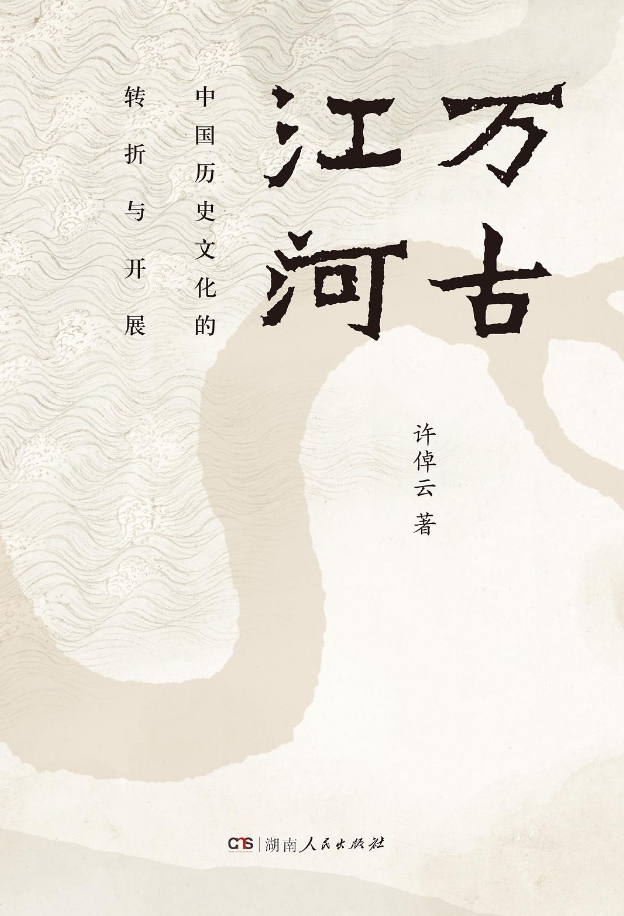
Eternal River by Cho-yun Hsu
To pay tribute to the late historian Cho-yun Hsu, many Chinese publishers and book bloggers have been compiling or recommending his works, saying that perhaps the best way to honor the master is to revisit his books. Hsu passed away on Monday in the US at the age of 95, according to multiple media sources such as the Xinhua News Agency.Regarded as one of the most influential historians in the Chinese-speaking world, Hsu authored a plethora of academic and popular works. His representative "Trilogy of Ancient China" collection includes Western Chou Civilization and Han Agriculture: The Formation of the Early Chinese Agrarian Economy (206BC-AD220), while his other celebrated collection, "Trilogy of Chinese Culture," includes Eternal River.
Yu Jinlong, a cultural critic based in Beijing, told Global Times on Tuesday that Hsu is a world-renowned historian with significant influence both in China and abroad. He noted that Hsu's work Eternal River is a timeless masterpiece in the study of Chinese history.
Grounded in a civilizational historical perspective, the author interprets and studies China with a broader and more open vision, with the development context of history fully in sight. His thought reflects deep concern for society's underprivileged and profound reverence for history and civilization itself, Yu said.
On one online bookstore, Eternal River ranked first on the best-seller list for books on historical research and commentary on Tuesday. In 2019, the president of Tsinghua University presented each new student with a copy of Eternal River with the hope that every student would finish reading it before the start of the semester.
Zhou Xueying, a professor with the School of History at Nanjing University, told Global Times that Hsu's historical works blend narrative with analysis. "Hsu's blend of heartfelt concern and incisive critique commands deep respect and invites profound reflection. His historical insights were ground-breaking, with many of his assertions striking at the heart of the matter," Zhou said.
Yu Shuang, a staff member from the Beijing Xiron Culture Group, told Global Times on Tuesday that they have released Four Hundred Years of Taiwan Island and the Civilization Trilogy of Cho-yun Hsu. Sales of the four books have performed well overall, accumulating around 250,000 copies since publication.
Yu noted that according to data from OpenBook, a monitoring system for book sales, the competing title Eternal River is Hsu's best-selling work, with accumulated sales exceeding 400,000 copies.
Liu Zhao, the editor responsible for the books, told Global Times that he felt honored to have published Hsu's works.
Liu recalled that at first, one might feel that such a great scholar is somewhat distant from us, but after communicating with him, he found that Hsu was a person with abundant feelings. For instance, when talking about his displacement during the War of Resistance against Japanese Aggression (1931-45), Hsu choked up for a moment.
The book Wanglizou, Andun Ziji, roughly translated as Inward Journey: Where the Soul Rests, had a great impact on Liu.
"In this society full of anxiety, we have been blindly seeking outward to prove ourselves, but in fact, the correct approach is that we should turn inward to temper ourselves. His words 'turn inward to settle yourself' has benefited me a lot," Liu noted.
Chinese writer Ai Song told Global Times that the book Inward Journey: Where the Soul Rests constructed a contemporary "philosophy of the heart" deeply engaged with the current era.
With a historian's broad vision, sharp intellect and rigorous logic, and a writer's simple prose, profound insight, and nuanced analysis, Hsu traversed history, nation, society, era, and human nature, ultimately arriving at the fundamental question of where the human heart finds belonging today. Between the lines shines the vast inclusivity and liberated clarity of Hsu's modern "philosophy of the heart," said Ai.
Song Hua from the Cultural and Creative Department of the Henan Museum described Hsu's Reorienting China as a symphony weaving history and geography in which Xu transcended academic confines to illuminate ancient artifacts and humanity's dialogue with nature.
As a museum worker, Song told Global Times that Hsu's book reveals that cultural relics are not isolated exhibits but connected evidence between the land and history, guiding people to see the broader context behind these artifacts, such as the Loess Plateau and the Yellow River behind a piece of pottery, and the ethnic migration codes in its shape.
RELATED ARTICLES