India, Brazil hit back at US tariff threats
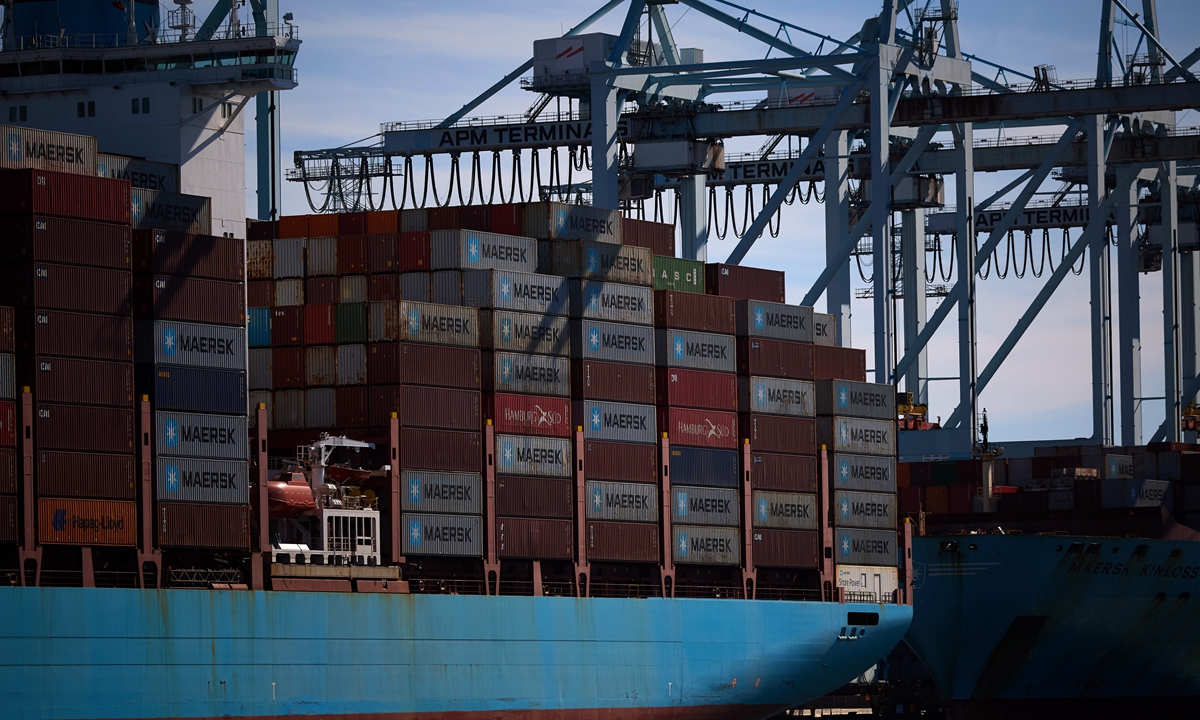
Shipping containers are loaded and unloaded onto ships at the Port of Los Angeles, California, on July 9, 2025. US President Donald Trump has sent letters to multiple countries dictating new US tariff rates on their countries' imports to the USA. Photo: VCG
India and Brazil, two economic powerhouses, fired back after US President Donald Trump threatened to hike tariffs on imports from the two countries.
India hit back by saying that tariffs were "unjustified" and "unreasonable" after Trump on Monday threatened to "substantially" raise tariffs on goods imported from India on the basis that India bought and resold Russian oil.
"India is not only buying massive amounts of Russian Oil, they are then, for much of the Oil purchased, selling it on the Open Market for big profits," Trump said in a post on Truth Social.
India's Ministry of External Affairs said in a statement that "the targeting of India is unjustified and unreasonable," and that India's oil imports are meant to "ensure predictable and affordable energy costs" for Indian consumers.
"Like any major economy, India will take all necessary measures to safeguard its national interests and economic security," according to the statement on the ministry's website.
Indian goods imported into the US will be subject to a 25 percent tariff starting August 7, according to an executive order signed by Trump on July 31. In early April, Trump announced 26 percent "reciprocal tariffs" on Indian goods in addition to the 10 percent baseline tariffs, but he then paused the imposition of such tariffs.
At the same time, Brazil is preparing to formally challenge the newly imposed US tariffs at the World Trade Organization (WTO) while keeping the door open to negotiations, officials said Monday, according to the Xinhua News Agency.
The move comes after Trump announced a 50 percent tariff on a range of Brazilian exports, including coffee, beef and petrochemicals, set to take effect on Wednesday. The measure affects roughly 35 percent of Brazil's exports to the US, though key products such as energy products and certain minerals were excluded.
India and Brazil, both core members of the Global South and BRICS nations, are among the top 10 in the world in terms of economic scale and maintain significant economic ties with the US while cultivating expansive opportunities in non-American markets. When facing US tariff pressures, each holds strategic cards to play, Li Haidong, a professor at China Foreign Affairs University, told the Global Times.
Many countries have voiced strong opposition to the recent US tariff measures, per Xinhua.
Responding with strategies
In the statement, India declared it "has been targeted by the US and the European Union for importing oil from Russia after the commencement of the Ukraine conflict… The US at that time actively encouraged such imports by India for strengthening global energy markets stability."
It noted that India's imports are meant to ensure predictable and affordable energy costs for Indian consumers and they are a necessity compelled by the global market situation. "However, it is revealing that the very nations criticizing India are themselves indulging in trade with Russia. Unlike our case, such trade is not even a vital national compulsion," said the statement.
India also pointed out the US' trade activities with Russia. Where the US is concerned, the Indian statement said, "it continues to import from Russia uranium hexafluoride for its nuclear industry, palladium for its EV industry, fertilizers as well as chemicals."
India depends on imports for nearly 90 percent of the oil needs of its enormous population. While it has diversified the sources of its oil imports - it buys from around 40 countries, officials said - its supplies have frequently been affected by US actions against some of the largest exporters, The New York Times reported.
Pankaj Saran, a former Indian deputy national security adviser and ambassador to Moscow, told The New York Times that "Given how sensitive the domestic economy is to oil prices, you have to ensure that you not just get diverse sources of imports but also, you know, the cheapest," he said. "It is, in a sense, a national security imperative."
In Brazil, the Chamber of Foreign Trade approved a proposal on Monday to begin a formal consultation with the WTO, the first step in a dispute settlement process. The chamber's council of ministers forwarded the decision to President Luiz Inacio Lula da Silva, who will determine "how and when" to present the complaint to the trade body.
Talks with Washington are likely to be slow and complex, Reuters quoted sources as saying, so Brazil's government is prioritizing immediate relief for exporters, such as through public credit lines and other support for export finance.
Brazil was first saddled with a 10 percent tariff, among the lowest in the world. Trump then tied a steeper 50 percent tariff in July due to what he called a political "witch hunt" against former president Jair Bolsonaro, Reuters reported.
RELATED ARTICLES