ARTS / CULTURE & LEISURE
A cleaner’s multifaceted life: Working to live, creating to thrive
Dust away, heart clear
By Published: Aug 06, 2025 09:27 PM
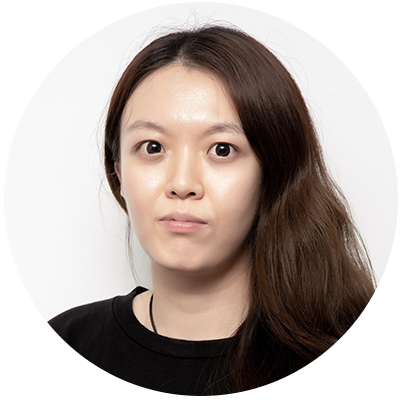
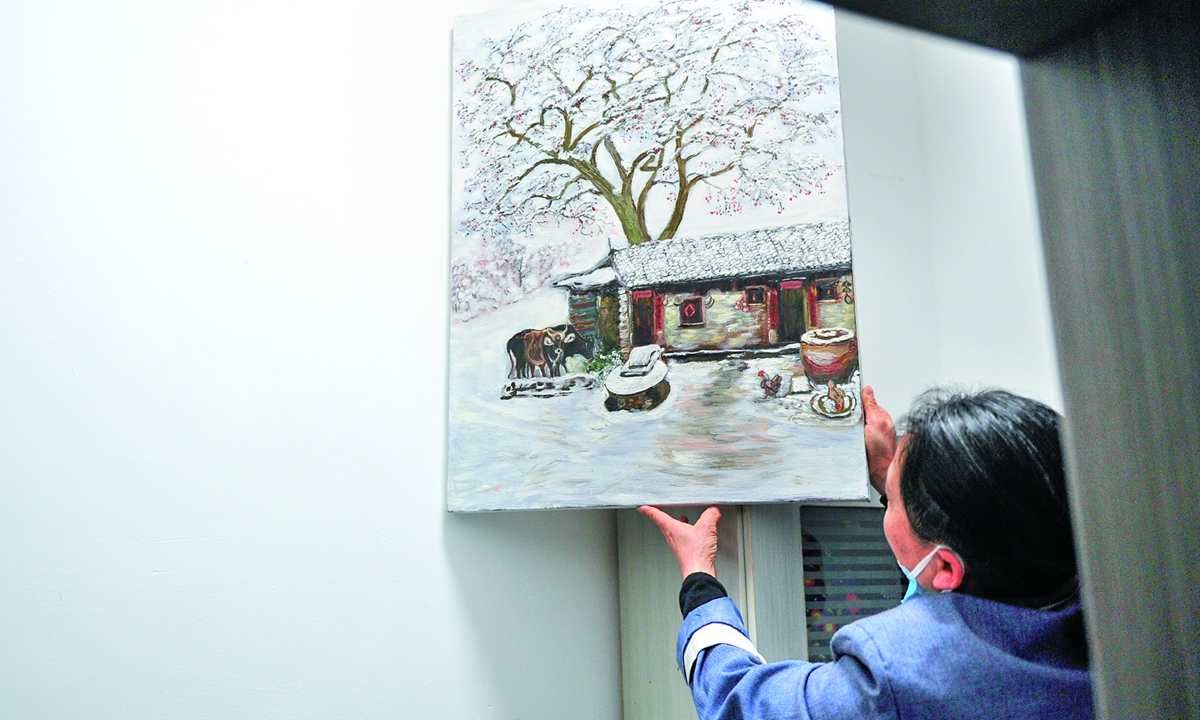
Wang Liuyun and her painting Photo: VCG
At 5 am, as the first light illuminates the city, 59-year-old Wang Liuyun has already begun her morning reading. By a little after 6 am, she is at work, cleaning office buildings; and during her lunch break, she uses every spare minute to write or sketch. In the routine of wiping windows and polishing staircases, she has created works like Broom and Starry Sky, engaging in a silent dialogue with Van Gogh, and penned poems such as The Weight of Dust: "When the wind tries to sweep everything away, only the dust close to the ground knows: Lightness is another kind of weight."In her shared rental room, and even while standing by the roadside, the cleaner writes whenever inspiration strikes, pulling out her phone to jot down sentences. Over four months, she completed nearly 180,000 words of her first novel. This long-form work, Feng Chuiqile Yueguang (lit: The Wind Lifts the Moonlight), has finally met its readers. "My motivation for writing," Wang told the Global Times, "is to describe to the world how I live in the secular world - the way you blossom amidst the mundane; the way they bend to loneliness in refusal to yield. I hope that when people read my book, they might suddenly let go and smile."
In one corner of Beijing, a city of millions, Wang still bends low, sweeping away dust, yet strives to show others through her words and paintings what it means to live with courage, optimism, and burning passion. "Now, I feel that every corner I clean holds my dignity. When I paint or write, I lose myself and find immense joy. The pains and hardships, I forget them all," Wang said.
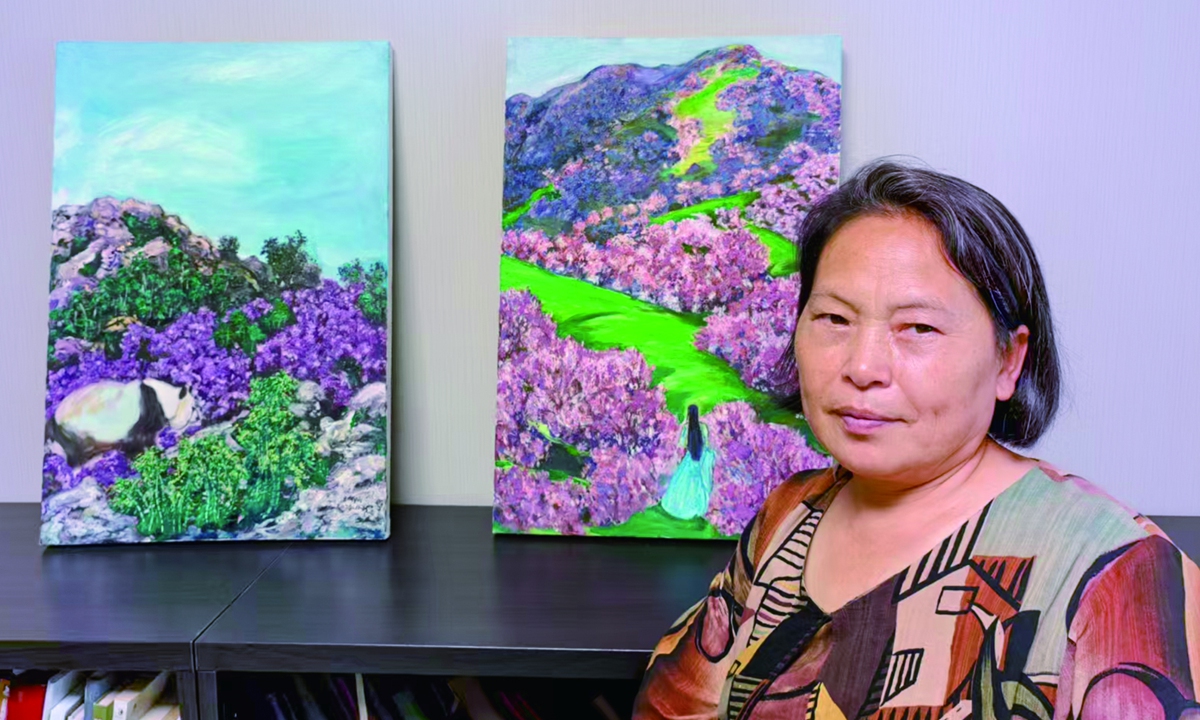
Wang Liuyun Photo: Courtesy of Wang
Dreaming with her head held highBorn into a farming family in Xinhua county, Central China's Hunan Province, Wang left high school after only half a year. She's worked as a shop assistant, a tailor, a waitress, and more. In 2017, fate took a turn: her daughter graduated from college and started working, giving the family some financial stability. Wang decided to follow her inner calling, traveling far to Shuangxi in East China's Fujian Province, to learn painting.
With a brush in hand, Wang discovered the light of art in everyday life. Her works, such as The Purple Fields and Ancient Stone Slab Road, capture the tranquility of the countryside, the lights of the city, the figures of laborers, and the breath of the sea.
In early 2020, carrying all her savings, Wang arrived in her dream city, Beijing, and became a cleaner in an office building. She was responsible for two floors. On weekdays, she wielded a large mop with both hands and a rag in her left, meticulously cleaning her assigned areas. During her lunch breaks, she would retreat to a tiny tool room near the restroom, barely three square meters, and sit on a stool to paint.
Two years later, a video of Wang creating art in that cramped tool room circulated online, bringing her into the public eye. In an article published by People's Daily on August 1, Wang wrote, "Many people call me the 'cleaner-artist Wang Liuyun.' Actually, what they don't know is, I was also trying to write, to tell the stories of life. To write, I have prepared my whole life."
That tool room held not just paints and brushes, but also a few books spread open. Books have always been her refuge. During her years as a migrant worker, Wang would steal time in every city to read in bookstores - reading quickly for the gist, then carefully savoring the best passages. "From last year to this year, outside of work, I've been reading a lot to replenish my energy," she said.
Since 2023, Wang has published three nonfiction collections. Her latest novel The Wind Lifts the Moonlight, focusing on the experiences of left-behind children, is her first full-length work. Her creative habit is to write in the WeChat dialogue box, sending herself segments as she goes.
"I never separate dreams from day or night. I walk and dream, head held high. Painting, to me, is colored poetry; writing is even freer, full of wild imagination, letting myself soar; the two complement each other," Wang shared. "I keep reading, painting, and writing, which is like feeding my soul, making me spiritually abundant." Apart from her essential cleaning work, reading, writing, and painting are the focal points of her schedule. "It is common for me to get up in the middle of the night - if a painting is not right, I repaint; if the writing is not good, I rewrite. Cleaning is my livelihood; art is part of my life."
Creation is life itself
At a recent event for the new book, fellow writer and former miner Chen Nianxi shared his impressions: Wang Liuyun, he said, has enough life experience and material to know what to write about, and her self-awareness in painting gives her a keen sense of color and line - making her language vivid and lively, according to The Paper.
Chen also noted that the recent surge in "ordinary people writing" is driven by both individuals' urge to express themselves and the times we live in - "Everyone wants to express, to appeal." He stressed that attentive perception of life is the fountainhead of literature: "In the face of today's fragmented and ambiguous information, we need to be mindful, sensitive, and observant - to discover the details of daily life. Literature is not an idea; it is life itself."
Despite the publicity, Wang remains calm and clear-headed, observing herself from above and never wavering from her commitment to a simple life. Her creations are deeply rooted in this simplicity; her stories are often born from the gains and losses amid pots and pans.
"Liuyun's writing is gentle, delicate, and unadorned, like fine stitches weaving touching stories for us," one reader wrote on lifestyle-sharing social media platform Xiaohongshu, leaving Wang deeply moved. Knowing her novels can accompany readers through life's hardships brings her great comfort.
RELATED ARTICLES