ARTS / CULTURE & LEISURE
Film experts outline future strategies at national briefing
Hollywood both a ‘benchmark and competitor’
By Published: Aug 07, 2025 10:49 PM

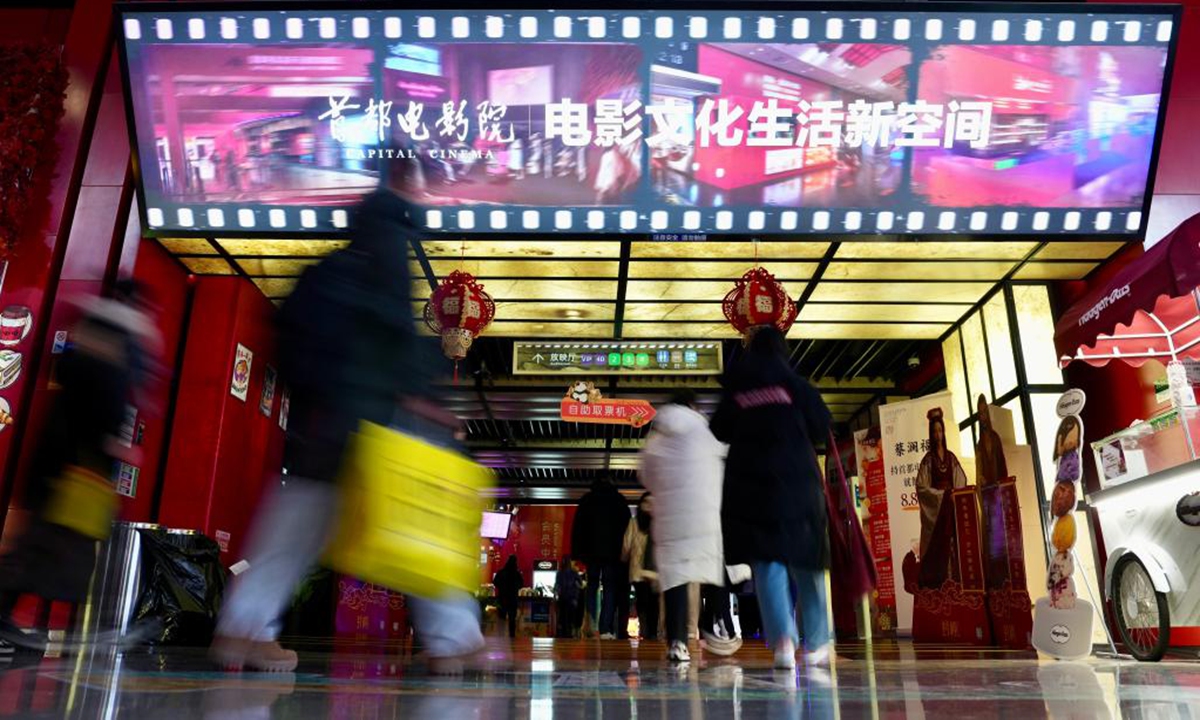
People are seen at a cinema in Beijing Photo: Xinhua
Five prominent film industry experts gathered at China's State Council Information Office (SCIO) on Thursday to map a collective vision for the nation's cinematic future amid transformative technologies and global ambition. The occasion marks the 120th anniversary of Chinese film, a legacy stretching from early black-and-white reels to today's technological spectacles.The press conference addressed critical industry inflection points, including streaming's disruption of traditional theaters, generative AI's rewriting of production pipelines, animation's cultural ascendancy, China's accelerating push for international audiences and more.
Against the backdrop of streaming disruption and AI's transformative impact, the experts emphasized China's commitment to cinematic artistry.
Director Shen Ao, whose historical drama Dead to Rights is set against the backdrop of the Nanjing Massacre in 1937, articulated cinema's dual mission.
"Film is not merely entertainment but a vessel for promoting social values," said Shen, referencing his earlier work No More Bets, which raised public awareness about telecom fraud.
He said that his latest film Dead to Rights, commemorating the 80th anniversary of victory in the Chinese People's War of Resistance against Japanese Aggression (1931-45) and the World Anti-Fascist War, aims to "make audiences remember history, cherish peace, and embrace the future through the power of light and shadow."
Chinese ticketing platform Maoyan shows that Dead to Rights had earned 1.88 billion yuan ($261.7 million) as of Thursday, topping the list of the highest grossing films at the box office in the summer of 2025. It has earned a stellar 8.6/10 rating on Chinese review platform Douban.
The conversation pivoted to technological challenges as Wei Ming, a VFX supervisor, acknowledged AI's double-edged nature.
"While generative tools slash rendering time, true creativity remains human," he stated, revealing his studio now conducts mandatory "AI audits" to ensure technology serves storytelling.
Animation producer Song Yiyi of Light Chaser Animation detailed her studio's hybrid approach. "We deploy AI for technical processes but hand-draw key expressions to preserve the emotional authenticity of Chinese aesthetics."
China's expanding international footprint emerged as a strategic priority.
Shen underscored Chinese cinema's urgent need to transcend cultural stereotypes when engaging global audiences.
"While China possesses a vast domestic market, our generation bears the mission to propel Chinese films onto the world stage," the director declared.
He argued that the industry should rapidly evolve from deploying superficial "Chinese symbols" to conveying authentic cultural depth. To achieve this, Shen advocated genre diversification beyond established pillars like wuxia and costume dramas.
"Suspense, youth stories, sci-fi, and romance… these genres represent new frontiers for international resonance," he noted.
Concluding with ambitious resolve, Shen positioned Hollywood as both a "benchmark and competitor."
Wang Jun, chairwoman of the Shanghai Film Group, suggested more co-productions for global markets alongside culturally specific arthouse films.
"We can actively participate in film cooperation and exchanges with countries involved in initiatives such as the Belt and Road Initiative, BRICS, and the Shanghai Cooperation Organization. This allows us to promote our outstanding works to overseas markets and introduce the essence of Chinese aesthetics," she said.
Looking ahead, panelists proposed concrete measures for sustainable growth.
Cinema chain executive Chen Kaifang advocated tiered pricing models to make premium viewing experiences accessible beyond major cities.
Song Yiyi championed animation as a vehicle for "cultural confidence," suggesting mythological epics redesigned for younger audiences.
Their insights arrive as the Chinese mainland's 2025 box office surged past 35 billion yuan ($4.87 billion) on Thursday, outpacing 2024 by nearly two months, according to Chinese ticketing platform Beacon.
Xu Liang, a lecturer from the Beijing Film Academy, highlighted this summer's cinematic vibrancy, noting diverse genres and critically acclaimed films have sparked widespread audience discussions.
"These productions skillfully balance core socialist values, artistic merits, and emotional resonance, demonstrating how domestic filmmakers are refining storytelling techniques to meet contemporary viewers' expectations," Xu told the Global Times on Thursday.
He emphasized that high-quality film development must fundamentally center on narrative strength.
"The most powerful driver for boosting Chinese cinema's engagement, appeal, recognition, and prestige lies in crafting compelling stories. When stories truly move, inspire, or enlighten audiences, their humanistic depth, intellectual substance, and commercial viability naturally follow," Xu asserted.
RELATED ARTICLES