ARTS / FILM
Film ‘Dead To Rights’ ignites nationwide tourism boom starting from Nanjing
In full swing

The poster of fim Dead To Rights Photo: Courtesy of Douban
In the fading moments of the film Dead To Rights, the screen transitions from the haunting ruins of 1937 Nanjing - smoldering debris, broken walls and weary survivors - to today's bustling metropolis, where glass skyscrapers pierce the city's skyline and neon-lit boulevards thrum with life. The past and present collide - not only on-screen, but in the hearts of audiences.For Nanjing-based travel blogger and finance worker Yang Yang, that collision was deeply personal. After sitting through the film's final credits alone in a theater in Nanjing, East China's Jiangsu Province, he found himself unable to shake its emotional weight.
Inspired by the film's closing scenes, which retraced historical landmarks through modern-day lenses, Yang embarked on a journey of his own - photographing the exact sites in Nanjing appeared in the movie, including the Zhonghua Gate, Zhongjiang Gate and Yijiang Gate.
"When I heard familiar accents and recognized familiar places in the film, I couldn't help but think about the prosperity we enjoy today - and how it stands in stark contrast to the heavy history behind it," Yang told the Global Times.
Yang's story is far from unique. Across the country, Dead To Rights, a film about the Nanjing Massacre during World War II, has resonated with audiences and sparked a wave of remembrance tourism to Nanjing.
On China's lifestyle-sharing platform Xiaohongshu, internet users have been sharing posts from the movie's filming locations and historically significant sites such as the Memorial Hall of the Victims in Nanjing Massacre by Japanese Invaders. These sites often captioned with emotional reflections and side-by-side comparisons of film stills and real-life scenery.
Since the start of the summer vacation, China's tourism market has shown strong momentum, according to a report by China National Radio.
In addition to the continued popularity of summer getaways and sports-related travel, "red tourism" - visits to historical sites with a modern revolutionary legacy - have attracted large crowds.
The success of large-scale live performances and the box-office hit Dead To Rights have further fueled interest in red tourism, driving up visitor numbers, according to the report.
Red tourism surge
Domestic tourism platform Tongcheng Travel said in a report sent to the Global Times that since late July, memorial halls and historical sites related to the War of Chinese People's Resistance against Japanese Aggression have seen a sharp rise in popularity, which has also boosted tourism at nearby attractions.
The most visited red tourism sites include the 9.18 Historical Museum in Shenyang, Northeast China's Liaoning Province and more. This year marks the 80th anniversary of the victory in the Chinese People's War of Resistance Against Japanese Aggression and the World Anti-Fascist War.
"Today's red tourism is no longer just about solemn visits to revolutionary sites," Sun Jiashan, a researcher at the Central Academy of Culture and Tourism Administration, told the Global Times. "Now it's interactive, emotional and deeply tied to cultural media."
Sun added that this shift reflects a broader, more inclusive narrative. "Today's red tourism integrates history and education, helping young travelers engage with their heritage in a more visceral and lasting way."
Sports-driven travel
This summer, the trend of "traveling with sports events" continues to gain momentum.
Since July, cultural and tourism bookings in Jiangsu have increased by 11 percent year-on-year. Accommodation orders in cities hosting matches saw a staggering rise of over 127 percent compared to the same period in 2024. Merchants in Jiangsu offering "Su Super League" themed packages on Meituan experienced an 856 percent surge in sales since the city football competition began, while nighttime leisure and entertainment spending climbed 43 percent year-on-year, according to China National Radio.
As the "Su Super League" matches kicked off one after another, host cities including Nanjing, Xuzhou, Huai'an, Zhenjiang and Yangzhou welcomed large numbers of fans and tourists, driving up lodging demand.
Meanwhile, the re-launched "Village Super League," also known as Cun Chao, also sparked a travel boom in Southwest China's Guizhou Province. According to travel platform Tuniu, the weekend following the league's July 26 restart (July 26-27) saw travel to Guizhou destinations increase by more than 30 percent compared to the previous weekend. Specifically, travel to Qiandongnan Miao and Dong Autonomous Prefecture, home to the Rongjiang Village Super League matches, surged by 54 percent.
"The booming Jiangsu 'Su Super League' and the popular Guizhou 'Cun BA' are enhancing consumer experiences and injecting strong momentum into the cultural tourism industry, while also driving local tourism development," Bu Xiting, an associate researcher with the School of Cultural Industries Management at the Communication University of China, told the Global Times.
According to Bu, these events are fueling regional tourism by creatively integrating local culture into the sports experience. For example, the "Su Super League" incorporates elements like Nanjing's salted duck and Wuxi's peaches into team identities, uniforms and event decor, turning matches into immersive cultural showcases. Similarly, Cun Chao blends Miao ethnic traditions, such as folk costumes and more into the games, transforming the tournament into a vibrant celebration of ethnic culture and drawing large crowds of tourists.
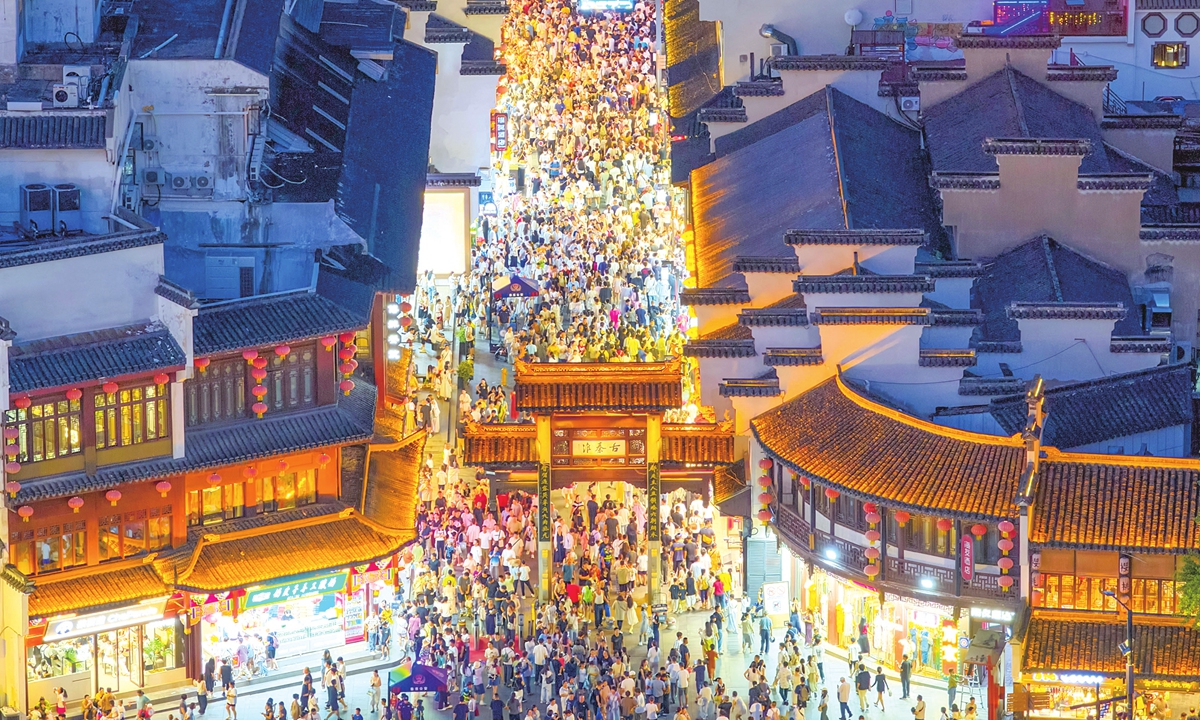
A street scene of Fuzimiao-Qinhuai scenic area in Nanjing, East China's Jiangsu Province Photo: VCG
RELATED ARTICLES