SPORT / MISCELLANY
Chinese athletes stand at 2nd on medal table at World Games
48 golds up for grabs on 3rd competition day
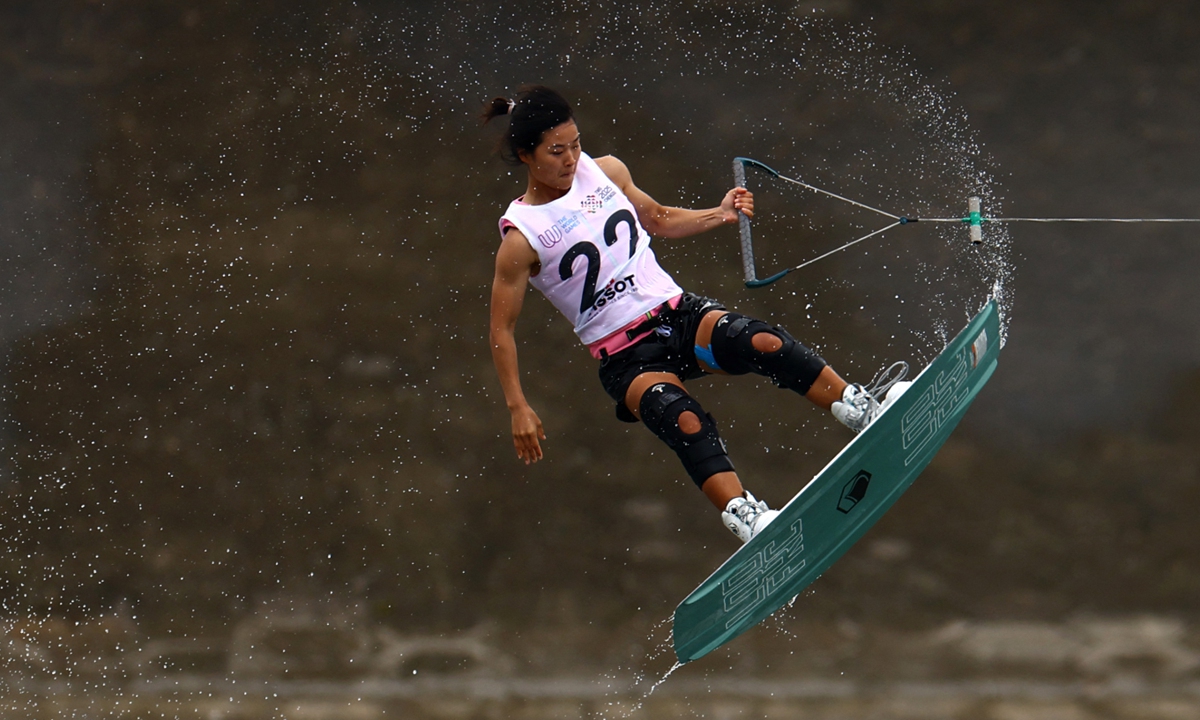
Xu Lu of China competes during the women's wakeboard freestyle final at the World Games 2025 in Chengdu, Southwest China's Sichuan Province, on August 10, 2025. Xu won gold in the event. Photo: IC
The 12th World Games in Chengdu, capital of Southwest China's Sichuan Province, entered its third day of gold medal competitions on Sunday. It featured the most gold medals contested in a single day since the opening of the Games, with 48 gold medals and a total of 144 medals awarded. By the end of the day, host China stands at second on the medal table with 11 gold, 3 silver and 1 bronze medals. Germany leads the table with 11 gold, 8 silver and 5 bronze medals.The 48 gold medals were contested across a wide range of events, including baseball/softball, canoeing, gymnastics, muaythai, water skiing, finswimming and more.
Beijing-based sports commentator Guo Ai told the Global Times on Sunday that the packed schedule meant virtually every venue offered a highlight, with athletes competing at peak intensity and spectators creating a charged atmosphere.
"Beyond the traditional powerhouse events, several debut sports at the World Games are generating buzz and standout moments," Guo noted. "Among them, freediving and para freediving are drawing particular attention for their high technical demand and strong spectator appeal."
This edition of the World Games features three underwater sports categories: freediving, para freediving, and finswimming. Freediving and para freediving made their debut as official competition events at the Chengdu World Games.
"Freediving was originally developed to support underwater surveying, salvage, repairs, and underwater engineering operations," Guo said. "With social development and rising living standards, people gradually integrated competitive and recreational elements into freediving, evolving it into a formal sport."
Para freediving is divided into two categories: dynamic with fins and dynamic without fins. Athletes are classified by disability levels and compete separately into men's and women's events. The competition lasted two days, with participants aiming to cover the longest possible distance underwater on a single breath in a pool, with final rankings based on the distance achieved.
At the men's dynamic without fins (FFS1-FFS2) final on Sunday, China's Long Dengxi claimed the gold medal with a record-breaking performance of 134.5 meters. This was China's fifth gold at the Games and marked Long's first appearance at a major international multi-sport event.
Later, in the women's dynamic with fins (FFS1-FFS2) final, 15-year-old Chinese rising star Huang Shiyu won the gold, securing China's sixth gold medal at the Chengdu World Games.
"We're making important strides in the integration of Parasports into our program. Rather than holding a separate event, we are fully incorporating two Para disciplines - Para Freediving and Para Ju-Jitsu - into the World Games," IWGA President Jose Perurena told the Global Times.
According to Perurena, these athletes will receive the same medals as all others, emphasizing that they are truly part of the World Games family.
On Saturday, the dragon boat events officially kicked off at the Chengdu World Games. This traditional Chinese water sport, with a history spanning thousands of years, made its debut as an official competition at the World Games. On Sunday, the men's 10-person 200-meter dragon boat final was held at the lakeside venue of Xinglong Lake, where the Thailand team claimed the championship and China took the runner-up position.
Lu Weihong, chair of the Dragon Boat Committee of the International Canoe Federation (ICF), told China News Service that dragon boat racing is an ancient folk sport in China, but its internationalization began in China's Hong Kong. The world's first international dragon boat race was held in June 1976 in Hong Kong, and since then, this competition format has gradually spread to Europe.
Lu also noted that in recent years, the ICF Dragon Boat Committee has been actively promoting dragon boat racing for Olympic inclusion. The sport was featured as a demonstration event at both the Tokyo and Paris Olympics, garnering widespread attention and praise. The 200-meter sprint race at the Chengdu World Games is designed to meet international broadcasting demands and move closer to Olympic standards.
Building on the theme of high-level competition, Perurena shared his perspective on how the World Games compares to the Olympic Games with the Global Times: "The Games in Chengdu will once again demonstrate that we deliver competitions at an Olympic level. What truly sets us apart is our unwavering focus on the athletes. We create an environment where they are front and center, where meaningful connections with fans are possible, and where the atmosphere is warm, personal, and genuine."
Looking ahead, Perurena expressed confidence that the 12th edition in Chengdu will set a new standard, providing a high-quality benchmark for the next host city, Karlsruhe, Germany, in 2029.
"The organizing committee will thoroughly evaluate the Chengdu Games, working with partners to analyze outcomes and support the growth of Member Federations," he said.
RELATED ARTICLES